
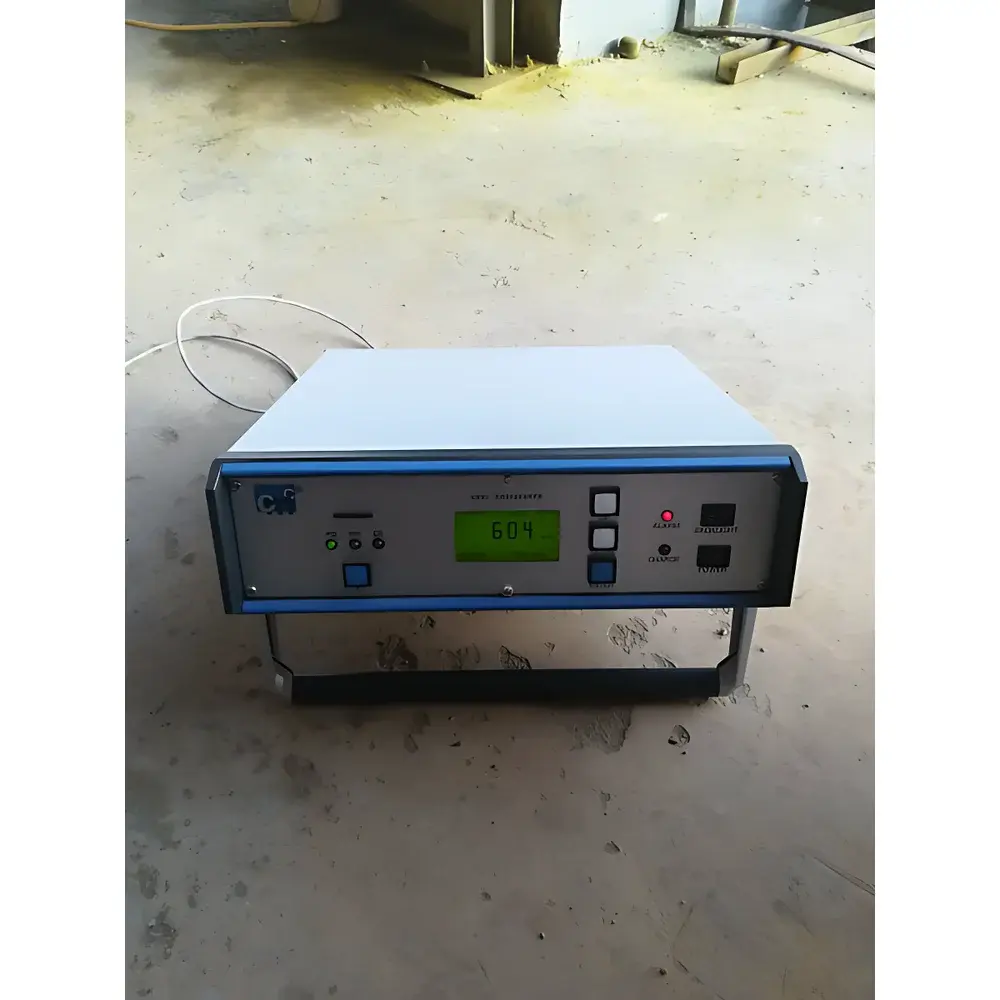
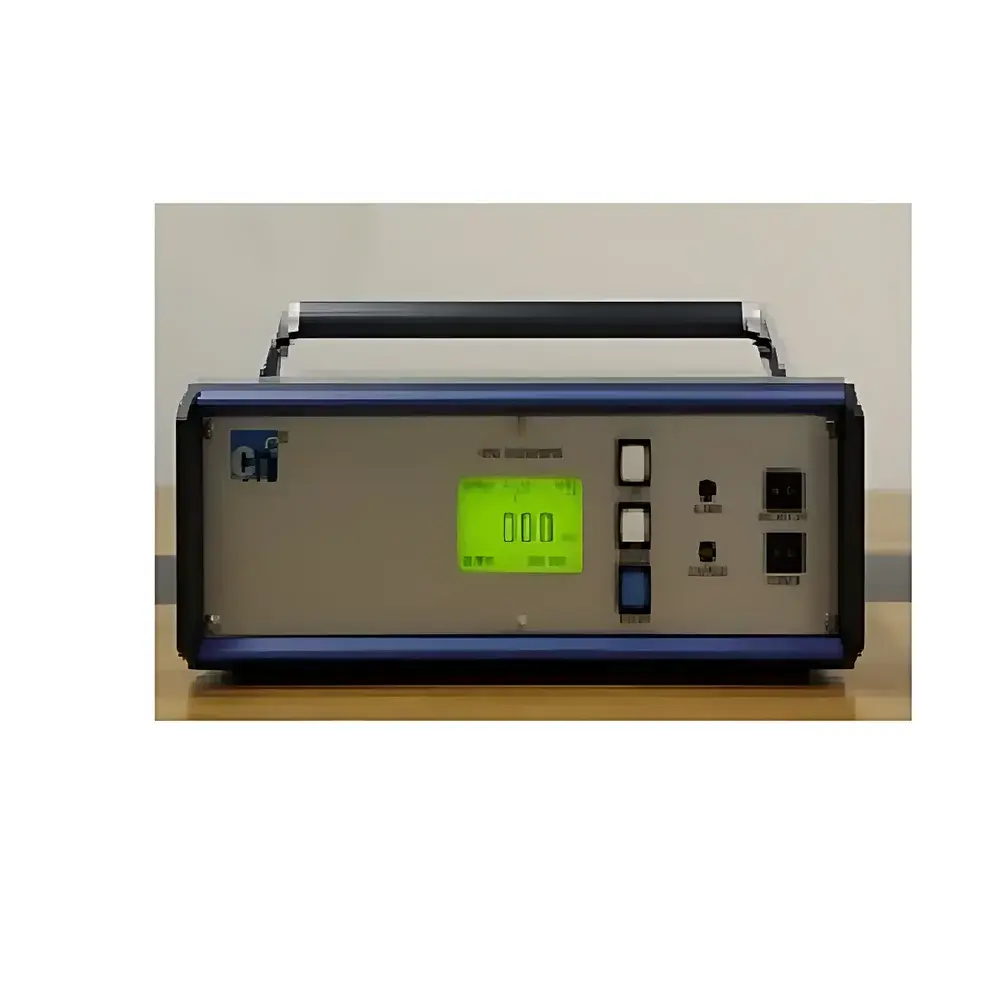
CMC TMA-210-P-ZB Portable Electrolytic Dew Point Analyzer
| Origin | Germany |
|---|---|
| Manufacturer Type | Authorized Distributor |
| Origin Category | Imported |
| Model | TMA-210-P-ZB |
| Product Type | Portable Dew Point Analyzer |
| Measurement Principle | Phosphorus Pentoxide (P₂O₅) Electrolytic Method |
| Operating Temperature | -20 °C to +50 °C |
| Accuracy | ±1 ppmv |
| Repeatability | ±1 ppmv |
| Range | 0–10 / 100 / 1000 / 2500 ppmv (Auto-ranging) |
| Full-Scale Accuracy | ±1% FS |
| Sensitivity | 0.1% FS |
| Display | Backlit LCD |
| Analog Output | 4–20 mA or 0–10 V |
| Alarm Outputs | 2 Relay Outputs |
| Sample Flow Rate | 20 NL/h |
| Recommended Sample Pressure | 0.1–0.5 barg |
| Sample Temperature | 5–150 °C |
| T₅₀ Response Time | <8 s |
| Total Response Time | <1 s |
| Ambient Operating Temperature | 5–65 °C |
| Standard Cable Length | 3 m (up to 300 m optional) |
| Dimensions (Desktop) | 257 mm (W) × 160 mm (H) × 316 mm (D) |
Overview
The CMC TMA-210-P-ZB is a portable, microprocessor-controlled electrolytic dew point analyzer engineered for trace moisture measurement in industrial process gases and high-purity specialty gases. It employs the phosphorus pentoxide (P₂O₅) electrolytic sensing principle — a well-established, NAMUR-compliant method recognized for its exceptional specificity, stability, and low detection limits in demanding gas environments. In this technique, water vapor in the sample gas is drawn into a P₂O₅-coated sensor cell where it undergoes quantitative electrolysis: H₂O → H₂ + ½O₂, with P₂O₅ acting as both catalyst and moisture scavenger. The resulting electrolytic current is linearly proportional to the water concentration, enabling precise, real-time quantification down to sub-ppmv levels. Unlike optical or capacitive methods, the P₂O₅ cell is inherently insensitive to hydrocarbons, CO₂, and inert gases — making the TMA-210-P-ZB especially suitable for ultra-dry applications in semiconductor, power transmission (SF₆ monitoring), petrochemical, and electronics-grade gas supply chains.
Key Features
- True portability with integrated battery option and ergonomic desktop/wall-mount form factor (257 × 160 × 316 mm)
- P₂O₅ sensor optimized for corrosive and reactive gases including Cl₂, HCl, SO₂, H₂S, F₂, and HBr — with electrode materials selected (Pt/Rh) to resist chemical degradation
- Sub-second total response time (<1 s) and T₅₀ ≤ 8 s — critical for dynamic process monitoring and leak verification
- Four auto-ranging measurement spans: 0–10, 0–100, 0–1000, and 0–2500 ppmv — eliminating manual range selection and minimizing operator error
- Self-diagnostic startup sequence with continuous sensor health monitoring and fault logging
- NAMUR NE 43-compliant output signaling and relay alarm interfaces compatible with DCS/PLC systems
- Robust signal conditioning architecture delivering ±1 ppmv absolute accuracy and ±1 ppmv repeatability across all ranges
Sample Compatibility & Compliance
The TMA-210-P-ZB is validated for use with over 25 industrial and specialty gases, including He, Ar, Kr, Xe, N₂, O₂, H₂, D₂, SF₆, CH₄, CO₂, C₂H₂, natural gas, Freon variants, and aggressive acid gases. Sensor compatibility excludes only those gases known to chemically attack phosphoric acid films (e.g., strong alkalis or reducing agents under elevated temperature). All units are CE-marked and conform to IEC 61000-6-2 (immunity) and IEC 61000-6-3 (emissions). For regulated environments, the device supports audit-ready operation when paired with optional data-logging firmware compliant with FDA 21 CFR Part 11 requirements (electronic signatures, user access control, and immutable event logs).
Software & Data Management
While the TMA-210-P-ZB operates autonomously via front-panel interface, optional PC software enables configuration, calibration history tracking, trend visualization, and report generation (PDF/CSV). Communication occurs via RS-232 or USB-to-serial adapter. Calibration data — including zero/gain coefficients, date/time stamps, and operator ID — is stored in non-volatile memory with write-protection. The system maintains full GLP/GMP traceability: every measurement event can be associated with calibration status, sensor age, and environmental conditions (sample temp/pressure). Optional analog output scaling allows direct integration into existing SCADA or LIMS infrastructure without protocol translation.
Applications
- Moisture verification in SF₆-insulated switchgear during commissioning and maintenance
- In-line monitoring of dry air or nitrogen purge lines in pharmaceutical lyophilization suites
- Quality control of electronic specialty gases (e.g., Cl₂ for etching, NH₃ for CVD) per SEMI F21 standards
- Field verification of desiccant dryer performance in compressed air systems (ISO 8573-1 Class 1–2)
- Leak detection support in vacuum systems using tracer gas dilution methodology
- Validation of moisture removal efficiency in hydrogen fuel cell feed gas streams
FAQ
What gases are incompatible with the P₂O₅ sensor?
Gases containing strong reducing agents (e.g., silane under heat), concentrated alkalis (e.g., NH₃ >1000 ppm at >60 °C), or oxidizers that degrade H₃PO₄ film integrity (e.g., hot NO₂) may shorten sensor life or cause drift. Consult CMC’s compatibility matrix before deployment.
Is field calibration possible without specialized equipment?
Yes — the TMA-210-P-ZB supports single-point zero calibration using certified dry gas (e.g., <0.1 ppmv N₂) and gain adjustment via reference standard (e.g., 10 ppmv H₂O in N₂), both executable on-site with standard gas handling hardware.
How does ambient humidity affect measurement accuracy?
The instrument’s sealed sensor housing and internal temperature stabilization ensure immunity to ambient RH fluctuations; however, condensation on external sampling lines must be prevented via heated line or chiller integration.
Can the unit operate continuously in explosive atmospheres?
The base TMA-210-P-ZB is not ATEX/IECEx-certified. For Zone 1/2 applications, CMC offers the intrinsically safe variant TMA-210-P-ZB-Ex (with entity approval for associated apparatus).
What maintenance intervals are recommended?
Sensor replacement is typically required every 12–24 months depending on cumulative exposure to reactive gases; electrolyte replenishment is not required. Annual verification against traceable standards is advised for ISO/IEC 17025-compliant labs.
Related Products





