
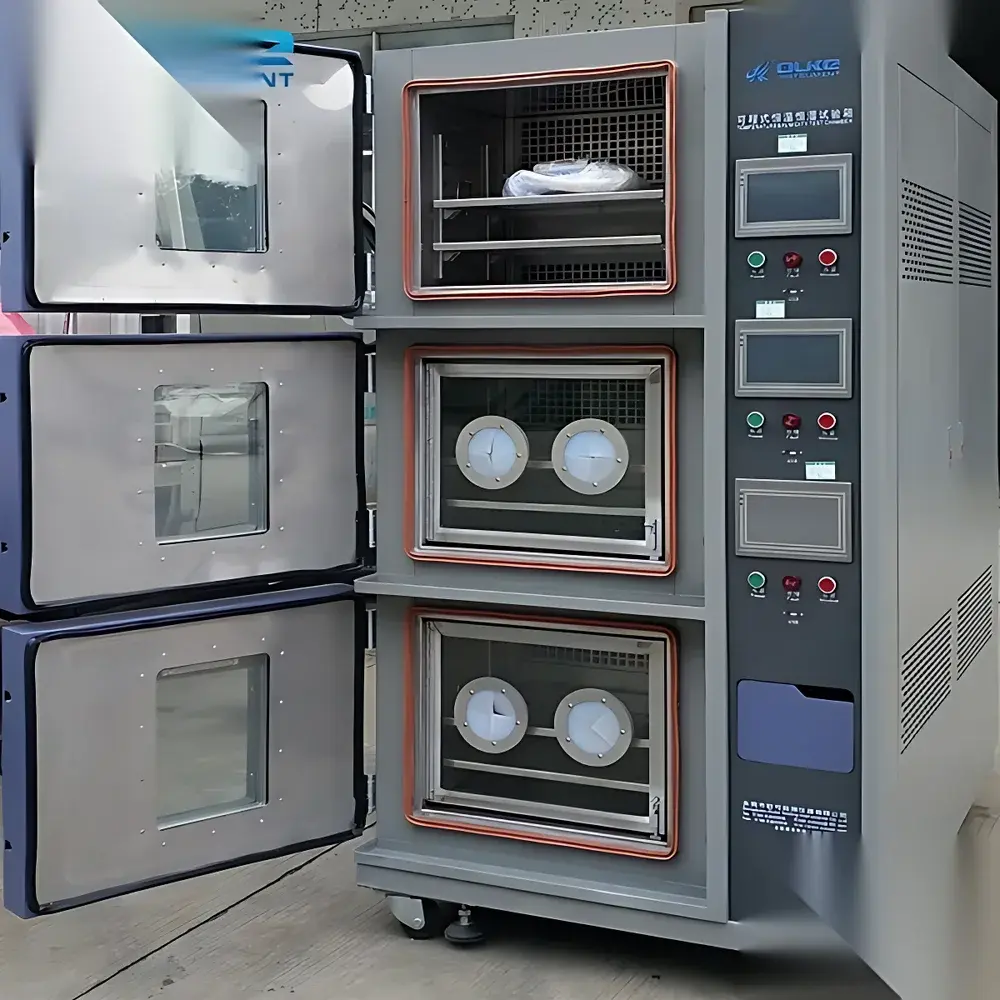
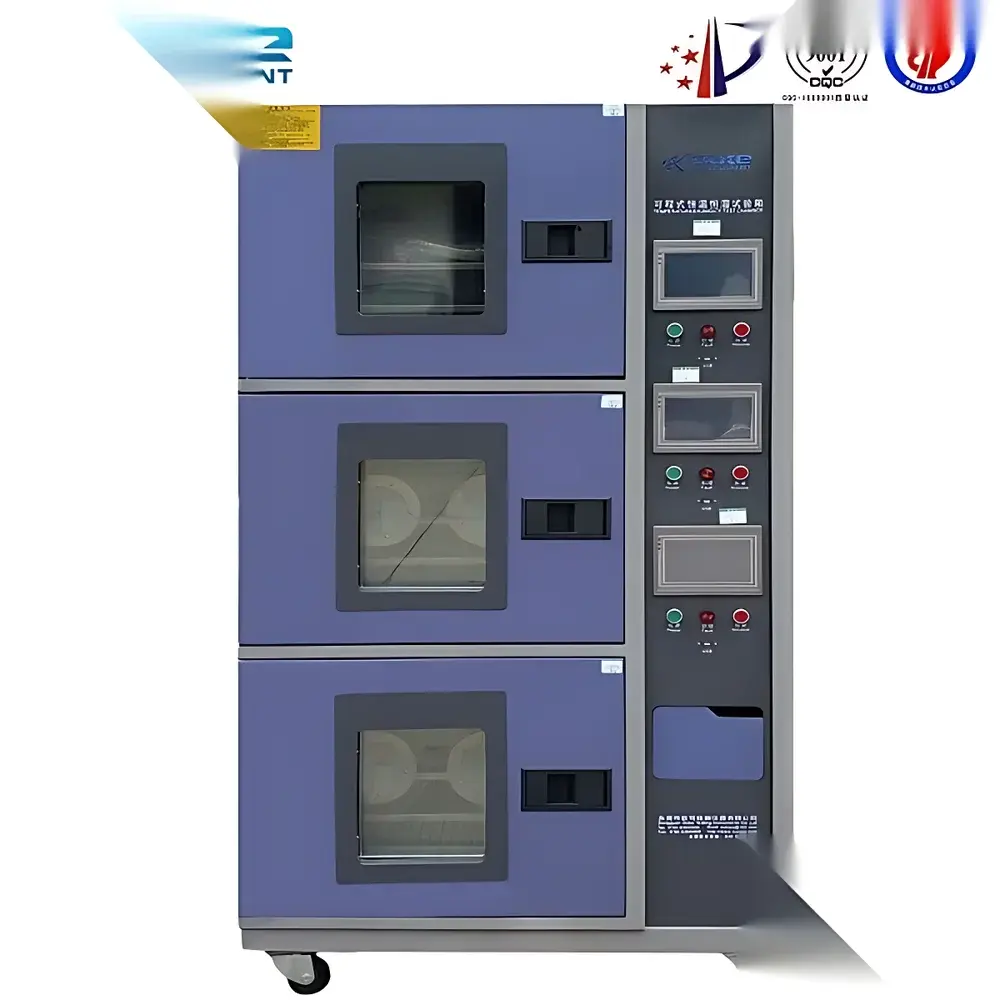
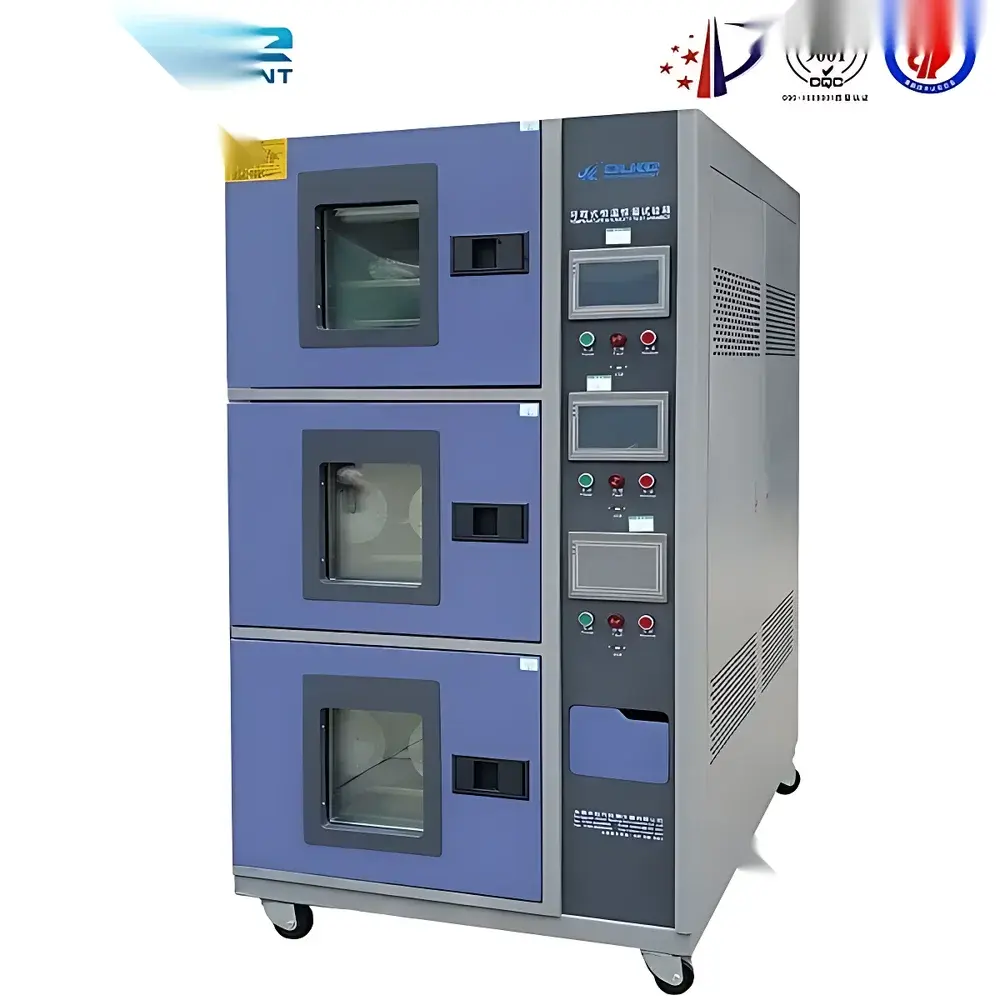
Generic Brand OK-TH Series Environmental Stress Screening Chamber – Temperature & Humidity Cycling Test Chamber
| Brand | Other Brands |
|---|---|
| Origin | Imported |
| Manufacturer Type | Authorized Distributor |
| Price | USD 2,650 (FOB) |
| Internal Dimensions (W×H×D, cm) | 40×50×40 to 100×100×100 |
| External Dimensions (W×H×D, cm) | 100×165×100 to 180×200×180 |
| Temperature Range | -70 °C to +150 °C (configurable in four standard variants) |
| Humidity Range | 20–98 %RH (optional 5–98 %RH or 10–98 %RH) |
| Temperature Ramp Rate | Up to 4.0 °C/min (heating), 1.0 °C/min (cooling) |
| Temperature Uniformity | ±0.5 °C |
| Humidity Uniformity | ±2.5 %RH |
| Temperature Stability | ±2 °C |
| Humidity Stability | +2 to +3 %RH |
| Resolution | 0.1 °C / 0.1 %RH |
| Refrigeration System | Hermetic dual-stage compressor with R404A/R23 eco-friendly refrigerant blend |
| Control Interface | Full-color LCD touchscreen controller with bilingual (English/Chinese) UI |
| Construction Material | Interior and exterior chambers fabricated from SUS#304 stainless steel |
| Viewing Window | Multi-layer laminated tempered glass with integrated conductive ITO film for anti-fog operation |
| Port | One 50 mm diameter cable/port access hole (left side) |
| Standard Accessories | Two-tier stainless steel shelves, four swivel casters with leveling feet |
| Power Supply | AC 380 V ±5 %, 50 Hz ±0.5 Hz, 3-phase 5-wire, 2.5 m cable length |
Overview
The OK-TH Series Environmental Stress Screening Chamber is a precision-engineered temperature and humidity cycling test system designed for accelerated reliability evaluation of electronic components, aerospace subsystems, automotive ECUs, military-grade enclosures, and industrial materials under controlled, repeatable climatic stress conditions. Operating on the principle of forced-air convection with independent dual-loop control of thermal and hygrometric parameters, the chamber enables programmable profiles that replicate real-world environmental exposure—including rapid transitions between extreme cold, dry heat, and high-humidity soak phases. Its architecture complies with fundamental thermodynamic and psychrometric standards governing environmental simulation, ensuring traceable thermal inertia management and minimized spatial gradients across the working volume. The system supports both steady-state and dynamic cycling protocols required by international qualification frameworks, serving as a core tool in design verification, production lot screening, and failure mode analysis workflows.
Key Features
- Full-color touchscreen controller with intuitive English/Chinese interface, supporting multi-segment ramp-soak cycling, profile storage, and real-time parameter logging.
- Dual-stage hermetic refrigeration system using R404A/R23 mixed refrigerant—optimized for low-temperature capability down to –70 °C while maintaining energy efficiency and long-term compressor reliability.
- SUS#304 stainless steel construction throughout interior and exterior chambers, including insulated double-wall panels with high-density polyurethane foam (≥100 mm thickness) for thermal stability and condensation suppression.
- Multi-layer electro-thermally coated viewing window with conductive ITO film, enabling unobstructed visual monitoring without fogging or optical distortion during high-humidity operation.
- Single 50 mm-diameter port on the left chamber wall, fitted with silicone gasket and clamping ring for secure feedthrough of power, signal, or sensor cables under sealed conditions.
- Integrated safety architecture including over-temperature cut-off, compressor high-pressure shutdown, door interlock, and real-time fault diagnostics with on-screen alarm codes and automatic power isolation.
Sample Compatibility & Compliance
The OK-TH chamber accommodates a broad range of sample geometries—from PCB assemblies and sensor modules to sealed enclosures and polymer specimens—within its standardized internal volumes (80 L to 1000 L). Its performance adheres to the physical and procedural requirements of multiple international environmental testing standards, including but not limited to: MIL-STD-810G Method 502.6 (Low Temperature), Method 501.6 (High Temperature), Method 507.6 (Humidity), and Method 506.6 (Temperature Shock); IEC 60068-2-1 (Cold), IEC 60068-2-2 (Dry Heat), IEC 60068-2-30 (Cyclic Damp Heat), and GB/T 2423.1–2423.4 (Chinese national equivalents). While not certified to ISO/IEC 17025 as a calibration laboratory, the chamber’s uniformity and stability metrics meet the acceptance criteria specified in ISO 17025 Annex A.3 for environmental test equipment used in accredited conformity assessment laboratories.
Software & Data Management
The embedded controller provides local data acquisition at user-configurable intervals (1–60 seconds), storing up to 100 test profiles and 30 days of continuous time-stamped temperature/humidity logs internally. Optional RS485 or Ethernet connectivity enables integration with third-party SCADA or MES platforms via Modbus RTU/TCP protocol. For regulated environments, optional software add-ons support 21 CFR Part 11-compliant audit trails—including operator login authentication, electronic signatures, and immutable record archiving—with export to CSV or PDF formats. All logged data retain traceability to NIST-traceable reference sensors calibrated per ASTM E2202 practices.
Applications
This chamber is routinely deployed in: accelerated life testing of lithium-ion battery packs under thermal-hygrometric stress; validation of conformal coating integrity on avionics circuitry; qualification of IP67-rated automotive connectors under cyclic condensation; evaluation of moisture absorption kinetics in composite laminates; and verification of sealant adhesion durability in medical device housings. It also supports pre-conditioning per IPC-J-STD-033 for moisture-sensitive devices prior to reflow soldering, and serves as an essential tool in HALT/HASS development labs where controlled environmental excitation is applied prior to mechanical vibration stress.
FAQ
What temperature and humidity ranges are supported across models?
Standard configurations offer four selectable low-temperature limits: 0 °C, –20 °C, –40 °C, and –70 °C, all with an upper bound of +150 °C. Humidity coverage is 20–98 %RH as standard; extended ranges (5–98 %RH or 10–98 %RH) are available as factory-installed options.
Is the chamber suitable for GMP or GLP-regulated testing?
Yes—when equipped with the optional 21 CFR Part 11 software module and paired with documented IQ/OQ protocols, the system meets baseline requirements for use in pharmaceutical, biotech, and medical device quality systems.
Can external sensors be connected for independent verification?
Yes—the 50 mm port allows routing of calibrated PT100 probes or capacitive RH sensors into the chamber workspace; the controller accepts analog 4–20 mA inputs for parallel monitoring.
What maintenance intervals are recommended?
Compressor oil and refrigerant levels should be verified annually; condensate drain lines require quarterly inspection; stainless steel surfaces should be cleaned with non-chlorinated solvents to preserve passive oxide layer integrity.
Does the system include calibration documentation?
Each unit ships with a factory-as-tested report showing uniformity and stability measurements at three load points (center, top-front-right, bottom-rear-left) per IEC 60068-3-5, referenced to NIST-traceable standards.



