
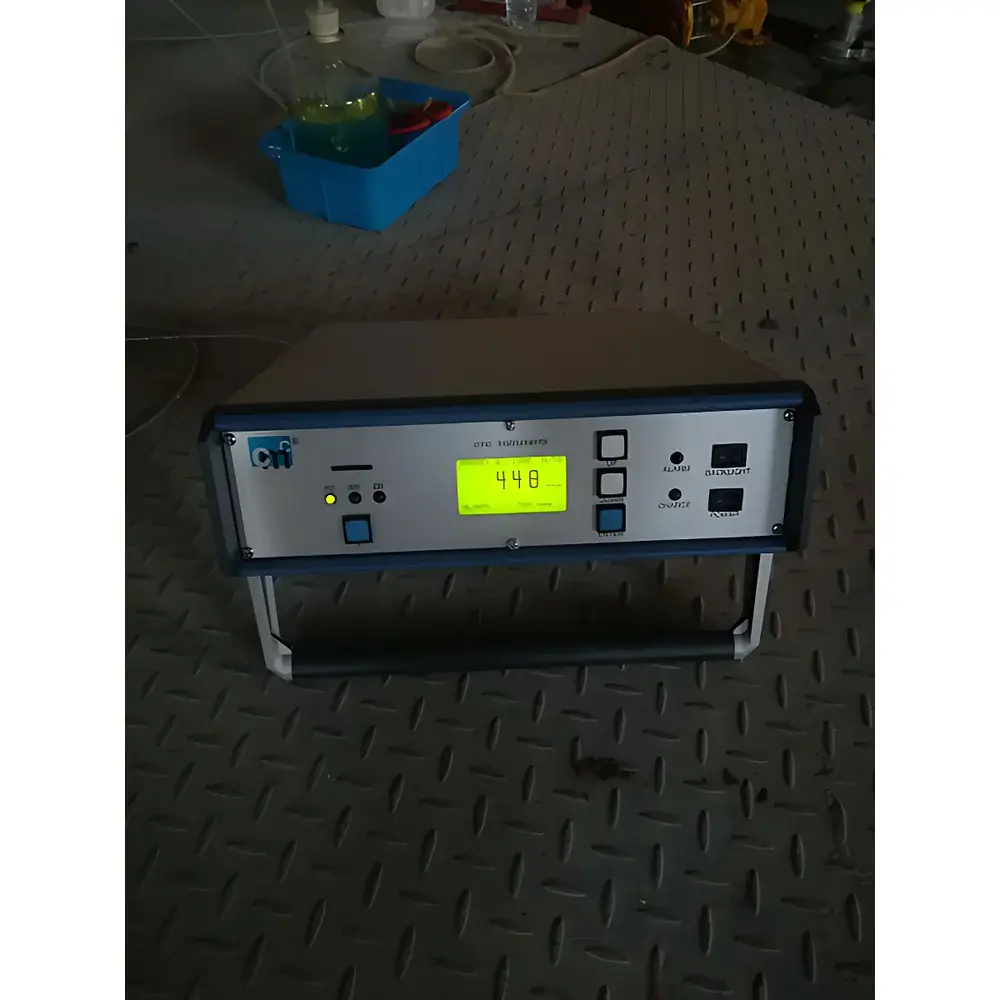
HSM-960-W Portable Trace Moisture Analyzer (P₂O₅ Electrolytic Dew Point Meter)
| Origin | Germany |
|---|---|
| Manufacturer Type | Authorized Distributor |
| Origin Category | Imported |
| Model | HSM-960-W |
| Product Type | Portable Dew Point Meter |
| Measurement Principle | Phosphorus Pentoxide (P₂O₅) Electrolytic Method |
| Operating Temperature | −20 °C to +50 °C |
| Accuracy | ±1 ppm (v/v) |
| Repeatability | ±0.1 ppm (v/v) |
| Range | 0–10 / 0–100 / 0–1000 / 0–2500 ppm (auto-ranging) |
| Display | Backlit LCD |
| Power Supply | Rechargeable lead-acid battery or 80–230 VAC, 50–60 Hz |
| Power Consumption | 8 W |
| Enclosure Rating | IP20 |
| Dimensions | 363 mm (W) × 115 mm (H) × 377 mm (D) |
| Weight | ~6 kg |
Overview
The HSM-960-W Portable Trace Moisture Analyzer is a field-deployable, P₂O₅-based electrolytic moisture measurement system engineered for high-precision quantification of water vapor in ultra-dry industrial gases. It operates on the fundamental electrochemical principle of quantitative water decomposition: moisture in the sample gas is absorbed by a thin phosphoric acid (H₃PO₄) film coated between two parallel electrodes (typically platinum or rhodium), then electrolyzed into hydrogen and oxygen. The resulting anhydrous phosphorus pentoxide (P₂O₅) continuously scavenges incoming water molecules, establishing a dynamic equilibrium where the measured electrolysis current is directly proportional to the partial pressure of water vapor—enabling trace-level detection down to sub-ppm concentrations. Unlike optical or chilled-mirror methods, this technique delivers stable, drift-free response in aggressive process streams, including corrosive (e.g., Cl₂, HCl, SO₂, H₂S) and reactive (e.g., F₂, O₃, PH₃) gases—provided they do not chemically degrade the P₂O₅ sensing layer. Its design complies with NAMUR NE 21 recommendations for intrinsic safety interface behavior and supports operation across ambient temperatures from −20 °C to +50 °C.
Key Features
- True portable architecture: Integrated rechargeable lead-acid battery enables >6 hours of continuous field operation without external power.
- P₂O₅ sensor with regenerable electrode membrane—no routine recalibration required; sensor recovery via built-in thermal regeneration cycle restores baseline sensitivity after exposure to high-moisture events.
- Auto-ranging measurement capability across four selectable spans (0–10 / 0–100 / 0–1000 / 0–2500 ppm), eliminating manual range switching during multi-point process monitoring.
- Full microprocessor control with self-diagnostic boot sequence verifying sensor integrity, amplifier gain stability, and power supply regulation prior to measurement initiation.
- High-speed response: T₉₀ < 60 seconds for step changes within calibrated range, critical for real-time purge validation and leak detection workflows.
- Robust analog I/O: Configurable 4–20 mA or 0–10 V output with user-defined scaling; single SPDT alarm relay for high/low limit triggering per ISO 14644-1 cleanroom or ISO 8573-3 compressed air quality compliance checks.
Sample Compatibility & Compliance
The HSM-960-W is validated for use with inert, oxidizing, reducing, and highly corrosive gases—including Xe, Ar, Kr, He, D₂, N₂, H₂, O₂, SF₆, C₂H₂, CO₂, CH₄, natural gas, Freon variants, and high-purity acid gases (Cl₂, HCl, SO₂, H₂S). Compatibility excludes gases known to react irreversibly with P₂O₅ or phosphoric acid (e.g., NH₃, amines, strong alkalis). All electrical interfaces conform to NAMUR NE 21 signal level standards. While not intrinsically safe certified, its IP20 enclosure is suitable for controlled indoor or sheltered outdoor environments per IEC 60529. Data acquisition and storage support audit-ready documentation aligned with GLP and GMP principles; optional timestamped data logging satisfies basic 21 CFR Part 11 record retention expectations when paired with compliant external software.
Software & Data Management
The analyzer features embedded firmware supporting menu-driven configuration of units (ppmv, µL/L, dew point °C), alarm thresholds, output scaling, and backlight timeout. Real-time readings are displayed on a backlit monochrome LCD with dual-line numeric readout and status icons. No proprietary PC software is bundled; however, analog outputs integrate seamlessly with SCADA systems, DCS controllers, or third-party data loggers (e.g., Campbell Scientific CR1000, Siemens Desigo CC). Optional RS-232 or USB-to-serial adapters enable ASCII-formatted serial output (9600 baud, N-8-1) for custom CSV export and trend analysis. Firmware updates are performed via SD card—ensuring field-upgradability without hardware replacement.
Applications
- Verification of dryness in semiconductor-grade carrier gases (N₂, Ar, He) prior to wafer processing chambers.
- In-line moisture monitoring during SF₆ reclamation and recycling in high-voltage switchgear maintenance.
- Quality assurance testing of medical oxygen and nitrous oxide per USP and ISO 8573-3 Class 1–2 specifications.
- Leak detection and purge validation in cryogenic LNG transfer lines and hydrogen fueling infrastructure.
- Process gas certification in fluoropolymer manufacturing where residual H₂O catalyzes degradation of PTFE precursors.
- Field verification of desiccant dryer performance in petrochemical plant instrument air systems.
FAQ
Does the HSM-960-W require periodic calibration with certified moisture standards?
No—its P₂O₅ sensor exhibits inherent zero and span stability. Calibration verification using traceable NIST-traceable moisture standards is recommended annually or after sensor regeneration cycles.
Can the instrument measure moisture in ammonia (NH₃) or amine-containing streams?
No—NH₃ reacts chemically with P₂O₅ to form ammonium phosphate salts, permanently deactivating the sensor. Alternative techniques (e.g., tunable diode laser absorption) are advised.
What is the expected service life of the P₂O₅ sensor under normal operating conditions?
With proper handling and avoidance of liquid water ingress or condensate exposure, typical sensor lifetime exceeds 24 months in continuous operation at ≤100 ppm levels.
Is the battery pack replaceable in the field?
Yes—the sealed lead-acid battery is user-serviceable using standard M4 fasteners; replacement kits include pre-charged cells and mounting hardware.
How does temperature compensation function during measurement?
Internal Pt100 RTD monitors sample gas temperature upstream of the sensor cell; firmware applies empirically derived correction curves to maintain accuracy across the full −20 °C to +50 °C operating envelope.
Related Products





