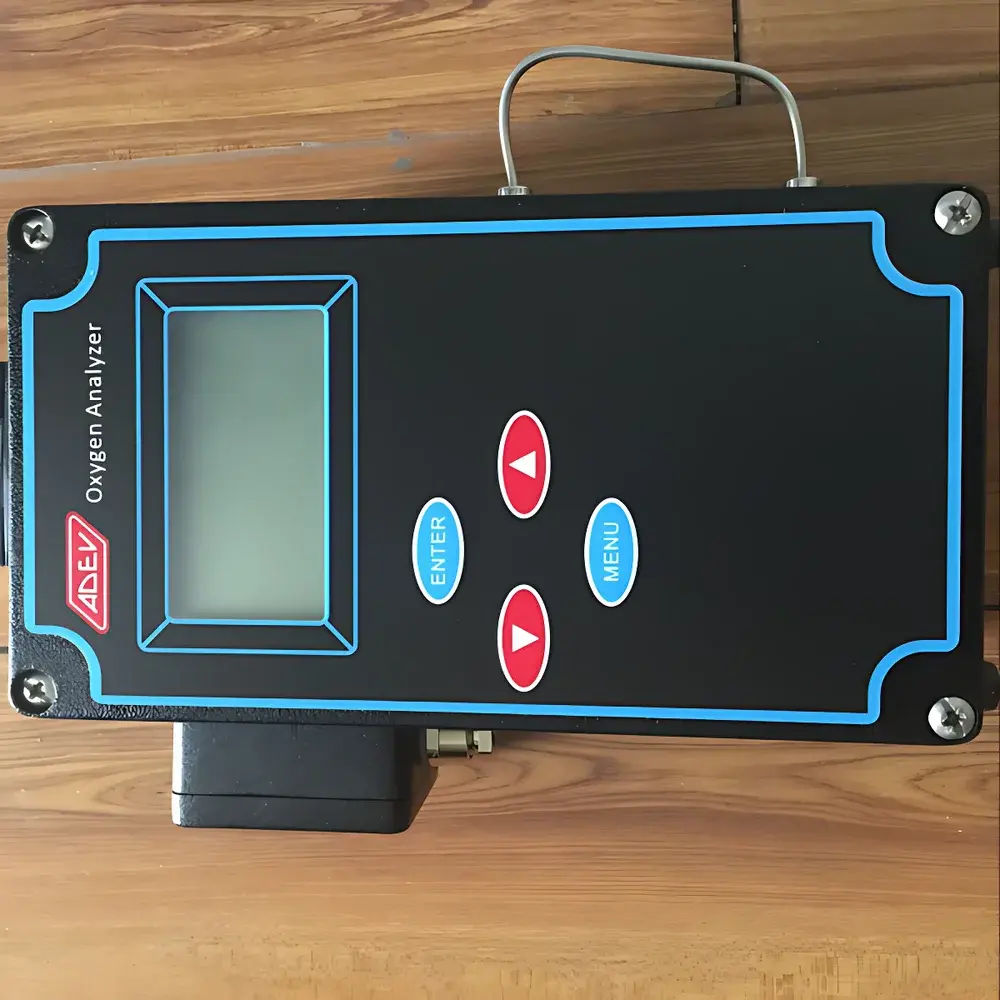
ADEV EC-2000FXTG Percent Oxygen Analyzer
| Brand | ADEV |
|---|---|
| Origin | Italy |
| Model | EC-2000FXTG |
| Sensor Type | Electrochemical Fuel Cell |
| Measurement Ranges | 0–1%, 0–5%, 0–10%, 0–25% O₂ (auto/manual range switching) |
| Accuracy | ±1% of full scale |
| Resolution | 0.01% O₂ |
| Linearity | R² > 0.995 |
| T₉₀ Response Time | ≤10 seconds |
| Operating Temperature | 5–45°C (GPR sensor), –20–45°C (XLT sensor) |
| Sample Pressure | 5–30 psig inlet, vent to atmosphere |
| Flow Rate | 0.5–5 SCFH (recommended: 2 SCFH / ~1 L/min) |
| Pressure & Temperature Compensation | Automatic |
| Output | 4–20 mA (2-wire), optional alarm relay |
| Power Supply | 9–28 V DC (24–28 V DC with intrinsic safety barrier) |
| Enclosure | Anodized aluminum, NEMA 4X rated |
| Dimensions | 4" × 9" × 3" (102 × 229 × 76 mm) |
| Weight | 1 kg |
| Wetted Materials | Corrosion-resistant alloys and fluoropolymers |
| Certifications | CE, ISO 9001 |
| Intrinsic Safety | Compatible with Class I, Division 1, Groups B, C, D when used with approved barrier |
Overview
The ADEV EC-2000FXTG Percent Oxygen Analyzer is a high-stability, electrochemical fuel cell-based analyzer engineered for continuous, real-time measurement of oxygen concentration in industrial process gas streams. Unlike paramagnetic or zirconia-based systems, the EC-2000FXTG employs a galvanic fuel cell sensor that generates a current proportional to the partial pressure of O₂—enabling precise, drift-free quantification across low-to-moderate concentration ranges (0–1% to 0–25% O₂). Its design prioritizes long-term repeatability and minimal maintenance in demanding environments such as hydrogen production, nitrogen generation, CO₂ purification, natural gas conditioning, and inert gas blanketing systems. The analyzer operates on the principle of selective electrochemical reduction of molecular oxygen at a catalyzed cathode, with a built-in reference anode and electrolyte membrane ensuring stable zero and span behavior over extended service intervals.
Key Features
- Electrochemical fuel cell sensor with proven longevity (>24 months typical service life under continuous operation)
- Four user-selectable measurement ranges (0–1%, 0–5%, 0–10%, 0–25% O₂) with automatic or manual range switching
- Integrated automatic temperature and pressure compensation (ATPC), eliminating manual correction factors during process fluctuations
- NEMA 4X-rated anodized aluminum enclosure suitable for outdoor or washdown-prone industrial locations
- Real-time display of sample pressure and temperature alongside O₂ concentration (0.1% resolution)
- Intrinsically safe configuration compliant with Class I, Division 1, Groups B, C, D when paired with an approved safety barrier
- Two-wire 4–20 mA analog output with HART-compatible signal options (optional) for integration into DCS/PLC systems
- Corrosion-resistant wetted materials—including Hastelloy, 316 stainless steel, and PTFE—ensuring compatibility with acidic gases, hydrocarbons, and inert mixtures
Sample Compatibility & Compliance
The EC-2000FXTG is validated for use with a broad spectrum of process gases including hydrogen, helium, nitrogen, argon, methane, propane, CO₂, and mixed industrial streams containing trace acid components (e.g., H₂S, CO₂, SO₂). It is not recommended for use in strongly oxidizing atmospheres (>25% O₂), chlorine-rich streams, or environments with condensable vapors unless equipped with appropriate filtration and conditioning. The analyzer meets CE marking requirements per Directive 2014/30/EU (EMC) and 2014/35/EU (LVD), and its quality management system is certified to ISO 9001:2015. For regulated industries, the device supports audit-ready calibration logging when integrated with compatible SCADA or MES platforms, aligning with GLP/GMP documentation expectations for traceable gas analysis in pharmaceutical and food-grade nitrogen applications.
Software & Data Management
While the EC-2000FXTG operates as a standalone hardware analyzer without embedded firmware-based data logging, its 4–20 mA output is fully compatible with industry-standard historian systems (e.g., OSIsoft PI, Emerson DeltaV, Siemens Desigo CC). Optional analog-to-digital interface modules enable direct RS-485 Modbus RTU communication for remote parameter access and event-triggered diagnostics. Calibration records—including date, standard gas concentration (certified to NIST-traceable standards), operator ID, and deviation from previous baseline—are retained externally via host system logging. The unit supports two-point calibration (zero and span) using certified reference gases; span gas concentration should be ≥80% of selected full-scale range to ensure optimal linearity validation per ASTM D6299 practice.
Applications
- Hydrogen purity monitoring in PEM and alkaline electrolyzers (O₂ leak detection down to 10 ppm equivalent)
- Oxygen residual control in nitrogen generator outlet streams (PSA/VSA systems) for electronics manufacturing and laser cutting
- CO₂ stream verification in beverage carbonation and biogas upgrading facilities
- Blanket gas integrity assurance in transformer oil preservation and semiconductor wafer annealing furnaces
- Process safety interlock signaling in solvent recovery units handling flammable vapors
- Quality assurance in medical gas production lines compliant with ISO 8573-7 and USP <823>
FAQ
What is the recommended calibration frequency for the EC-2000FXTG in continuous operation?
Calibration should be performed at least every 3–6 months under stable conditions; more frequent checks (e.g., weekly bump tests) are advised in high-contamination or high-cycling environments per ISO 17025 guidance.
Can the analyzer measure oxygen in hydrogen-rich streams without sensor poisoning?
Yes—the fuel cell design is inherently tolerant of H₂ backgrounds up to 100%, provided no catalytic poisons (e.g., siloxanes, heavy metals, halogens) are present above threshold limits specified in ADEV’s application note AN-FX-02.
Is the 4–20 mA output isolated and loop-powered?
Yes—the output is fully isolated and operates in true two-wire loop-powered mode, requiring no auxiliary power at the receiver end.
Does the unit support digital communication protocols beyond analog output?
Standard configuration includes only 4–20 mA; optional RS-485 Modbus RTU interface is available via the EC-2000FXTG-DIG module (sold separately).
How does automatic pressure compensation function in practice?
An integrated piezoresistive pressure transducer continuously measures inlet pressure and applies real-time correction to the raw sensor signal using the ideal gas law relationship between partial pressure and volumetric concentration—critical for variable-pressure processes like compressor discharge monitoring.
Related Products