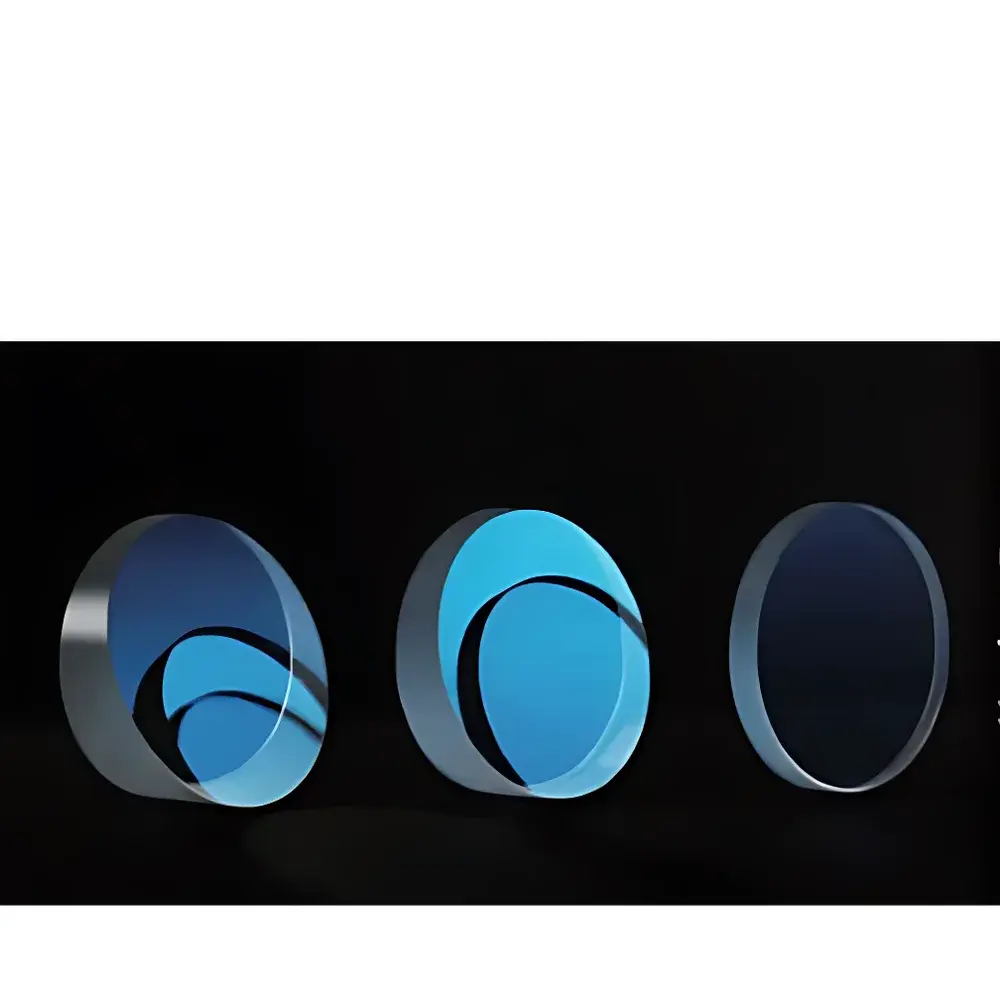
MiXran Meg1065 High-Precision Fused Silica Wedge Prism
| Brand | MiXran |
|---|---|
| Model | Meg1065 |
| Material | UV-grade fused silica |
| Diameter | Φ25.0 mm |
| Edge thickness | 3.0 mm |
| Wedge angle options | 0.5°, 1.0°, 2.0°, 4.0°, 6.0° |
| Beam deviation @355 nm | 0.87° to 10.51° |
| Surface quality | 20–10 scratch-dig |
| Surface flatness | λ/10 @633 nm |
| Coating options | Uncoated |
| AR coating | Broadband anti-reflection (250–400 nm), Ravg < 0.5% per surface |
Overview
The MiXran Meg1065 is a high-precision wedge prism engineered for demanding ultraviolet optical systems requiring stable beam steering, controlled angular dispersion, or precise wavefront manipulation in the deep-UV to near-UV spectral range (250–400 nm). Fabricated from synthetic UV-grade fused silica (SiO₂), it exhibits exceptional transmission (>99.5% per cm at 355 nm), low thermal expansion (α ≈ 0.55 × 10⁻⁶ /°C), and high laser-induced damage threshold (LIDT > 5 J/cm² at 355 nm, 10 ns pulse). Its optical path relies on refraction governed by Snell’s law, where incident collimated light undergoes deterministic angular deviation proportional to the physical wedge angle and refractive index of the substrate. Unlike prisms designed for dispersion or total internal reflection, the Meg1065 serves as a passive, alignment-stable angular offset element—ideal for cavity tuning, interferometric path-length balancing, and UV laser beam walk-off compensation.
Key Features
- UV-optimized fused silica substrate with certified OH-content < 1 ppm and metallic impurity levels compliant with SEMI F57 specifications
- Precision-polished surfaces meeting λ/10 surface flatness (measured at 633 nm HeNe wavelength) and 20–10 scratch-dig cosmetic standard per MIL-PRF-13830B
- Five standardized wedge angle variants (0.5°, 1.0°, 2.0°, 4.0°, 6.0°) enabling predictable beam deviation from 0.87° to 10.51° at 355 nm
- Optional broadband anti-reflection coating (GW25-025-XXX-UV series) optimized for 250–400 nm, achieving average reflectance < 0.5% per surface with < ±0.2% spectral uniformity across the band
- Consistent edge thickness (3.0 mm) and outer diameter (Φ25.0 mm) supporting compatibility with standard SM25-compatible lens tubes, kinematic mounts, and UV-grade optomechanical breadboards
- Traceable metrology: each unit supplied with individual test report including interferometric surface map, spectral transmittance curve (200–800 nm), and wedge angle verification via autocollimation
Sample Compatibility & Compliance
The Meg1065 is compatible with continuous-wave and pulsed UV sources—including frequency-tripled Nd:YAG (355 nm), excimer lasers (248 nm, 193 nm), and deuterium lamps—provided fluence remains below LIDT limits. It meets material and dimensional requirements referenced in ISO 10110-3 (optical component tolerances) and ASTM E1331 (spectral transmittance measurement). The uncoated variant complies with USP optical clarity criteria for UV-transparent components used in analytical instrumentation. When integrated into Class I or II laser systems, it satisfies EN 60825-1:2014 mechanical stability and labeling provisions for passive optical elements.
Software & Data Management
While the Meg1065 is a passive optical component, its specification data is fully integrated into MiXran’s Optical Component Digital Twin Platform—a web-accessible database supporting traceable calibration records, spectral performance archives, and mounting configuration libraries. Each product serial number links to downloadable Zemax-compatible .ZBF files (including measured surface error maps) and MATLAB-readable .mat datasets containing measured wedge angle uncertainty (±0.5 arcsec), transmitted wavefront error (RMS < 0.03λ), and polarization-dependent loss (< 0.02% over S- and P-states at 355 nm). Audit logs comply with FDA 21 CFR Part 11 requirements for electronic records in regulated analytical environments.
Applications
- UV laser cavity alignment and intracavity beam repositioning in solid-state and excimer laser systems
- Angle-tuned interference filters and Lyot depolarizers in UV spectroscopy and ellipsometry platforms
- Reference path correction in Michelson and Mach–Zehnder interferometers operating below 400 nm
- Beam steering in UV lithography mask inspection tools and wafer metrology scanners
- Wavefront shearing and differential phase contrast in UV microscopy and coherent diffraction imaging
- Calibration artifact for angular encoder verification and autocollimator linearity testing in NIST-traceable metrology labs
FAQ
What is the maximum permissible beam diameter for the Φ25.0 mm Meg1065 prism without vignetting?
For collimated input, the clear aperture is ≥Φ24.0 mm; full transmission is guaranteed for beams ≤Φ22.5 mm at all specified wedge angles.
Can the Meg1065 be used in vacuum environments?
Yes—UV-grade fused silica is vacuum-compatible; outgassing rate is < 1.0 × 10⁻¹⁰ g/(cm²·s) per ASTM E595, and no adhesives or organic coatings are used in standard configurations.
Is the AR coating durable under repeated UV exposure?
The GW25-025-XXX-UV coating employs ion-assisted e-beam deposition of MgF₂/Ta₂O₅ multilayers; accelerated lifetime testing shows < 0.05% reflectance drift after 10⁹ pulses at 355 nm (10 Hz, 5 ns).
Do you provide custom wedge angles or diameters?
Yes—custom geometries (Φ12.7 mm to Φ50.8 mm, wedge angles from 0.1° to 15.0°) are available under MiXran’s OEM Optical Component Program with full ISO 9001:2015 process control and test documentation.
How is wedge angle verified during final inspection?
Each unit undergoes double-pass autocollimation using a Zygo GPI XP interferometer with a calibrated reference flat; measurement uncertainty is ±0.3 arcsec (k = 2).