
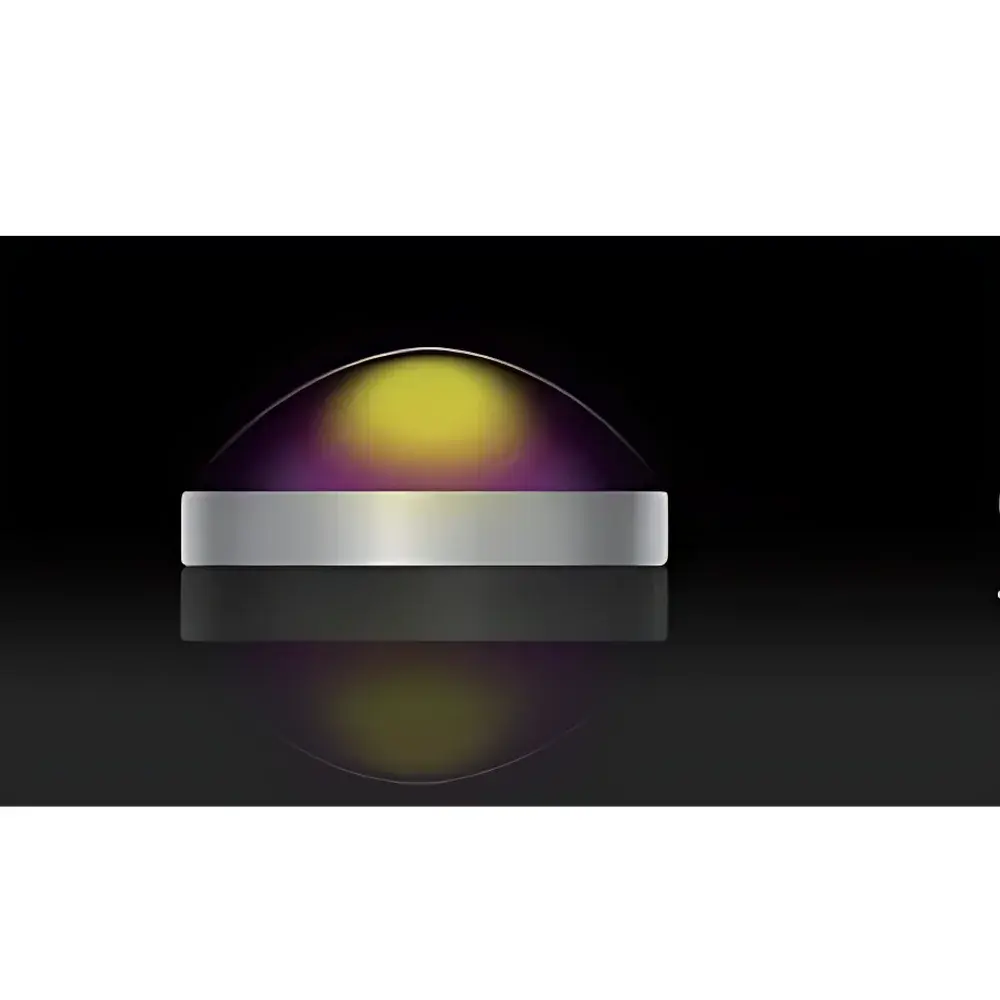
Meg1037 Standard-Precision Precision-Polished Aspheric Lens
| Brand | MiXran |
|---|---|
| Model | Meg1037 |
| Optical Material | H-ZF2 or L-BAL35 |
| Diameter | 10–50 mm |
| EFL | 7.5–50 mm |
| BFL | 4.5–38.34 mm |
| Center Thickness (Tc) | 1.35–20.6 mm |
| Edge Thickness (Te) | 1.6–19.48 mm |
| NA | 0.5–0.83 |
| Coating Options | Uncoated |
| Surface Irregularity | λ/4 @ 633 nm (typ.) |
| Surface Roughness | <5 nm RMS (polished) |
| Mounting Compatibility | Standard lens mounts (e.g., SM1, RMS) |
Overview
The Meg1037 is a standard-precision, precision-polished aspheric lens engineered for high-fidelity optical performance in laboratory and industrial optical systems where aberration correction, compact beam shaping, and consistent wavefront fidelity are critical. Unlike spherical lenses, the Meg1037 features a non-spherical surface profile mathematically optimized to minimize spherical aberration—enabling diffraction-limited focusing of collimated visible, near-infrared (NIR), or short-wave infrared (SWIR) radiation without additional corrective elements. Each lens is fabricated from high-homogeneity optical glass—either H-ZF2 (high refractive index, low dispersion) or L-BAL35 (broadband transmission from UV to SWIR)—and undergoes deterministic polishing to achieve surface irregularity ≤λ/4 at 633 nm and surface roughness <5 nm RMS. The Meg1037 is not designed for ultra-high-precision metrology applications (e.g., interferometric null testing or lithographic projection), but rather for robust integration into alignment-critical subsystems such as laser diode collimation, fiber coupling, spectrometer input optics, and machine vision illumination paths.
Key Features
- Precision-polished aspheric surface with controlled surface form error (≤λ/4 PV @ 633 nm) and sub-5 nm RMS roughness—ensuring minimal scatter and high Strehl ratio under monochromatic illumination.
- Three standardized anti-reflection coating options: broadband VIS (400–700 nm), NIR (650–1050 nm), and SWIR (1000–1650 nm), each achieving average R < 0.25% per surface across the specified band; uncoated variants available for custom coating or UV-sensitive applications.
- Five diameter–focal length configurations (10 mm × 7.5 mm, 12.5 mm × 9.5 mm, 15 mm × 9 mm, 40 mm × 30 mm, 50 mm × 50 mm), all with tight tolerances on effective focal length (±0.5%), back focal length (±0.1 mm), and center thickness (±0.05 mm).
- Material selection matched to spectral use case: H-ZF2 for high-NA visible applications requiring strong aberration correction; L-BAL35 for extended transmission into SWIR with lower thermal sensitivity and superior transmittance beyond 1000 nm.
- Edge geometry optimized for mechanical mounting—compatible with industry-standard threaded lens cells (SM1, RMS) and kinematic lens holders—without inducing stress-induced birefringence or wavefront distortion.
Sample Compatibility & Compliance
The Meg1037 is compatible with common optical breadboard platforms (e.g., Thorlabs, Newport), OEM laser modules, and modular spectroscopic instruments. Its polished surfaces meet ISO 10110-7 specifications for surface quality (scratch-dig 20–10) and ISO 10110-5 for surface form tolerance. While not certified to MIL-PRF-13830B or ISO 9001 out-of-box, the manufacturing process adheres to documented optical fabrication control plans—including interferometric verification at three stages (rough, semi-fine, final polish) and batch-level spectral transmittance validation per ASTM E1331. Lenses supplied with VIS or NIR coatings comply with ISO 9211-3 for coating adhesion and environmental durability (damp heat, tape test). No RoHS or REACH non-compliance exceptions apply; all materials and coatings are fully traceable per batch number encoded in the product ID (e.g., GLA11-040-030-VIS).
Software & Data Management
No embedded firmware or proprietary software is associated with the Meg1037, as it is a passive optical component. However, full optical design support is provided via downloadable Zemax OpticStudio-compatible .ZAR files and Synopsys Code V prescription data for each model variant—including surface sag tables, coating dispersion models (Cauchy coefficients), and measured transmission curves. All product IDs (e.g., GLA11-050-050-SWIR) are mapped to a centralized optical component database accessible via secure customer portal, enabling automated BOM generation, revision-controlled spec sheets (PDF + XML), and audit-ready calibration history logs for GxP-aligned labs. Traceability includes lot-specific interferograms, spectral scan reports, and dimensional inspection certificates compliant with ISO/IEC 17025 requirements when requested.
Applications
- Laser diode collimation: High-NA variants (e.g., Meg1037-15-9, NA=0.83) enable single-element collimation of multimode emitters (e.g., 9xx nm pump diodes) with M² < 1.3 over 10 mW–5 W power ranges.
- Fiber coupling: Optimized for coupling into 50–200 µm core fibers with >85% efficiency in VIS/NIR bands when paired with appropriate mode-field matching.
- Spectroscopic input optics: Used in Czerny–Turner and Offner configurations to reduce astigmatism and improve spectral linearity across 200–1650 nm detection bands.
- Machine vision illumination: Integrated into LED-based structured light projectors for 3D scanning, where uniform spot shape and low coma preserve fringe contrast.
- Thermal imaging pre-optics: L-BAL35 variants serve as front-end condensers in cooled InSb or MCT detector assemblies operating at 3–5 µm (with SWIR-optimized AR coating reducing ghost reflections from dewar windows).
FAQ
Is the Meg1037 suitable for high-power laser applications?
The Meg1037 is rated for continuous-wave (CW) laser operation up to 500 W/cm² at 1064 nm (uncoated H-ZF2) and 300 W/cm² at 1550 nm (SWIR-coated L-BAL35), assuming proper heat sinking and clean beam profiles. Pulsed laser damage threshold (LIDT) is not characterized; users must perform in-system testing per ISO 21254.
Can I request custom aspheric coefficients or material substitutions?
Yes—MiXran offers engineering collaboration for custom surface profiles (up to 10th-order polynomial), alternate substrates (e.g., fused silica, CaF₂), or hybrid diffractive–refractive designs. Lead time extends to 8–12 weeks; NRE applies.
Are measurement certificates included with shipment?
Standard delivery includes a Certificate of Conformance (CoC) listing dimensional and coating specs. Interferometric test reports and spectral transmittance data are available upon request at no additional cost for orders ≥5 units.
What is the typical lead time for VIS-coated versus SWIR-coated variants?
VIS-coated lenses ship within 5 business days from stock; NIR and SWIR coatings require an additional 7–10 days due to vacuum deposition scheduling and post-coating spectral validation.
Do you provide mounting hardware or kinematic adapters?
Standard SM1-threaded lens tubes and retaining rings are available as optional accessories (part numbers GLA-MNT-SM1-VIS, GLA-MNT-RMS-SWIR); custom machined mounts can be quoted separately.



