
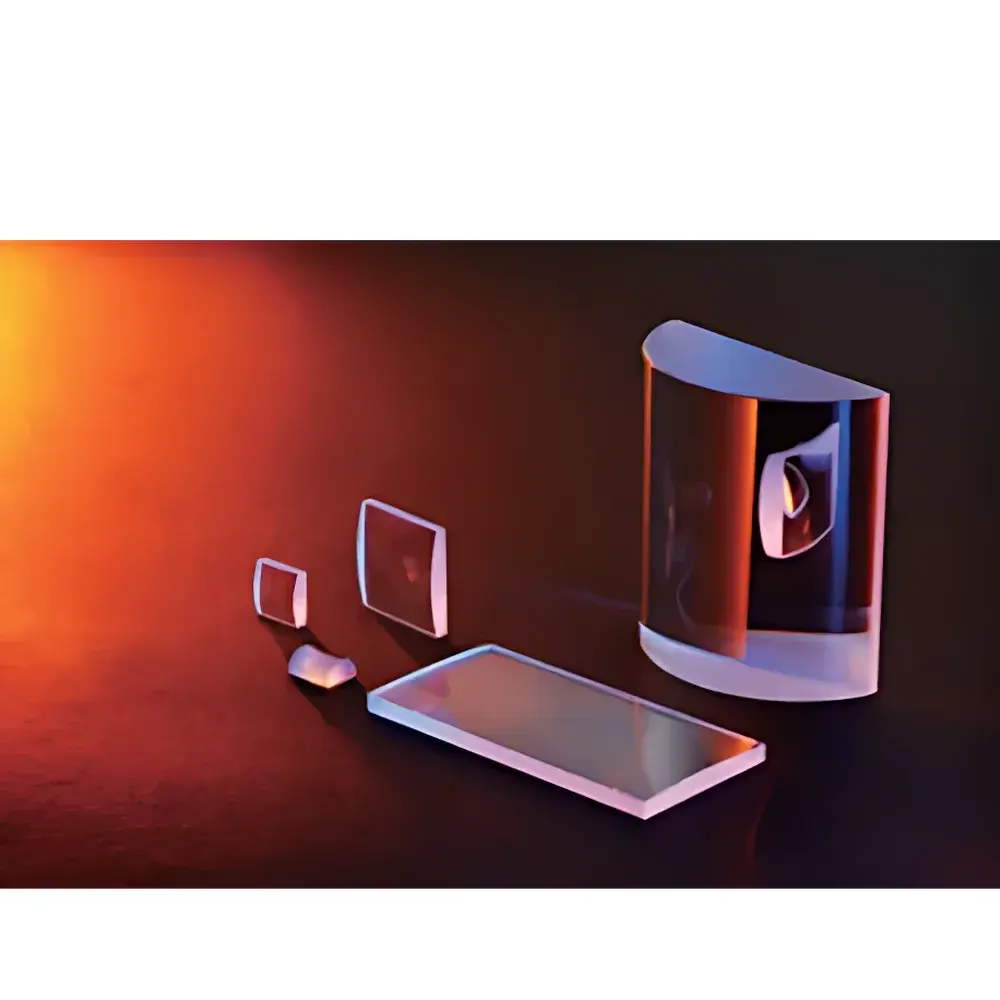
Meg1003 Plano-Convex Cylindrical Lens
| Brand | MiXran |
|---|---|
| Model | Meg1003 |
| Optical Component Type | Plano-Convex Cylindrical Lens |
| Coating Options | Uncoated, VIS AR (400–700 nm), NIR AR (650–1050 nm), SWIR AR (1000–1650 nm) |
| Material | N-BK7 (Schott) |
| Dimensional Range | 5×5 mm to 60×30 mm |
| Focal Length Range | 20 mm to 1000 mm |
| Surface Quality | 40–20 scratch-dig |
| Clear Aperture | ≥90% of nominal dimension |
Overview
The Meg1003 Plano-Convex Cylindrical Lens is a precision optical component engineered for beam shaping, line generation, anamorphic correction, and laser profile conditioning in research-grade optical systems. Unlike spherical lenses, cylindrical lenses possess curvature along only one axis—enabling asymmetric focusing to transform circular Gaussian beams into uniform line foci or correct astigmatism in imaging paths. The Meg1003 series utilizes high-homogeneity N-BK7 optical glass (Schott catalogue compliant), offering excellent transmission across the visible spectrum (350–2000 nm) and low thermal expansion for stable performance under thermal load. Each lens features a plano surface orthogonal to the optical axis and a convex cylindrical surface with precisely calculated radius of curvature (R₁), enabling accurate focal length (EFL) control per design specification. Back focal length (BFL), center thickness (Tc), and edge thickness (Te) are tightly controlled to ±0.05 mm tolerance to ensure repeatability in multi-element mounts and kinematic alignment stages.
Key Features
- High-precision cylindrical surface figure: λ/2 RMS wavefront error over clear aperture, verified via interferometric testing per ISO 10110-5.
- Multiple anti-reflection coating options: VIS (400–700 nm, Ravg < 0.5%), NIR (650–1050 nm, Ravg < 0.8%), and SWIR (1000–1650 nm, Ravg 5 J/cm² @ 1064 nm, 10 ns pulse.
- Standardized dimensional matrix: Available in rectangular cross-sections from 5×5 mm to 60×30 mm, supporting integration into standard optomechanical breadboards and OEM laser modules.
- Consistent metrology traceability: All lenses undergo full dimensional inspection (CMM and optical profilometry), surface quality verification (ISO 10110-7), and spectral transmittance validation (PerkinElmer Lambda 950 UV/VIS/NIR spectrophotometer).
- Robust mechanical stability: Edge thickness and center thickness tolerances maintained at ±0.05 mm; chamfered edges (0.2 mm × 45°) prevent chipping during handling and mounting.
Sample Compatibility & Compliance
The Meg1003 lens family is compatible with standard kinematic lens mounts (e.g., Thorlabs SM1-threaded, Newport 60-series), cage systems (30 mm and 60 mm), and custom-designed optomechanical housings. Its N-BK7 substrate meets MIL-O-13830A surface quality requirements and complies with ISO 10110 optical drawing standards for surface form, roughness, and coating specifications. All AR coatings conform to ISO 9211-3 for coating adhesion, abrasion resistance, and humidity stability (tested per DIN EN 60068-2-30). For regulated environments—including ISO 13485-certified medical device manufacturing and FDA-regulated analytical instrumentation—the lenses are supplied with full material certification (Schott Certificate of Conformance), batch-specific spectral data sheets, and RoHS/REACH-compliant documentation.
Software & Data Management
Each Meg1003 lens shipment includes a digital calibration report containing measured EFL, BFL, R₁, Tc, Te, and spectral transmittance curves (VIS/NIR/SWIR bands). These reports are generated using validated in-house metrology software (Zemax OpticStudio v23-integrated measurement pipeline) and archived in a secure, audit-ready format compliant with 21 CFR Part 11 requirements (electronic signatures, change history, user access logs). Customers may request raw interferogram files (.zmf), spectral data (.csv), or Zemax-compatible .zmx model files for system-level ray tracing and tolerance analysis. Traceable calibration records are retained for ≥10 years per GLP/GMP archival protocols.
Applications
- Laser line generation for structured light illumination in machine vision, confocal microscopy, and triangulation-based profilometry.
- Astigmatism correction in diode-pumped solid-state (DPSS) lasers and fiber-coupled pump optics.
- Beam homogenization in UV lithography illumination systems and LED collimation arrays.
- Anamorphic expansion/compression of ultrafast laser pulses in chirped pulse amplification (CPA) compressors.
- Optical coherence tomography (OCT) sample arm optics requiring diffraction-limited line focus stability across broadband sources (800–1300 nm).
- Educational optics labs: Demonstrating cylindrical aberration, focal line geometry, and Fourier plane manipulation in spatial filtering setups.
FAQ
What is the difference between a plano-convex cylindrical lens and a spherical lens?
A plano-convex cylindrical lens focuses light to a line rather than a point, as its curvature exists only along one meridional plane. This enables one-dimensional focusing critical for applications such as laser line generation and astigmatism compensation—functions impossible with isotropic spherical optics.
Can Meg1003 lenses be used in high-power laser systems?
Yes—when specified with VIS/NIR/SWIR AR coatings, Meg1003 lenses support continuous-wave (CW) power densities up to 5 kW/cm² and pulsed operation (10 ns, 10 Hz) with LDT >5 J/cm² at 1064 nm. Substrate thermal conductivity (1.1 W/m·K) and low dn/dT (2.7×10⁻⁶ /K) minimize thermal lensing effects.
Is custom focal length or dimension available?
Custom geometries—including non-standard dimensions, focal lengths outside the published range (e.g., EFL = 12.5 mm or 850 mm), and alternate substrates (e.g., fused silica, CaF₂)—are available under OEM agreement with lead times of 4–6 weeks and full metrological validation.
How is surface quality verified?
Surface quality is assessed per ISO 10110-7 using automated dark-field inspection systems calibrated against NIST-traceable scratch-dig standards. Each lens receives a documented pass/fail result for both plano and cylindrical surfaces, with 40–20 scratch-dig being standard and 20–10 available upon request.
Do you provide Zemax or Code V models?
Yes—standard Zemax (.zmx) and Code V (.seq) sequential models are provided free of charge with every order. Non-sequential scattering models (including bulk scatter and coating BRDF data) are available under NDA for system integrators performing rigorous stray light analysis.





