
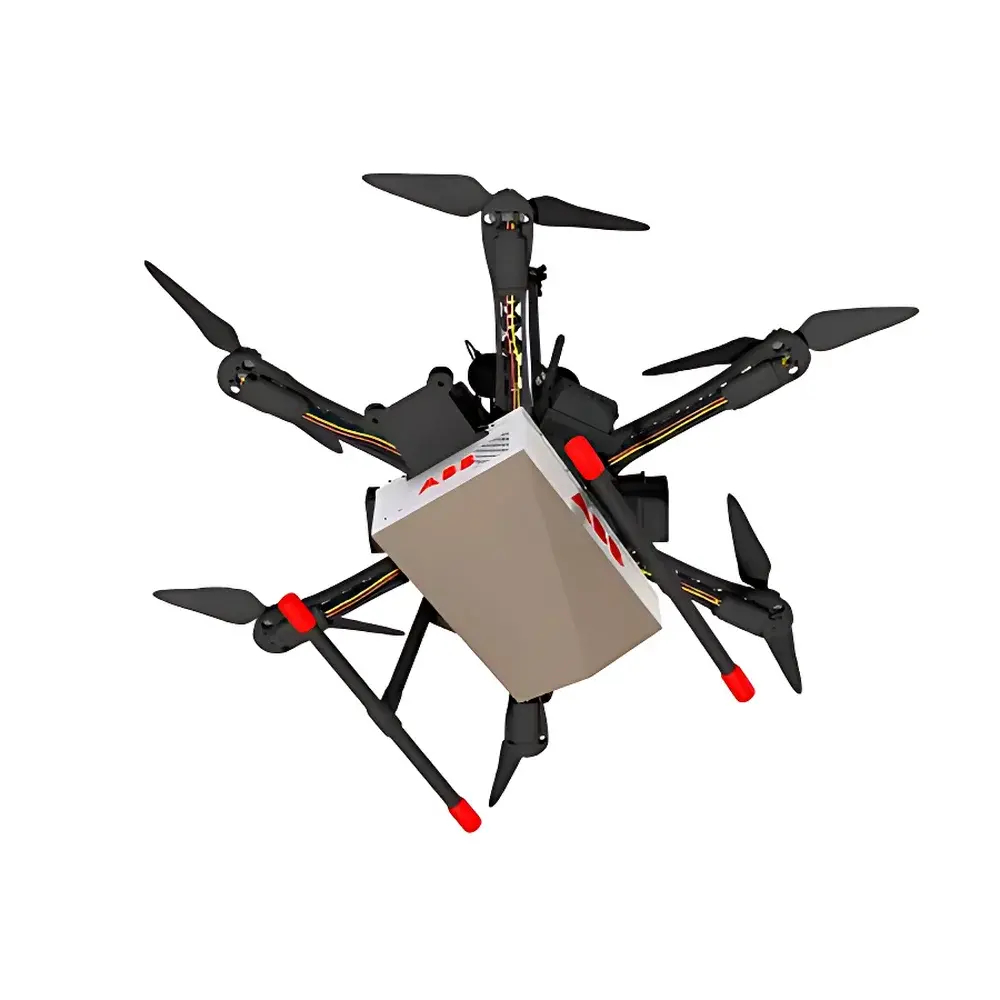
ABB GLA133 UAV-Mounted Greenhouse Gas Analyzer
| Brand | ABB |
|---|---|
| Origin | Canada |
| Manufacturer Type | Authorized Distributor |
| Origin Category | Imported |
| Model | GLA133 |
| Detection Gases & Ranges | CH₄ (0–100 ppm standard |
| Response Time | 2.5 Hz (1/e) |
| Power Consumption | <35 W |
| Weight | <3 kg |
| Measurement Rate | Up to 10 Hz |
| Technology | Off-Axis Integrated Cavity Output Spectroscopy (OA-ICOS) |
Overview
The ABB GLA133 UAV-Mounted Greenhouse Gas Analyzer is a field-deployable, high-precision optical gas analyzer engineered specifically for airborne eddy covariance and flux mapping applications. Built upon ABB’s patented Off-Axis Integrated Cavity Output Spectroscopy (OA-ICOS) platform—the fourth-generation evolution of cavity-enhanced absorption spectroscopy—it delivers laboratory-grade sensitivity and stability in a ruggedized, drone-integrated form factor. Unlike conventional direct absorption or cavity ring-down spectroscopy (CRDS) systems, OA-ICOS eliminates mode-hopping artifacts and thermal drift through passive cavity alignment and robust optical path design, enabling continuous, unattended operation under dynamic UAV flight conditions. The instrument simultaneously quantifies methane (CH₄), carbon dioxide (CO₂), and water vapor (H₂O) with sub-ppb-level detection limits and traceable calibration traceability to NIST-standard reference gases. Its compact architecture (<3 kg, <35 W) meets Class II UAV payload constraints while maintaining full compliance with atmospheric measurement best practices defined by the AmeriFlux and ICOS networks.
Key Features
- Ultra-low power consumption (<35 W) compatible with standard UAV battery systems—no external power conversion required
- Real-time data acquisition at up to 10 Hz, with 2.5 Hz system response time (1/e) for rapid plume tracking and turbulent flux resolution
- Three configurable variants: GLA133-GGA (optimized for CH₄/CO₂/H₂O co-measurement with extended 0–1% CH₄ range), GLA133-GPC (CO₂-dominant with 0–500 ppm CH₄ extension), and GLA133-CH4 (dedicated high-sensitivity CH₄ monitoring)
- Zero cross-sensitivity between target gases—validated per ISO 13861:2020 for multi-gas interference assessment
- Onboard embedded computer with SD card logging (continuous storage of raw spectra, concentration time series, diagnostic metadata, and synchronized UAV telemetry)
- Integrated WiFi and serial interfaces (RS-232/485) for real-time streaming to ground control tablets or smartphones running ICOS FastScanner™ software
- Full cold-start operation: stable measurements achieved within 20 seconds of power-on, minimizing pre-flight delays
Sample Compatibility & Compliance
The GLA133 accepts ambient air samples via a heated, laminar-flow inlet assembly with particulate filtration (0.2 µm PTFE membrane) and pressure-regulated sampling (±0.1 kPa control). It operates continuously across −10 °C to +45 °C ambient temperature ranges and 10–95% RH (non-condensing), meeting IEC 60068-2 environmental stress testing requirements. All measurement outputs comply with EPA Method TO-15 and ASTM D6348-18 for trace VOC and greenhouse gas quantification. Data integrity adheres to FDA 21 CFR Part 11 principles via audit-trail-enabled firmware logging, including operator ID, calibration timestamps, and sensor health diagnostics. Optional ACC-UAV Flux Measurement Kit (for DJI M600 Pro) includes Trisonica 3D ultrasonic anemometer synchronization and post-processing scripts aligned with EddyPro® and TK3 workflows.
Software & Data Management
The analyzer ships with factory-installed ICOS FastScanner™ v4.x firmware and companion desktop software for configuration, spectral diagnostics, and batch processing. Raw absorbance spectra (1310 nm and 1570 nm bands) are stored alongside concentration time series (10 Hz), GPS-coordinated position stamps, and internal pressure/temperature/humidity telemetry. All data files conform to NetCDF-4/HDF5 standards with CF-1.8 metadata conventions, ensuring interoperability with Python (xarray/netCDF4), MATLAB, and R-based flux analysis pipelines. Firmware updates and remote parameter tuning are supported over secure TLS-encrypted WiFi connections. Optional software licenses enable automated zero/span validation routines, spectral residual analysis, and GLP-compliant electronic signature workflows.
Applications
- Airborne eddy covariance flux mapping of CH₄ and CO₂ emissions from landfills, oil & gas infrastructure, and agricultural sites
- High-resolution leak detection surveys over pipeline corridors and well pads using differential concentration gradient analysis
- Validation of satellite-based GHG retrieval algorithms (e.g., TROPOMI, OCO-2/3) through coordinated low-altitude transects
- Boundary layer profiling and vertical mixing studies in urban and peri-urban environments
- Long-term monitoring of biogenic emissions from wetlands, rice paddies, and permafrost thaw zones
- Regulatory compliance support for EPA LDAR programs and EU MRV reporting frameworks
FAQ
What is the minimum detectable concentration for CH₄ under standard operating conditions?
For the GLA133-GGA variant, the 1σ precision is 0.9 ppb at 1-second averaging and improves to 0.3 ppb at 10-second integration—verified using certified NIST-traceable CH₄ standards.
Does the instrument require external calibration gas cylinders during field deployment?
No. The OA-ICOS platform uses wavelength-stabilized laser sources and cavity-length referencing to maintain long-term baseline stability; periodic zero checks (using synthetic air) are recommended every 48 hours for regulatory-grade reporting.
Can the GLA133 be integrated with third-party UAV autopilot systems (e.g., Pixhawk, ArduPilot)?
Yes. MAVLink-compatible telemetry output is available via UART; custom integration guides and ROS2 drivers are provided under NDA for qualified research and commercial partners.
Is the data format compatible with FLUXNET or ICOS data submission protocols?
Yes. Preconfigured export modules generate Level 2–3 eddy covariance data products compliant with ICOS Central Analytical Laboratories (CAL) ingestion specifications, including mandatory QC flags and uncertainty propagation fields.
What maintenance intervals are recommended for field-deployed units?
Filter replacement every 100 flight hours; mirror cleaning with MTN-CLEAN-1V kit every 200 hours; full pump and valve service (SPK-131V2) recommended annually or after 500 operational hours—documented in onboard service log.







