
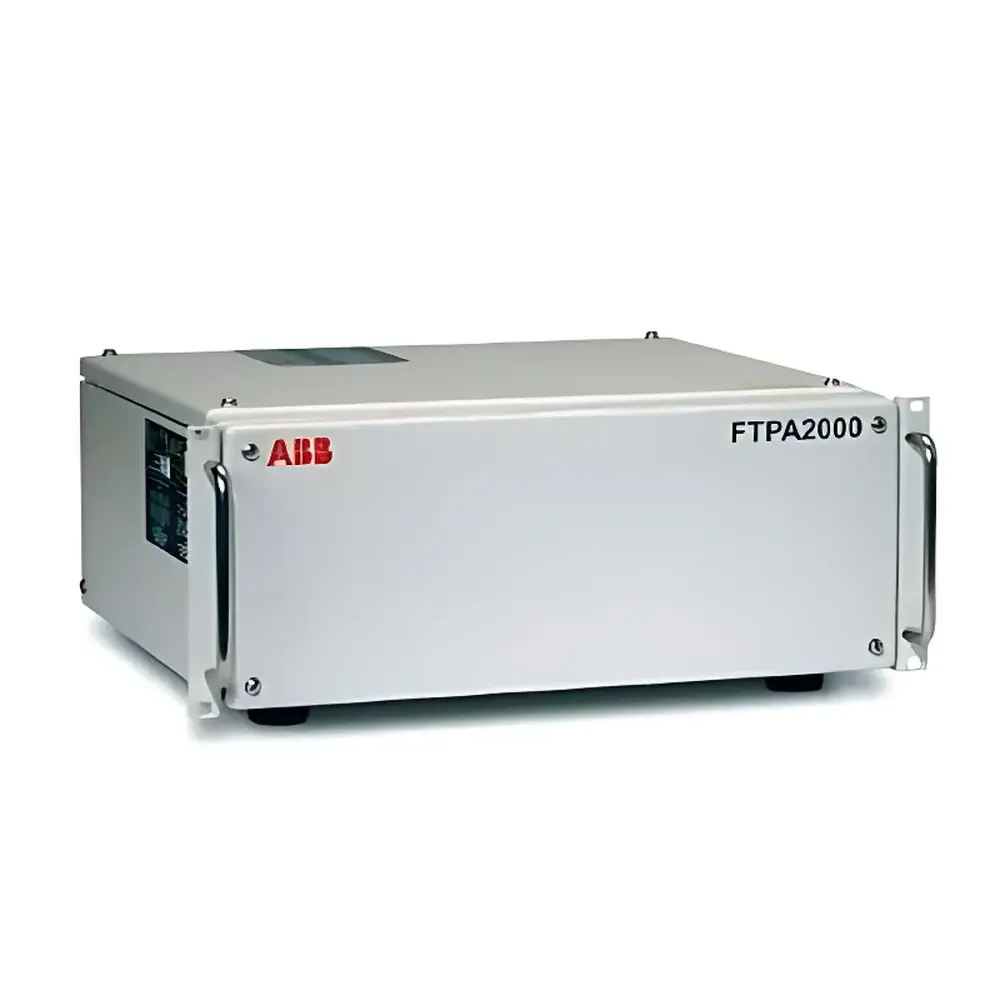
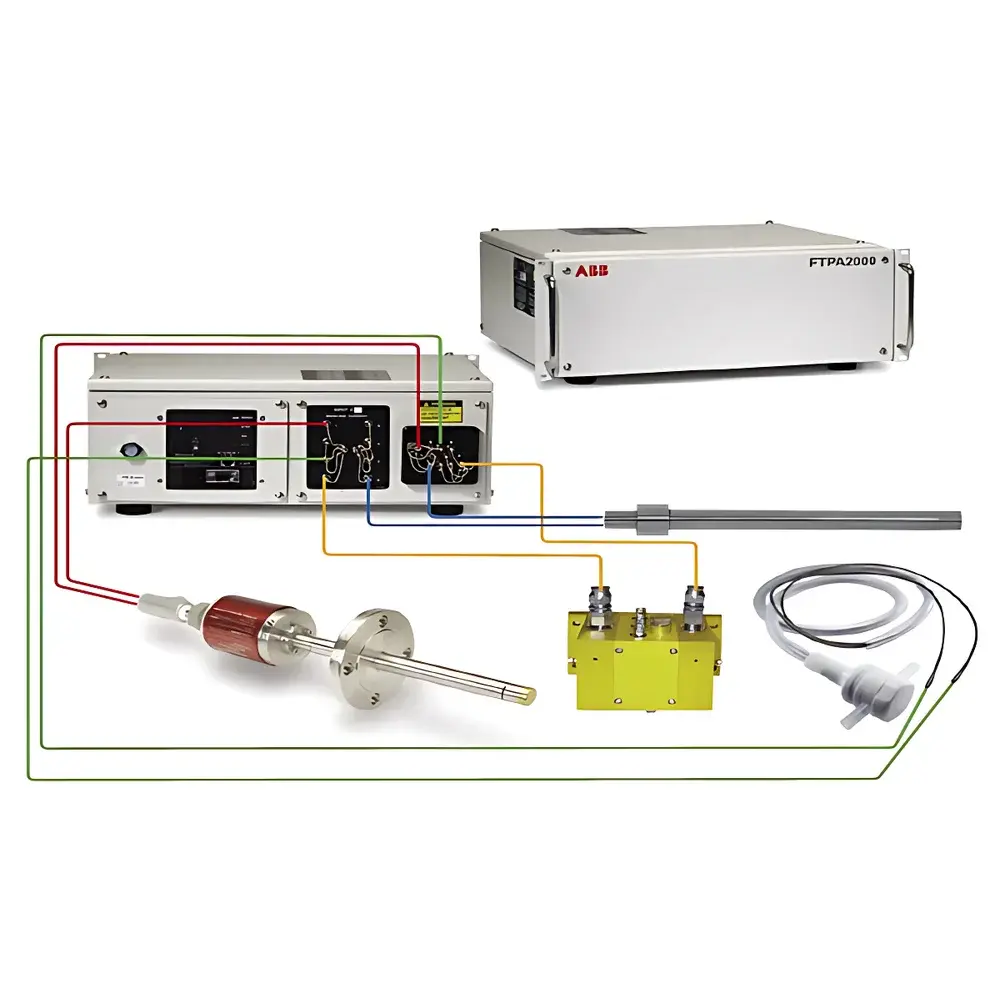
ABB FTPA2000-260 Multi-Channel Online Fourier Transform Near-Infrared (FT-NIR) Analyzer
| Brand | ABB |
|---|---|
| Origin | Canada |
| Model | FTPA2000-260 |
| Type | Online Analyzer |
| Principle | Fourier Transform (FT) |
| Wavelength Range | 3800–14000 cm⁻¹ |
| Spectral Resolution | 1–128 cm⁻¹ (in 2× steps) |
| Optical Path Difference (OPD) Scan Speed | 1 cm/s |
| Wavenumber Repeatability | 0.002 cm⁻¹ RMS @ 7300 cm⁻¹ |
| Wavenumber Reproducibility | 0.04 cm⁻¹ RMS @ 7300 cm⁻¹ |
| Absorbance Linearity Error | ≤0.1% of peak response |
| SNR (1 scan, 16 cm⁻¹, room-temp InGaAs) | ≥15,000:1 (29 µabs @ 0 abs) |
| Sampling Modes | Transmission / Diffuse Reflectance / Transflectance |
| Detector Options | Thermoelectrically Cooled InAs or InGaAs |
| Channel Count | 8 independent optical channels (8-in/8-out) |
| Fiber Interface | SMA-905 |
| Fiber Types | Low-OH silica core (300–600 µm), multi-fiber bundle (650 µm, NA 0.22–0.28) |
| Max Fiber Length | 100 m (solids), 300 m (liquids) |
| Software | Horizon MB, FTSW100 |
| Compliance | FDA 21 CFR Part 11, GMP/GLP-ready, OPC, Modbus TCP |
Overview
The ABB FTPA2000-260 is a high-performance, multi-channel online Fourier Transform Near-Infrared (FT-NIR) analyzer engineered for continuous, real-time compositional monitoring in demanding industrial process environments. Based on a permanently aligned, dual-axis Michelson interferometer (U.S. Patent No. 4,383,762), the system delivers exceptional long-term spectral stability—eliminating the need for routine optical recalibration even after maintenance or component replacement. Its core measurement principle relies on interferometric acquisition of broadband NIR spectra (3800–14000 cm⁻¹), followed by fast Fourier transformation to yield high-fidelity absorbance spectra with wavenumber repeatability of ±0.002 cm⁻¹ RMS and reproducibility of ±0.04 cm⁻¹ RMS at 7300 cm⁻¹. Designed explicitly for unattended, 24/7 operation in refinery, chemical, pharmaceutical, and semiconductor manufacturing settings, the FTPA2000-260 supports Process Analytical Technology (PAT) frameworks and integrates seamlessly into distributed control systems (DCS) without requiring custom PLC programming.
Key Features
- Eight fully independent optical channels (8-in/8-out) with electronic channel switching—no moving parts, eliminating mechanical wear and ensuring 100% spectral reproducibility per channel.
- Modular detector architecture: Each channel supports selection from thermoelectrically cooled InAs, extended-range InGaAs, or ambient-temperature InGaAs detectors—optimized for sensitivity, spectral range, and thermal stability per application.
- Remote fiber-optic sampling via low-OH silica fibers (300–600 µm core or 650 µm multi-fiber bundles), enabling installation up to 300 meters from hazardous process zones while maintaining signal integrity.
- High-fidelity spectral performance: ≥15,000:1 SNR (single-scan, 16 cm⁻¹ resolution, extended InGaAs), <0.1% absorbance nonlinearity, and temperature coefficient of <2%/°C across 4000–10000 cm⁻¹.
- Permanently aligned interferometer with BK7 beam splitter—designed for zero-drift operation under ambient temperature fluctuations and vibration-prone plant conditions.
- Full model transfer capability: Quantitative calibration models are instrument-transferable across FTPA2000-260 units with negligible absorbance deviation (<0.001 AU), enabled by laser-stabilized spectral encoding and precision manufacturing.
Sample Compatibility & Compliance
The FTPA2000-260 accommodates diverse sample forms—including liquids, slurries, powders, and solids—via interchangeable fiber-optic probes (reflectance, transflectance, immersion) and flow cells compatible with both ABB and third-party accessories. Its modular optical interface (SMA-905) supports rapid reconfiguration for multi-stream monitoring in batch or continuous processes. The system complies with critical regulatory requirements for regulated industries: software validation support for FDA 21 CFR Part 11 (audit trail, electronic signatures, role-based access), alignment with ICH Q5/Q7 and USP for PAT implementation, and adherence to ASTM E1655 (standard practices for NIR quantitative analysis) and ISO 12099 (animal feed analysis). All hardware components meet IP65-rated enclosure standards for industrial deployment.
Software & Data Management
FTSW100 is a modular, Windows-based process analytics platform built for mission-critical industrial applications. It provides full instrument control, multivariate calibration management (PLS, PCR, PCA), real-time spectral visualization, alarm handling, and automated report generation. Horizon MB serves as the dedicated chemometrics workbench for method development, validation, and transfer—supporting cross-instrument model portability and robustness testing per ASTM E1655 guidelines. FTSW100 implements hierarchical security (multi-level password protection, session timeouts, granular user permissions) and maintains full audit trails compliant with GLP/GMP documentation standards. Communication protocols include native OPC UA, Modbus TCP (fully addressable register mapping), and DDE—enabling direct integration with DeltaV, Emerson DeltaV, Honeywell Experion, and Siemens PCS7 systems without middleware.
Applications
The FTPA2000-260 is deployed globally for closed-loop process control and quality assurance across multiple sectors. In petroleum refining, it monitors hydrocarbon composition (e.g., octane number, benzene content, sulfur species) in real time during FCC, hydrotreating, and blending operations. In fine chemical synthesis, it tracks reaction endpoints (e.g., esterification, amidation) and quantifies residual solvents (e.g., methanol, THF, DMF) in API streams. Within biopharmaceutical manufacturing, it supports upstream (cell culture viability, glucose/lactate) and downstream (protein concentration, aggregate formation) monitoring per ICH Q5 and Q7. Semiconductor-grade chemical suppliers use it for ultra-trace moisture and metal impurity detection in etchants and photoresist solvents—leveraging its sub-ppm detection capability in transmission mode with high-pathlength flow cells.
FAQ
What is the maximum allowable fiber length between the analyzer and the sampling point?
For liquid samples, up to 300 meters using 650 µm multi-fiber bundles; for solid or powder interfaces, up to 100 meters using 300–600 µm low-OH silica fibers. Spectral cutoff shifts with length—e.g., 10 m fiber preserves full 14000–4750 cm⁻¹ range.
Can calibration models developed on one FTPA2000-260 be deployed directly on another unit?
Yes. ABB guarantees model transferability across instruments due to laser-encoded spectral referencing and sub-0.001 AU inter-unit absorbance consistency—no revalidation required under identical optical configuration.
Does FTSW100 support integration with legacy DCS platforms?
Yes. Native Modbus TCP and OPC UA drivers enable plug-and-play connectivity with Emerson DeltaV, Honeywell Experion, Yokogawa CENTUM VP, and Siemens PCS7—no custom driver development or gateway hardware needed.
Is the interferometer sensitive to environmental vibration or temperature drift?
No. The dual-axis, permanently aligned interferometer exhibits <0.04 cm⁻¹ wavenumber reproducibility over 24-hour cycles at ±5°C ambient fluctuation—validated per ASTM E1421 for industrial FT instrumentation.
What detector options are available for low-light or high-resolution applications?
Thermoelectrically cooled InAs (for 10000–14000 cm⁻¹), extended InGaAs (3800–10000 cm⁻¹), and standard InGaAs (5000–10000 cm⁻¹) can be mixed across the eight channels—each independently selectable and optimized for SNR and dynamic range.



