
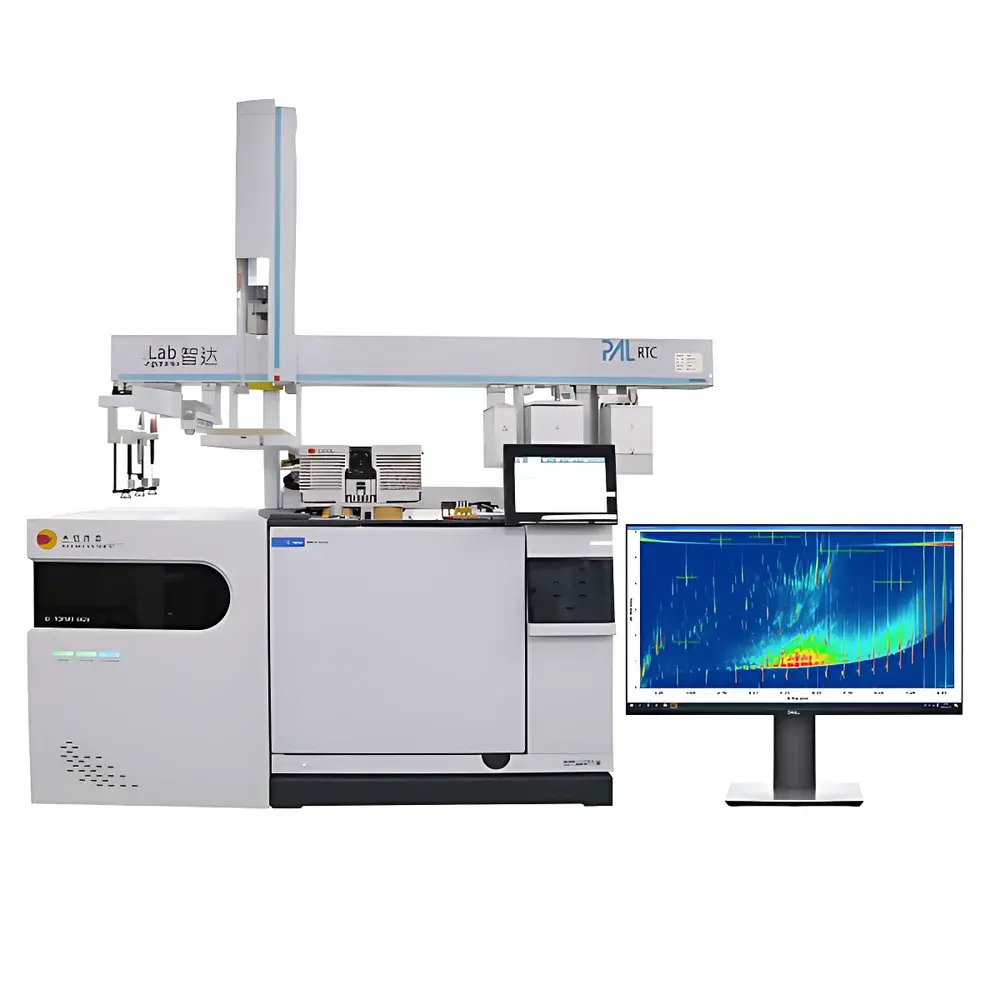
HEXIN GGT 0620 Comprehensive Two-Dimensional Gas Chromatography Time-of-Flight Mass Spectrometer
| Brand | HEXIN Mass Spectrometry |
|---|---|
| Origin | Guangdong, China |
| Manufacturer Type | Authorized Distributor |
| Instrument Type | Time-of-Flight Mass Spectrometer (TOF-MS) |
| GC Configuration | Comprehensive 2D Gas Chromatography (GC×GC) |
| Model | GGT 0620 |
| Mass Range | Available upon request |
| Resolution | Available upon request |
| Sensitivity | Available upon request |
| Scan Speed | Up to 500 spectra/sec |
| Mass Accuracy | Available upon request |
| Oven Ramp Rate | Available upon request |
| Detector | Microchannel Plate (MCP)-based TOF detector |
| Pressure Control Precision | Available upon request |
Overview
The HEXIN GGT 0620 is a high-performance comprehensive two-dimensional gas chromatography time-of-flight mass spectrometry (GC×GC-TOFMS) system engineered for deep molecular characterization of highly complex mixtures. It integrates a dual-column modulation architecture with a high-speed, high-fidelity time-of-flight mass analyzer to deliver exceptional peak capacity, spectral fidelity, and quantitative reproducibility. Unlike conventional one-dimensional GC-MS, the GGT 0620 leverages cryogen-free solid-state thermal modulation—eliminating liquid nitrogen or CO₂ dependency—to achieve robust, field-deployable operation without compromising chromatographic orthogonality. Its core measurement principle relies on orthogonal separation in GC×GC (first dimension: low-polarity column; second dimension: short, high-polarity column), followed by full-spectrum acquisition at up to 500 Hz, enabling complete capture of narrow elution bands (<100 ms) and accurate deconvolution of co-eluting compounds. This architecture is particularly suited for untargeted analysis where compound identification, class separation (e.g., alkanes vs. aromatics vs. oxygenates), and trace-level quantification must be achieved simultaneously under stringent regulatory or research-grade requirements.
Key Features
- Solid-state thermal modulator: No cryogens required; compact footprint; stable modulation efficiency across ambient temperature ranges (15–35 °C); suitable for mobile labs and continuous online monitoring.
- High-speed TOFMS acquisition: Full mass spectra acquired at ≤2 ms dwell time, supporting real-time spectral reconstruction and retention time alignment across GC×GC peaks.
- Integrated control architecture: Unified software platform synchronizes GC oven programming, modulator timing, TOF voltage ramping, and data acquisition—no manual switching between modules.
- Dual ionization capability: Optional hybrid electron ionization/soft photoionization (EI/SPI) source enables complementary fragmentation patterns for confident structural elucidation of unknowns.
- Modular configuration support: Configurable for offline lab analysis, semi-automated headspace/SPME workflows, or permanent installation in atmospheric VOCs or water-quality monitoring stations.
Sample Compatibility & Compliance
The GGT 0620 accommodates diverse sample introduction methods—including direct injection, split/splitless, thermal desorption (TD), solid-phase microextraction (SPME), and purge-and-trap—enabling analysis of volatile and semi-volatile organic compounds (VOCs/SVOCs) across environmental, clinical, petrochemical, food, and pharmaceutical matrices. It supports compliance-critical workflows aligned with ASTM D6348 (gaseous emissions), EPA Method TO-15/TO-17 (ambient air), ISO 16000-6 (indoor air), and USP (method validation). Data integrity is maintained through audit-trail-enabled software adhering to FDA 21 CFR Part 11 principles, including electronic signatures, user role-based access control, and immutable raw data archiving. System suitability testing (SST) protocols are embedded for routine verification of modulation stability, mass calibration drift, and peak shape fidelity per GLP/GMP laboratory standards.
Software & Data Management
The proprietary GGT Workstation provides end-to-end workflow automation—from method setup and instrument control to spectral deconvolution, compound identification, and statistical reporting. Its chemometric engine performs automated peak detection using retention time correlation across both dimensions, followed by library matching against NIST, Wiley, and custom-built spectral libraries. Advanced features include class-based annotation (e.g., “C9–C12 alkylbenzenes”), hierarchical clustering of sample groups, PCA and PLS-DA modeling for biomarker discovery, and batch processing of >100 samples with QC flagging. All raw data (.cdf/.d) and processed results are stored in vendor-neutral formats compatible with third-party platforms such as Compound Discoverer, SIMCA, and R-based metabolomics pipelines. Data export supports CSV, mzML, and ANDI-NetCDF for long-term interoperability and regulatory submission.
Applications
The GGT 0620 delivers decisive analytical advantage in domains where compositional complexity exceeds the resolving power of 1D-GC-MS. In environmental science, it resolves isomeric POPs (e.g., PCB congeners from mono- to decachlorinated), quantifies speciated VOC profiles in urban air plumes, and characterizes oxidation products in secondary organic aerosol (SOA) formation studies. In petroleum analysis, it achieves true hydrocarbon class separation (paraffins, naphthenes, aromatics, heteroatom-containing species) in crude oils and refined fuels—supporting ASTM D7169 and IP 548 methodologies. For food authenticity and flavor chemistry, it discriminates geographic origin markers in citrus oils, detects adulterants in essential oils, and maps dynamic volatile release during fermentation or roasting. In clinical metabolomics, it identifies breath-borne biomarkers and urinary SVOC signatures linked to exposure or disease state, with demonstrated utility in smoking status differentiation and herbal medicine quality assessment.
FAQ
Does the GGT 0620 support regulatory-compliant reporting for environmental laboratories?
Yes—the system includes preconfigured reporting templates compliant with EPA, ISO, and EU EN standards, along with full audit trail functionality meeting GLP and 21 CFR Part 11 requirements.
Can the solid-state modulator operate reliably outside controlled laboratory environments?
Yes—it maintains consistent modulation performance across ambient temperatures from 15 °C to 35 °C and has been validated in vehicle-mounted and outdoor monitoring deployments.
Is method transfer possible from existing 1D-GC-MS workflows?
Yes—retention index calibration and spectral library search parameters are fully compatible with legacy GC-MS databases; migration paths include retention time mapping and 2D peak table alignment tools.
What data formats are supported for integration with enterprise LIMS or statistical analysis platforms?
Raw data exports in netCDF and mzML; processed results in CSV, Excel, and XML; API access available for custom LIMS integration via RESTful endpoints.
How is mass calibration stability maintained during extended unattended runs?
An internal lock-mass reference channel operates continuously during acquisition, correcting for mass drift in real time with sub-ppm accuracy over 24-hour sequences.
Related Products





