
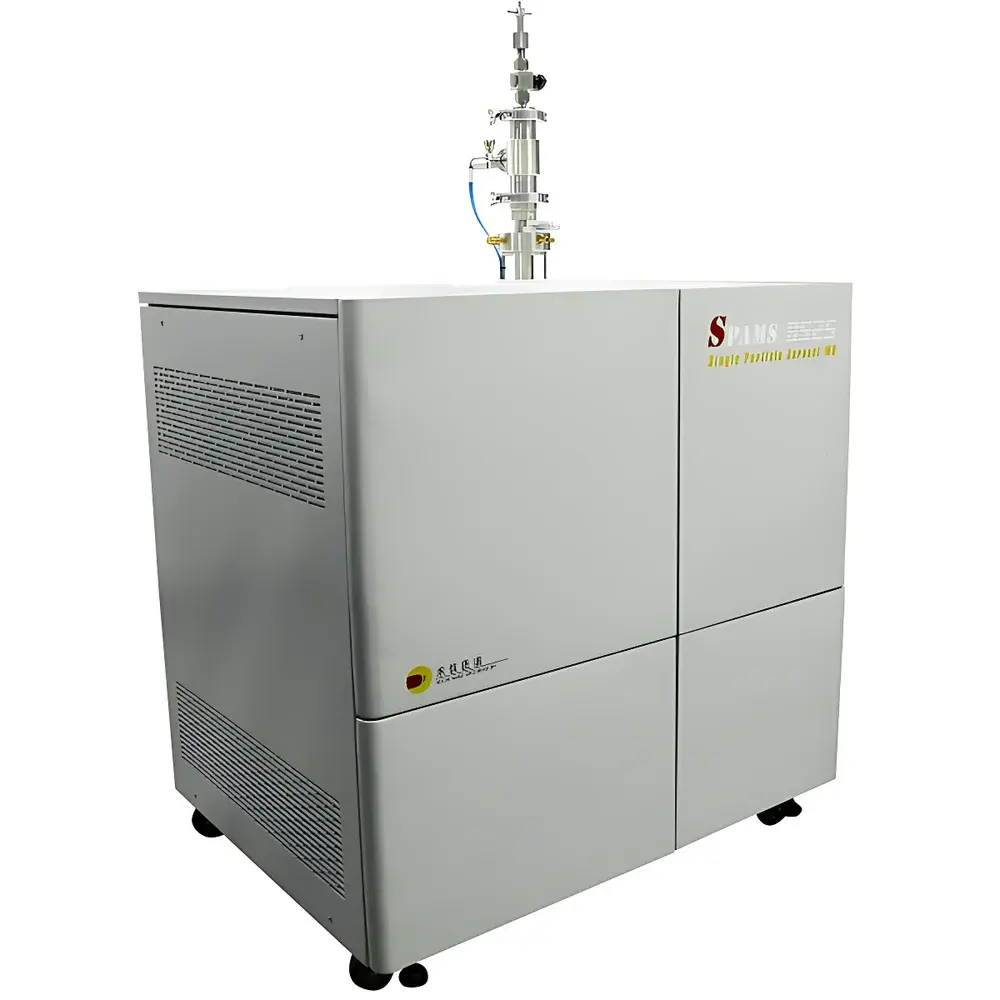
HEXIN SPAMS 05 Series Aerosol Time-of-Flight Mass Spectrometer for Real-Time PM2.5 Source Apportionment
| Brand | HEXIN MASS SPECTROMETRY |
|---|---|
| Origin | Guangdong, China |
| Manufacturer Type | Authorized Distributor |
| Product Origin | Domestic (China) |
| Model | SPAMS 05 Series |
| Pricing | Upon Request |
Overview
The HEXIN SPAMS 05 Series is a fully integrated, real-time aerosol time-of-flight mass spectrometer engineered for high-resolution, single-particle chemical and size characterization of ambient PM2.5. Based on dual-laser single-particle aerosol time-of-flight mass spectrometry (SP-ATOFMS), the system simultaneously measures aerodynamic diameter (0.2–5000 nm) and bipolar time-of-flight mass spectra (m/z 1–1000) for each individual particle—without sample collection, extraction, or offline derivatization. This enables continuous, unattended operation with 1-hour temporal resolution for source apportionment, supporting regulatory decision-making under evolving air quality management frameworks including China’s Action Plan on Prevention and Control of Air Pollution and international best practices aligned with WHO Air Quality Guidelines. The instrument operates across extreme environments—from polar research stations (Arctic and Antarctic) to high-altitude monitoring sites (>4500 m ASL) and marine platforms—demonstrating robust thermal, mechanical, and electromagnetic stability.
Key Features
- Real-time dual-laser ionization: 266 nm Nd:YAG laser for desorption/ionization + 193 nm ArF excimer laser for secondary ion enhancement, enabling detection of refractory and semi-volatile species (e.g., black carbon, metal oxides, organosulfates)
- High mass resolving power: ≥1000 FWHM at m/z 200, sufficient to resolve isobaric interferences (e.g., 40Ca+ vs. 40Ar+, NO2− vs. CNO−) critical for tracer-based source identification
- Extended particle sizing range: 0.2–5000 nm aerodynamic diameter via dual-stage aerodynamic lens and precise time-lag acceleration
- Enhanced dynamic range: 5× improvement over prior generations, enabling quantitative capture of both trace organic markers (e.g., levoglucosan, adipic acid) and dominant inorganic peaks (e.g., Na+, NH4+, SO42−) within a single acquisition
- Modular platform architecture: SPAMS 0515 (benchtop laboratory), SPAMS 0525 (mobile-optimized with active vibration isolation for vehicle/ship mounting), and SPAMS 0535 (enhanced sensitivity/resolution configuration for advanced research)
Sample Compatibility & Compliance
The SPAMS 05 Series accepts ambient air directly at standard flow rates (0.3–1.5 L/min), requiring no filter substrates, solvents, or calibration standards during routine operation. It complies with ISO 21501-4:2018 for aerosol particle sizing instrumentation and supports GLP-aligned data integrity through hardware-enforced audit trails. Raw spectral and sizing data are stored in vendor-neutral HDF5 format, compatible with third-party chemometric tools (e.g., Python-based PySPAMS, MATLAB PLS Toolbox). The system meets requirements for regulatory-grade monitoring under China’s HJ 653–2013 technical specification for PM2.5 source apportionment and supports retrospective reprocessing for method validation per US EPA Guidance for PM Source Apportionment (EPA/600/R-15/117).
Software & Data Management
The SPAMS Data Processing Suite includes three core modules: (1) Real-time spectral classification using unsupervised machine learning (k-means++ clustering with silhouette optimization); (2) “Fingerprint” matching against the HEXIN China Source Library—a continuously updated, peer-reviewed spectral reference database containing >12,000 particle spectra from 37 emission categories (e.g., coal combustion, biomass burning, vehicular exhaust, crustal dust); and (3) Time-resolved source contribution quantification via positive matrix factorization (PMF) with uncertainty estimation. All software modules generate 21 CFR Part 11–compliant electronic records, including user authentication logs, parameter change history, and version-controlled spectral libraries.
Applications
- Emergency response during haze episodes: Hourly source contribution updates enable rapid attribution of transient pollution spikes (e.g., fireworks events, agricultural burning) and evaluation of emergency control measure efficacy
- Fine-scale source differentiation: Resolves sub-categories within broad source types—e.g., distinguishing residential coal vs. industrial coal combustion via K+/Cl−/Zn+ ratio patterns
- Anomalous site investigation: Integrates with meteorological data (wind direction, boundary layer height) and gas-phase measurements (O3, NOx, SO2) to localize emission hotspots using conditional probability function (CPF) analysis
- Policy impact assessment: Quantifies year-on-year changes in source contributions following implementation of clean energy policies or traffic restriction schemes
- Major event support: Deployed for air quality assurance during the Beijing 2008 Olympics, Shanghai Expo 2010, Guangzhou Asian Games 2010, and Hangzhou G20 Summit 2016
FAQ
What particle size range does the SPAMS 05 Series cover?
It measures aerodynamic diameters from 0.2 nm to 5000 nm, with optimal sensitivity between 0.3–2000 nm.
Is the system compliant with international data integrity standards?
Yes—it supports 21 CFR Part 11 compliance through role-based access control, electronic signatures, and immutable audit trails for all processing steps.
Can the instrument operate unattended in remote locations?
Yes—designed for continuous operation at −25°C to +50°C ambient temperature, with optional solar-powered configurations for off-grid deployment.
How frequently is the source library updated?
The HEXIN China Source Library undergoes biannual expert review and expansion, incorporating new field-collected spectra and inter-laboratory validation results.
Does the system require consumables or routine recalibration?
No consumables are required; mass calibration is performed automatically every 2 hours using internal reference ions (e.g., N2+, O2+), with drift correction validated against certified aerosol standards (NIST SRM 1963).
Related Products





