
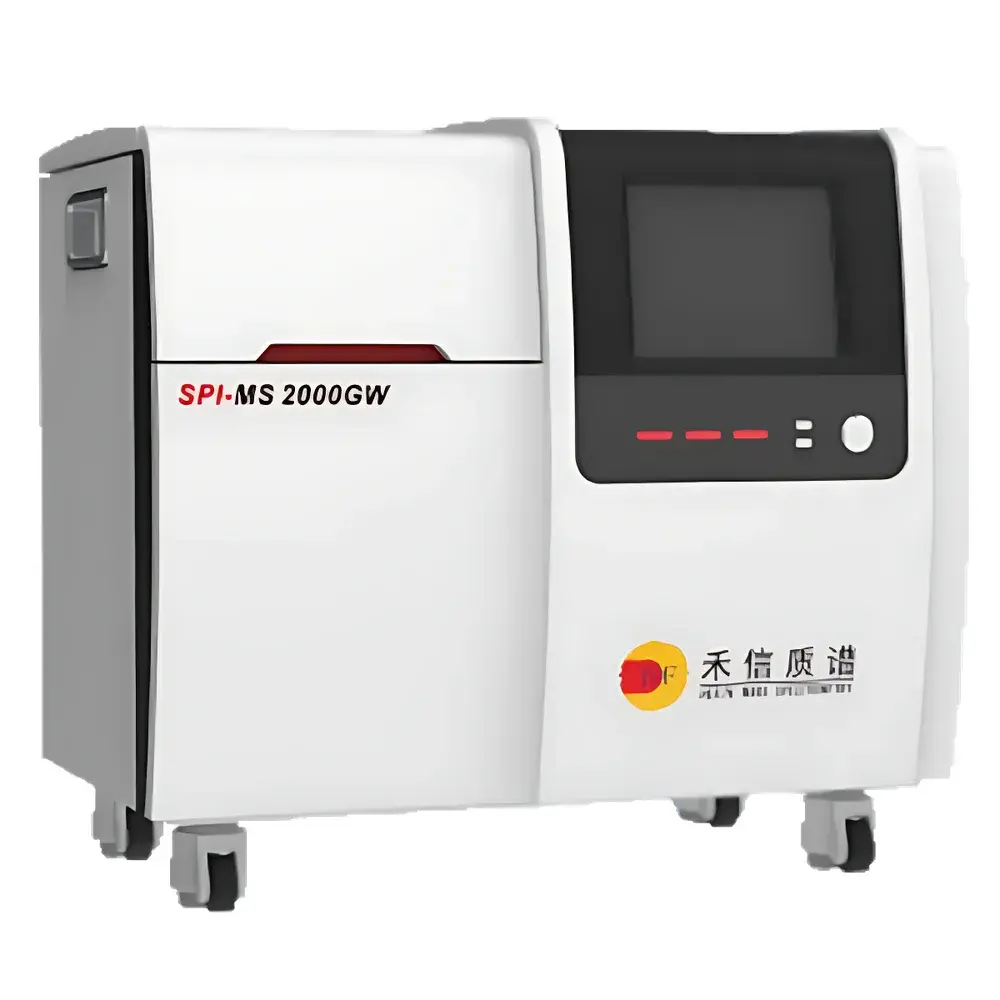
SPI-MS 2000GW Water-and-Air Dual-Mode VOCs Monitoring System by Hexin Mass Spectrometry
| Brand | Hexin Mass Spectrometry |
|---|---|
| Origin | Guangdong, China |
| Model | SPI-MS 2000GW |
| Application Mode | Switchable Gas/Liquid Sampling (Sub-second Transition) |
| Detection Principle | Soft Ionization Time-of-Flight Mass Spectrometry (SPI-TOFMS) |
| Regulatory Context | Designed for EPA Method TO-15/TO-17–compatible workflows and ISO 14644-8 environmental monitoring frameworks |
| Compliance Support | Audit-ready data logging aligned with GLP/GMP traceability requirements |
| Deployment | Mobile platform–integrated or fixed-site installation |
Overview
The SPI-MS 2000GW is a dual-mode volatile organic compounds (VOCs) monitoring system engineered for concurrent, field-deployable analysis of gaseous and aqueous environmental matrices. Unlike conventional single-phase analyzers requiring separate instrumentation for air and water sampling, this system integrates a proprietary soft photoionization (SPI) source with high-resolution time-of-flight mass spectrometry (TOFMS) to enable sub-second mode switching between gas-phase and liquid-phase introduction pathways. The core analytical architecture leverages vacuum ultraviolet (VUV) photon energy (typically 10.0–10.6 eV) to selectively ionize VOCs—including benzene, toluene, ethylbenzene, xylenes (BTEX), chlorinated solvents, aldehydes, and low-molecular-weight hydrocarbons—while minimizing fragmentation and preserving molecular ion integrity. This facilitates unambiguous compound identification and quantification without derivatization or pre-concentration in most operational configurations. The system is purpose-built for real-time, mobile environmental surveillance: it supports vehicle-mounted deployment for atmospheric mapping (e.g., fence-line monitoring, industrial plume tracking) and rapid-response aquatic surveys (e.g., surface water screening, groundwater well testing, wastewater influent characterization). Its design addresses critical gaps in regulatory environmental monitoring—particularly where dynamic source attribution, spatial-temporal trend analysis, and cross-media contamination linkage are required.
Key Features
- Sub-second dual-mode switching: Seamless transition between ambient air sampling (via heated permeation tube or direct draw) and aqueous sample introduction (via membrane inlet or purge-and-trap interface) without hardware reconfiguration.
- High-sensitivity SPI-TOFMS detection: Mass resolution >3,000 (FWHM), mass accuracy <3 ppm, and detection limits ranging from 0.1–5 pptv (gas) and 0.5–10 ng/L (water), depending on compound volatility and matrix interference.
- Real-time spectral acquisition: Continuous full-spectrum acquisition at 10 Hz, enabling second-scale temporal resolution for transient emission events or rapid mixing zone profiling.
- Ruggedized field architecture: IP54-rated enclosure, -10°C to 45°C operating temperature range, shock/vibration resistance certified per MIL-STD-810G for mobile deployment.
- Onboard compound library: Preloaded spectral database containing >350 VOCs compliant with EPA CompTox Chemicals Dashboard nomenclature and CAS registry alignment.
- Integrated GPS and IMU: Georeferenced data tagging with 1-meter positional accuracy and inertial motion compensation for moving-platform measurements.
Sample Compatibility & Compliance
The SPI-MS 2000GW accommodates a broad range of environmental sample types without modification: ambient air (including humid or particulate-laden streams), surface water, groundwater, treated effluent, and leachate. For aqueous analysis, the system employs a hydrophobic microporous membrane interface that permits selective VOC transfer while rejecting salts, colloids, and dissolved organic carbon—eliminating need for filtration or pH adjustment. In gas mode, it meets ISO 16000-6:2011 criteria for indoor air VOC measurement and supports method adaptation for EPA Method TO-15 (canister-based) and TO-17 (sorbent tube) validation protocols. All raw spectral data, calibration logs, instrument parameters, and operator annotations are timestamped and stored in HDF5 format, ensuring compliance with 21 CFR Part 11 electronic record integrity requirements when configured with user authentication and audit trail modules.
Software & Data Management
The embedded acquisition and analysis suite—Hexin VOCView v3.2—provides synchronized visualization of concentration heatmaps, time-series chromatograms, and mass spectral deconvolution. It supports automated peak detection using adaptive noise-thresholding algorithms and enables comparative spectral matching against NIST MS Search, Wiley Registry, and custom reference libraries. Data export options include CSV, NetCDF, and mzML for third-party processing (e.g., R packages xcms, CAMERA; Python libraries pyOpenMS, MZmine2). Remote access is enabled via TLS-secured web interface, permitting centralized fleet management across distributed monitoring networks. All data handling adheres to ISO/IEC 27001-aligned cybersecurity practices, including encrypted local storage and role-based permission controls.
Applications
- Mobile atmospheric VOC mapping: Real-time 3D plume reconstruction during industrial incident response or routine perimeter monitoring.
- Watershed-scale contamination assessment: Rapid identification of petroleum hydrocarbon intrusion, chlorinated solvent plumes, or pesticide runoff in rivers and reservoirs.
- Regulatory compliance verification: Supporting national surface water quality standards (e.g., China’s GB 3838-2002, EU WFD Annex V) through quantitative multi-analyte reporting.
- Source apportionment studies: Coupling with positive matrix factorization (PMF) modeling for receptor-oriented pollution origin analysis.
- Early-warning system integration: Feeding real-time concentration thresholds into SCADA platforms for automatic alert generation at municipal water intakes or industrial discharge points.
FAQ
Does the SPI-MS 2000GW require external calibration gases or standard solutions for routine operation?
No—built-in internal calibration introduces perfluorotributylamine (PFTBA) vapor at defined intervals to maintain mass axis stability and sensitivity drift correction. External standards are only required during initial method validation or regulatory audit preparation.
Can the system quantify VOCs in turbid or high-salinity water samples?
Yes—the membrane inlet system is chemically inert and physically excludes suspended solids and ions; validation data demonstrate consistent recovery (>92%) for BTEX and chloroform in seawater (35 ppt salinity) and sediment-pore water (NTU >200).
Is remote software update supported?
Yes—over-the-air firmware and library updates are delivered via authenticated HTTPS channels with SHA-256 signature verification and rollback capability.
What level of technical support is provided for method development?
Hexin offers application-specific protocol development services, including matrix-matched calibration curve generation, interferences assessment, and EPA-compliant validation documentation (precision, accuracy, LOD/LOQ, robustness).







