
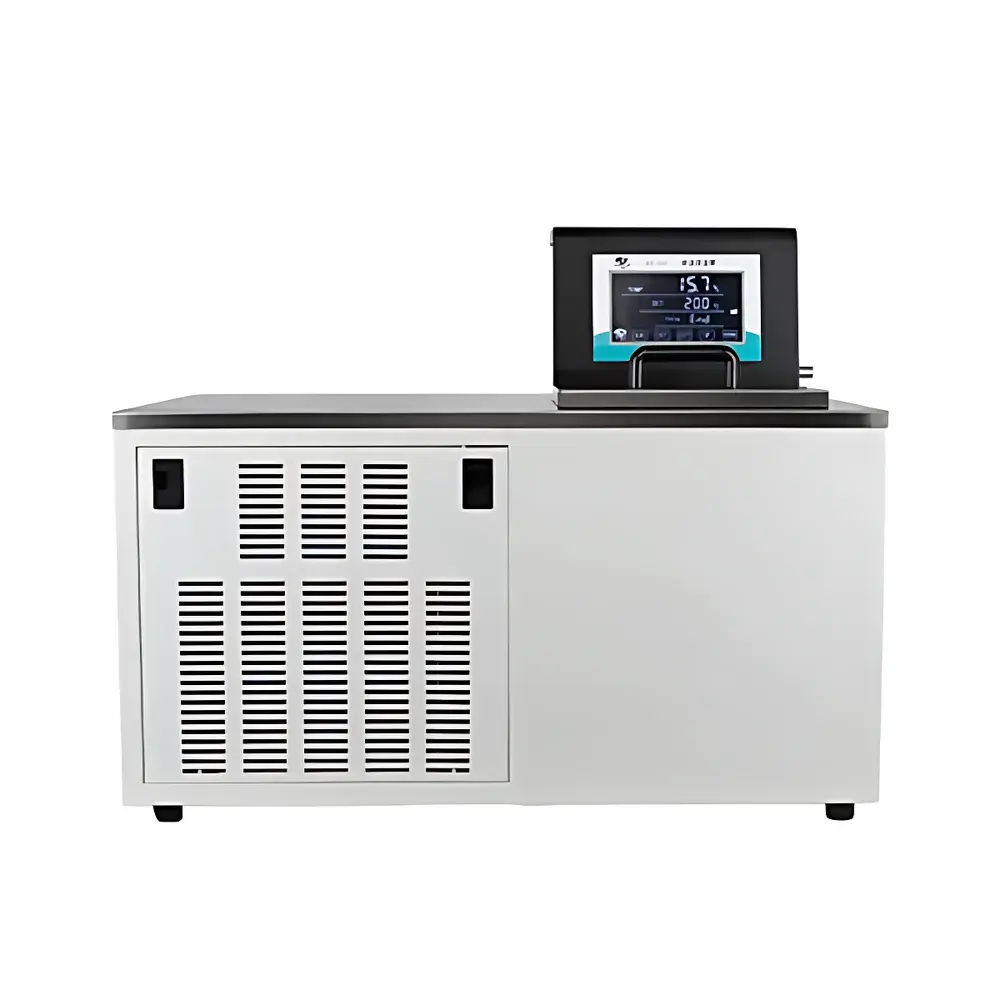
Ningbo Scientz DCW-4006 Low-Temperature Circulating Chiller/Heater
| Brand | Ningbo Scientz |
|---|---|
| Origin | Zhejiang, China |
| Manufacturer Type | Direct Manufacturer |
| Instrument Category | Liquid Bath Circulator (Water/Oil) |
| Model | DCW-4006 |
| Temperature Range | −40 °C to +100 °C |
| Temperature Stability | ±0.1 °C |
| Bath Dimensions (L×W×H) | 260 × 200 × 140 mm |
| Circulation Mode | Internal & External Dual-Circulation |
| Control System | Microprocessor-Based PID with 7″ Touchscreen Interface |
| Refrigerant | Environmentally Compliant HFC Blend |
| Compressor | Secop (Germany) Hermetic Scroll Compressor |
| Safety Protections | Compressor Overheat & Overload Protection, Dry-Run Prevention, Auto-Recovery After Power Interruption |
| Pump Flow Rate | Adjustable (0–20 L/min), Max Head: 8 m |
| External Load Compatibility | Yes (via dual-port fluid interface) |
Overview
The Ningbo Scientz DCW-4006 is a high-precision, dual-mode circulating chiller/heater engineered for laboratory environments requiring stable thermal control across an extended temperature range (−40 °C to +100 °C). Unlike conventional water baths limited to heating-only operation, the DCW-4006 integrates a closed-loop refrigeration system with electric heating elements, enabling seamless transition between active cooling and heating without manual intervention. Its core function relies on forced convection via a variable-speed centrifugal pump, delivering thermally uniform liquid media—water, ethanol-water mixtures, silicone oil, or other compatible heat-transfer fluids—to both internal bath chambers and external experimental apparatuses. The unit employs a Secop (Germany) hermetic scroll compressor, known for low vibration, high efficiency, and long-term reliability in continuous-duty scientific applications. Temperature regulation is achieved through a microprocessor-driven PID algorithm with real-time adaptive tuning, ensuring minimal overshoot and rapid stabilization within ±0.1 °C under steady-state conditions.
Key Features
- 7-inch angled capacitive touchscreen interface with intuitive icon-based navigation, supporting simultaneous display of setpoint, actual bath temperature, elapsed time, pump speed, and system status.
- Dual-circulation architecture: switchable internal recirculation (for bath homogeneity) and external circulation (for remote temperature control of rotary evaporators, condensers, reactors, or analytical instruments).
- Adjustable flow rate (0–20 L/min) with pressure head up to 8 meters, accommodating diverse tubing configurations and thermal loads.
- Programmable timer function: automatic shutdown upon reaching user-defined duration; optional auto-restart or standby mode following power restoration.
- Environmentally compliant refrigerant (HFC blend meeting current EU F-Gas Regulation Annex I criteria), eliminating ozone-depleting substances and reducing global warming potential relative to legacy R22 or R134a systems.
- Comprehensive safety suite: compressor thermal overload protection, motor phase-loss detection, low-level fluid sensor, dry-run prevention, and overtemperature cut-off independent of main controller.
Sample Compatibility & Compliance
The DCW-4006 supports a wide range of heat-transfer media—including deionized water, 30% ethylene glycol/water solutions (for sub-zero operation), and silicone oils up to 100 cSt viscosity—enabling compatibility with cryogenic reaction setups, high-temperature synthesis, and sensitive biological sample conditioning. Its construction adheres to IEC 61010-1:2010 for electrical safety in laboratory equipment and incorporates CE marking per Machinery Directive 2006/42/EC. While not certified for medical device manufacturing, the unit meets general requirements for GLP-compliant laboratories when integrated into validated temperature-control workflows. Traceable calibration records (NIST-traceable reference sensors available upon request) support ISO/IEC 17025 documentation needs.
Software & Data Management
The DCW-4006 operates autonomously via embedded firmware with no PC dependency. All operational parameters—including temperature setpoints, ramp rates, hold times, pump speeds, and alarm thresholds—are stored in non-volatile memory and retained during power loss. While it does not feature native USB/Ethernet connectivity or cloud integration, analog 0–10 V and 4–20 mA process output signals are provided for integration into centralized SCADA or LIMS environments. Optional RS485 Modbus RTU interface (add-on module) enables remote monitoring and parameter adjustment via third-party lab automation software. Audit trail functionality is implemented at the hardware level: all critical events (e.g., temperature excursions >±0.3 °C, compressor fault, low-fluid alert) are timestamped and logged internally for up to 30 days.
Applications
- Condenser cooling for rotary evaporation systems, maintaining consistent solvent recovery efficiency across volatile compound isolation protocols.
- Temperature control of non-contact ultrasonic disruptors used in cell lysis, nanoparticle dispersion, and tissue homogenization—preventing thermal degradation of labile biomolecules.
- Thermal management of semiconductor test fixtures and electronic component burn-in stations requiring precise thermal cycling profiles.
- Calibration of thermocouples, RTDs, infrared thermometers, and thermal imaging systems against traceable reference standards.
- Controlled-rate freezing and thawing in biobanking workflows, particularly for cryopreservation media validation and viability assays.
- Viscometry and rheometry sample conditioning where bath-induced thermal gradients must remain below ±0.05 °C across measurement intervals.
FAQ
What is the maximum allowable viscosity of heat-transfer fluid for external circulation?
The pump is rated for fluids up to 100 cSt at 20 °C; higher viscosities require reduced flow rates and may affect temperature stability.
Can the DCW-4006 be used with flammable solvents such as acetone or ether?
No—only non-flammable, chemically inert heat-transfer media compliant with ASTM D1384 and ISO 20439 should be used; consult the Fluid Compatibility Matrix before operation.
Is the unit suitable for GMP-regulated environments?
It supports GMP-aligned practices (e.g., password-protected parameter locks, event logging) but requires site-specific IQ/OQ validation; no pre-certified 21 CFR Part 11 compliance package is included.
How often should the refrigerant circuit be serviced?
Under normal laboratory use (8 h/day, 5 days/week), refrigerant integrity and compressor performance should be verified annually by authorized service personnel using calibrated manifold gauges and leak detectors.
Does the external circulation port support pressurized delivery to a jacketed reactor?
Yes—the dual-port design includes one inlet and one outlet rated for continuous operation at ≤2.5 bar static pressure; dynamic pressure spikes must remain below 3.0 bar to avoid seal compromise.



