
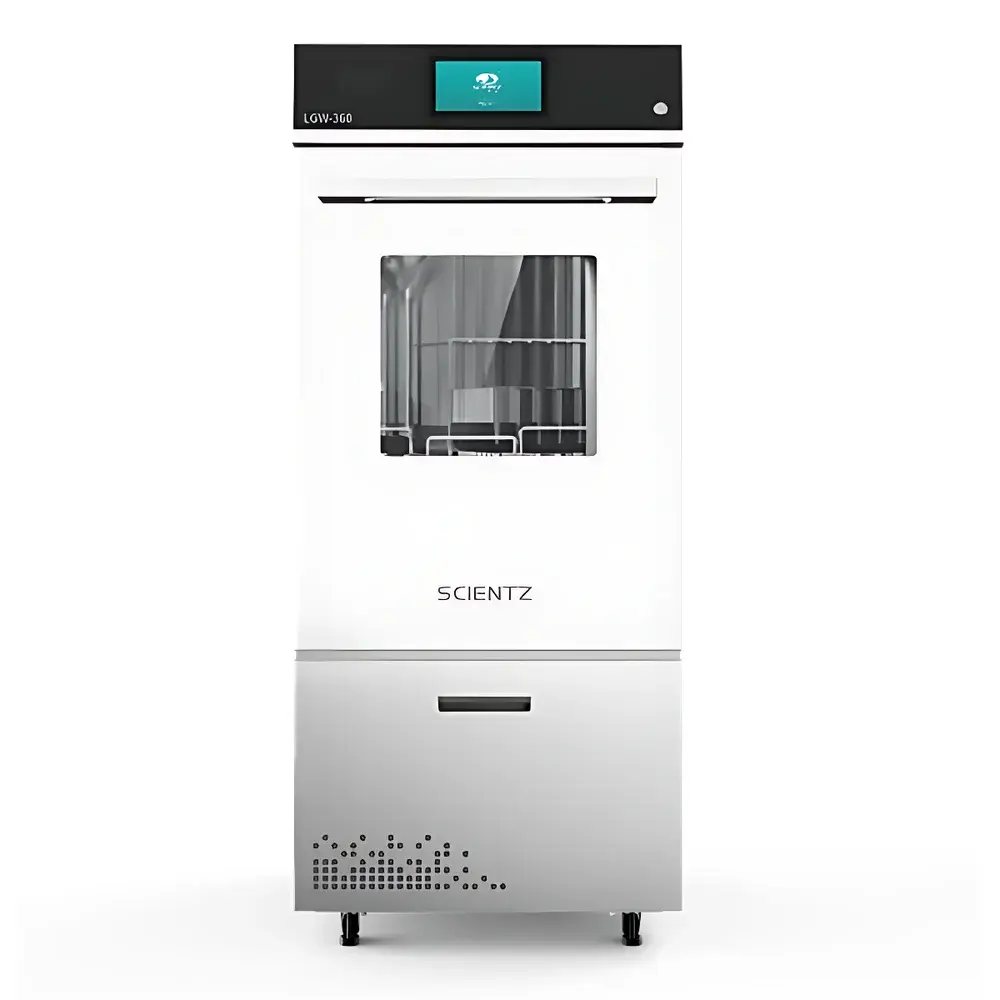
Scientz LGW-360 Laboratory Glassware Washer
| Brand | Scientz |
|---|---|
| Origin | Zhejiang, China |
| Manufacturer Type | Direct Manufacturer |
| Country of Origin | China |
| Model | LGW-360 |
| Chamber Volume | 396 L |
| Heating Power | 6 kW |
| Temperature Range | Ambient to 95°C |
| External Dimensions (L×W×D) | 710 × 933 × 1665 mm |
Overview
The Scientz LGW-360 Laboratory Glassware Washer is an integrated, fully automated cleaning, disinfection, and drying system engineered for high-reproducibility processing of laboratory glassware, plasticware, and stainless-steel vessels in regulated and research-intensive environments. It operates on the principle of dynamic spray-wash technology—using precisely controlled pressurized rinse cycles with heated aqueous solutions (tap water, softened water, or purified water) and validated detergents to remove organic, inorganic, and biological residues via combined mechanical impact (rotating spray arms and fixed nozzles), thermal energy, and chemical action. The system complies with core requirements of EN ISO 15883-1 and EN ISO 15883-2 for washer-disinfectors used in healthcare and laboratory settings, supporting thermal disinfection at ≥93°C for ≥1 minute—a condition validated to achieve ≥log₆ reduction of vegetative microorganisms per ISO 15883-2 Annex B. Designed for continuous operation in GLP, GMP, and ISO/IEC 17025-accredited laboratories, it replaces manual washing while ensuring traceable, repeatable, and auditable cleaning outcomes.
Key Features
- Stainless steel construction: 304 stainless steel exterior with anti-fingerprint finish; seamless, mirror-polished 316L stainless steel wash chamber with radius-rounded corners and self-cleaning geometry for residue-free operation and simplified validation.
- 10.1-inch capacitive LCD touchscreen interface with real-time display of cycle phase, temperature, pressure, fault codes, and audit trail status.
- 100 programmable wash protocols—fully customizable for rinse count, dwell time, temperature ramping, pump speed, and detergent dosing—enabling method-specific cleaning for volumetric flasks, culture tubes, HPLC vials, bioreactor components, and custom labware.
- Three-level password-protected access control (operator, supervisor, administrator) with full electronic audit trail compliant with FDA 21 CFR Part 11 requirements for data integrity and user accountability.
- Dual peristaltic pumps (standard), expandable to four, delivering precise, pulse-free detergent and rinse solution delivery with ±2% volumetric accuracy.
- Integrated PT100 temperature sensors (water and air), ultrasonic liquid level detection, and over-temperature cut-off safeguards ensuring process safety and regulatory compliance.
- HEPA-filtered hot-air drying system (99.99% efficiency at 0.3 µm) with filter life monitoring and visual alarm; steam condenser prevents ambient humidity rise and indoor air contamination.
- Triple-layer stainless steel filtration system with quick-release mechanism for routine maintenance; variable-frequency soft-start circulation pump minimizes mechanical stress on delicate glassware during startup.
Sample Compatibility & Compliance
The LGW-360 accommodates up to four stacked universal wash baskets (modular, interchangeable, and autoclavable), supporting standard ANSI/SLAS-compliant labware including 50 mL centrifuge tubes, 1 L reagent bottles, Erlenmeyer flasks (up to 2 L), pipette tips racks, and custom fixtures. Its chamber design meets ISO 15883-1 definitions for “Class B” washer-disinfectors, with documented thermal uniformity across load configurations. All cleaning programs are compatible with common alkaline and enzymatic detergents approved under ASTM E2579 and CLSI EP21-A guidelines. Validation documentation—including IQ/OQ templates, thermocouple mapping reports, and detergent residue testing protocols—is available upon request to support internal qualification and external inspection readiness (e.g., FDA, ANVISA, MHRA).
Software & Data Management
Embedded firmware supports USB-based data export of complete cycle logs (timestamp, setpoints, actual values, alarms, operator ID), with CSV-compatible formatting for integration into LIMS or ELN systems. Optional thermal printer module provides hard-copy output of cycle certificates—including start/end times, peak temperatures, and pass/fail status—for batch record retention. All data entries are immutable and timestamped; system events (e.g., door opening, parameter changes, error resets) are logged with user attribution. Firmware updates are performed via secure USB transfer with SHA-256 signature verification to ensure integrity and prevent unauthorized modification.
Applications
The LGW-360 serves as a critical utility in environmental testing labs (EPA Method 500-series sample bottle cleaning), biopharmaceutical QC/QA (vial and syringe component decontamination pre-sterilization), food and beverage safety labs (AOAC-certified residue removal from extraction vessels), and academic core facilities requiring high-throughput, low-variability glassware reprocessing. Its ability to deliver validated thermal disinfection makes it suitable for biosafety level 2 (BSL-2) containment workflows where prion- or spore-resistant soiling is not expected. Routine use reduces solvent consumption by >90% versus manual ethanol wiping and eliminates ergonomic injury risk associated with repetitive hand-scrubbing.
FAQ
Does the LGW-360 meet international washer-disinfector standards?
Yes—it conforms to EN ISO 15883-1 and EN ISO 15883-2 for Class B devices, including thermal disinfection validation at ≥93°C for ≥60 seconds.
Can cleaning parameters be locked to prevent unauthorized changes?
Yes—three-tiered password protection restricts editing rights by role, and all modifications are recorded in the electronic audit trail.
Is purified water required for final rinses?
No—dual-inlet capability allows programmable selection between tap, softened, or purified water sources per rinse stage; optional integrated DI module is available for ultra-low conductivity final rinses.
How is maintenance accessibility designed?
All filters, pumps, and sensors feature tool-free access; the triple-layer filter assembly uses a bayonet-lock release, and the HEPA module slides out without disassembly.
What documentation is provided for validation support?
Factory-supplied IQ/OQ protocol templates, calibration certificates for PT100 sensors and flow meters, and a comprehensive user manual with traceability matrices are included with shipment.



