
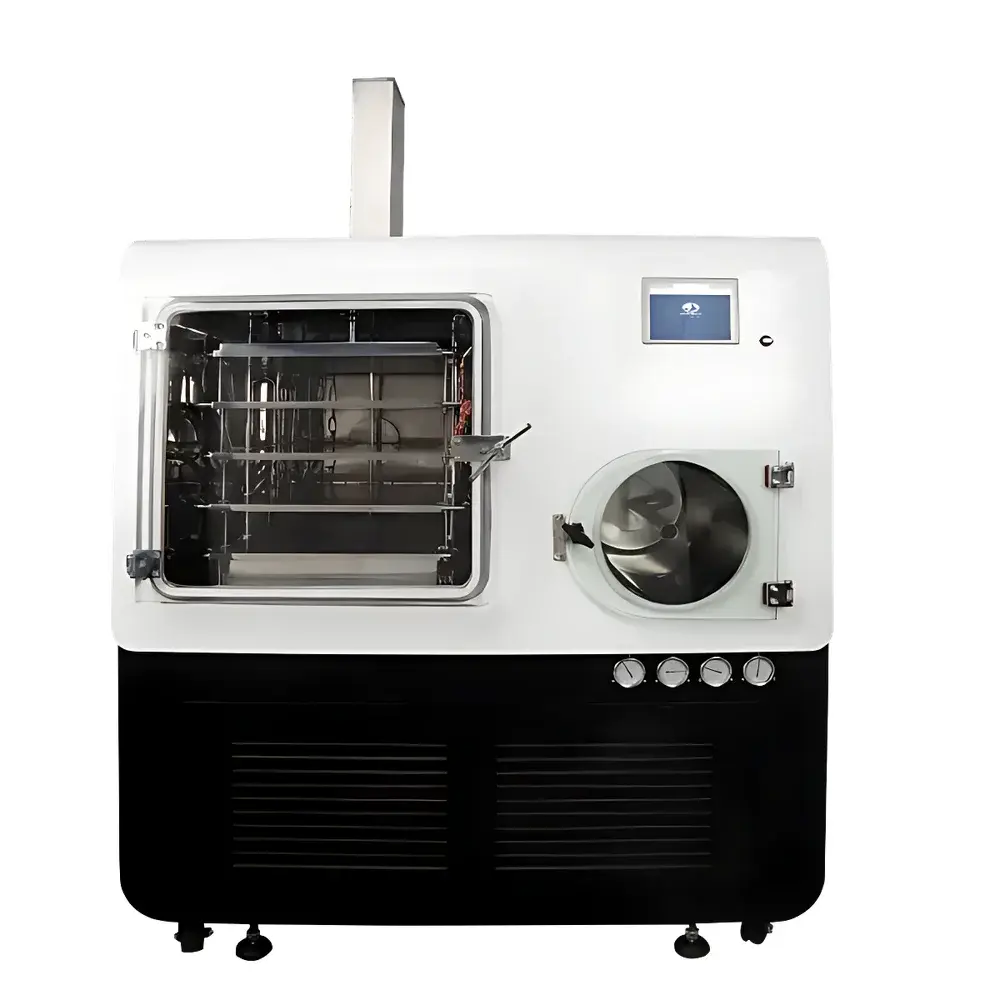
Scientz SCIENTZ-100F/A Benchtop Pilot-Scale Silicone Oil Manifold Freeze Dryer
| Brand | Scientz |
|---|---|
| Origin | Zhejiang, China |
| Manufacturer Type | Direct Manufacturer |
| Instrument Type | Standard Shelf-Type Freeze Dryer |
| Application Scope | Pilot-Scale Processing |
| Lyophilization Area | 1.08 m² |
| Ultimate Vacuum (No Load) | ≤5 Pa |
| Ice Capacity (24 h) | 15 kg/24 h |
| Cold Trap Temperature (No Load) | ≤−70 °C |
| Dimensions (L×W×H) | 1300 × 1000 × 1480 mm |
Overview
The Scientz SCIENTZ-100F/A is a pilot-scale, silicone oil-heated, in-situ freeze dryer engineered for precise thermal control and reproducible lyophilization of thermally sensitive biologicals, pharmaceuticals, and research-grade materials. It operates on the principle of sublimation under deep vacuum—where frozen water transitions directly from solid to vapor without passing through the liquid phase—thereby preserving structural integrity, bioactivity, and chemical stability of labile compounds. Unlike resistive or steam-heated systems, the SCIENTZ-100F/A employs a closed-loop silicone oil circulation system to deliver uniform heat transfer across its stainless steel shelves, enabling accurate ramp-and-hold temperature profiles critical for optimizing primary and secondary drying stages. Its cascade refrigeration architecture achieves cold trap temperatures down to −70 °C (no load), ensuring high condensation efficiency and minimal backstreaming during extended batch cycles. Designed for GxP-aligned environments, the unit supports process development, scale-up validation, and small-batch production in compliance with ISO 22000, USP , and ICH Q5C guidelines.
Key Features
- Silicone oil heating system with ±1 °C shelf temperature uniformity (RA ≤ 0.5 µm surface finish) and PID-controlled ramp/hold profiles
- Cascade refrigeration circuit using imported compressors; cold trap reaches ≤−70 °C (no load), with 4 kg maximum ice capacity and enhanced surface area for efficient vapor capture
- 7-inch full-color industrial touchscreen interface with real-time display of shelf temperature, product temperature (via optional Pt100 probes), vacuum pressure, and cold trap temperature
- Industrial-grade PLC controller supporting up to 40 customizable freeze-drying protocols, each with up to 40 programmable segments (linear ramp, slope-controlled, hold-at-temperature)
- Automatic data logging with timestamped storage on internal memory and USB export; audit-trail-capable for GLP/GMP-compliant environments per FDA 21 CFR Part 11 requirements
- Dual-chamber design featuring corrosion-resistant cold trap, transparent aerospace-grade acrylic door, and external coil cold trap for easy cleaning and maintenance
- Integrated vacuum protection logic—including automatic oil-backflow prevention via optional differential vacuum valve and corrosion-resistant custom vacuum pump designed for aggressive solvent vapors
Sample Compatibility & Compliance
The SCIENTZ-100F/A accommodates diverse sample formats including serum vials, ampoules, glass flasks, petri dishes, and custom trays—compatible with both standard and stopper-compatible configurations. Its in-situ freezing capability eliminates manual transfer between pre-freezer and dryer, reducing contamination risk and thermal shock. The system meets key international standards for laboratory freeze drying: ISO 13485 (medical device manufacturing), ASTM F2695 (lyophilization process validation), and EU Annex 1 (sterile processing). Optional features—including nitrogen backfill port, co-lyophilization support, and CE-marked electrical architecture—facilitate integration into regulated QC labs and pilot manufacturing suites operating under cGMP or ISO 9001 quality management systems.
Software & Data Management
The embedded control software provides dual-mode operation (manual override and fully automated sequence execution), with password-protected multi-level user access (operator, technician, administrator). All process parameters—including vacuum setpoints, shelf temperature gradients, hold durations, and pressure decay rates—are digitally recorded at configurable intervals (1–60 s). Historical batches can be replayed graphically for root-cause analysis or protocol refinement. Data export is supported via USB 2.0 to CSV or PDF format for LIMS integration. Optional remote monitoring via secure mobile application enables real-time status alerts and limited parameter adjustment—subject to network authentication and role-based permissions. System firmware supports periodic updates to maintain cybersecurity compliance and regulatory alignment.
Applications
This freeze dryer serves cross-disciplinary applications requiring structural fidelity and functional retention post-drying. In biopharmaceutical R&D, it supports formulation development of monoclonal antibodies, mRNA-LNPs, viral vectors, and live-attenuated vaccines. Academic users employ it for cryopreservation of microbial cultures, fungal spores, and insect tissues; nanomaterial scientists use it to dry colloidal suspensions without aggregation. Environmental laboratories rely on its consistent performance for soil and sludge matrix stabilization prior to elemental analysis. Food science departments apply it to nutrient-sensitive botanical extracts and probiotic cultures. Regulatory agencies—including CDC, CNAS-accredited testing labs, and customs inspection centers—utilize the SCIENTZ-100F/A for residue analysis sample preparation and reference material archiving.
FAQ
Does the SCIENTZ-100F/A support in-situ freezing?
Yes—it integrates direct shelf cooling to −45 °C, enabling complete freeze-drying cycles without external ultra-low temperature freezers.
What vacuum level is achievable during active drying?
The system maintains ≤5 Pa under no-load conditions and typically sustains 10–30 Pa during dynamic sublimation, depending on ice load and chamber geometry.
Is the control system compliant with 21 CFR Part 11?
Yes—the PLC-based architecture includes electronic signatures, audit trails, and data integrity safeguards when configured with appropriate user access controls and backup protocols.
Can shelf temperature be independently controlled per layer?
No—shelves operate in synchronized mode for uniform thermal delivery, optimized for consistency in pilot-scale development rather than multi-zone process differentiation.
What materials are used in wetted parts contacting samples?
All product-contact surfaces are electropolished 316L stainless steel (shelf plates, condenser housing) or food-grade silicone gaskets; cold trap coils are copper-nickel alloy with passivated finish.



