
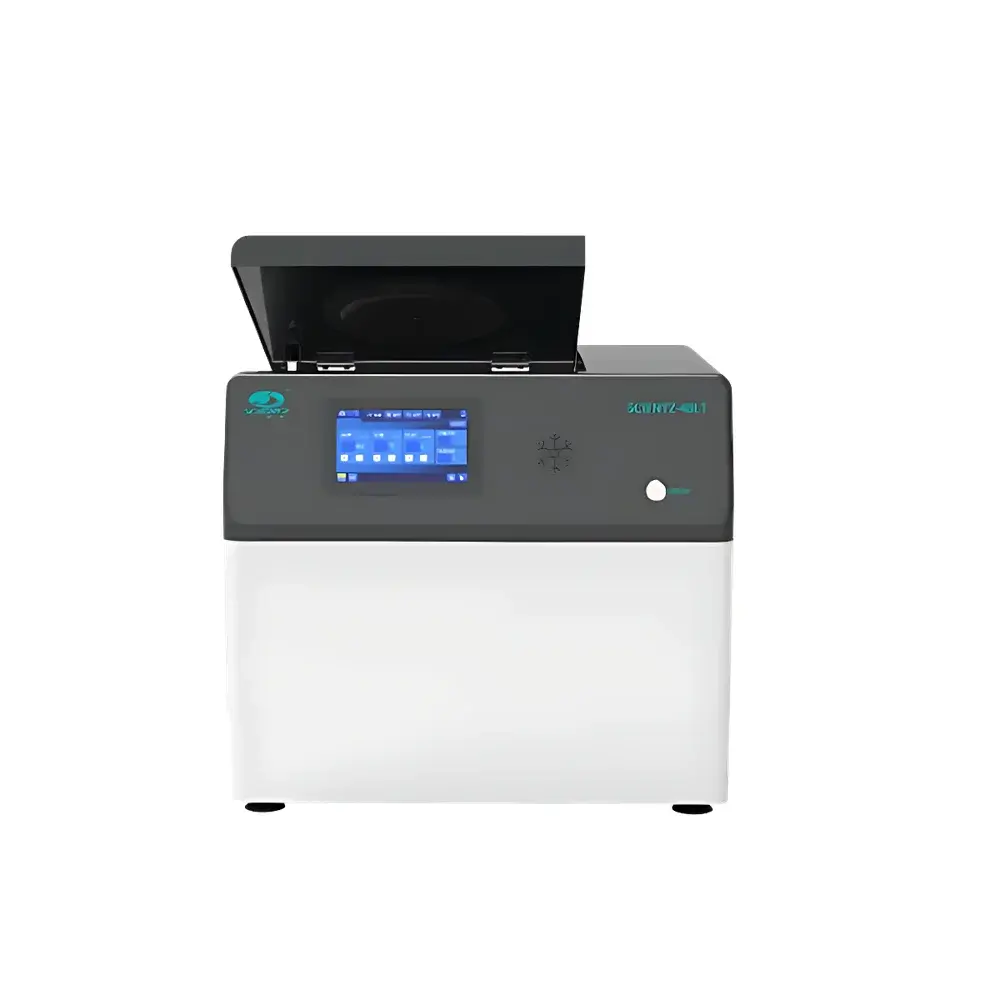
Ningbo Scientz SCIENTZ-48LT High-Throughput Cryogenic Tissue Grinder
| Brand | Ningbo Scientz |
|---|---|
| Model | SCIENTZ-48LT |
| Throughput | 48 samples per run |
| Drive Mechanism | High-frequency vertical oscillation |
| Temperature Control | Integrated refrigerated compressor (–10 °C to +4 °C operational range) |
| Sample Vessel Type | Sealed 0.2–2.0 mL centrifuge tubes |
| Display | Full-color capacitive touchscreen interface |
| Compliance | Designed for GLP-compliant workflows |
| Power Supply | 220 V, 50/60 Hz |
| Dimensions (W×D×H) | 360 × 420 × 520 mm |
| Net Weight | 42 kg |
Overview
The Ningbo Scientz SCIENTZ-48LT High-Throughput Cryogenic Tissue Grinder is an engineered solution for rapid, reproducible mechanical lysis of biological and non-biological samples under controlled low-temperature conditions. It operates on the principle of high-frequency vertical oscillation—generating kinetic energy through reciprocating motion that drives grinding beads within sealed centrifuge tubes. This induces repeated impact and shear forces between beads and sample matrix, resulting in efficient cellular disruption and homogenization. Unlike rotor-stator or blade-based systems, the SCIENTZ-48LT avoids localized heating and sample degradation by integrating a built-in refrigerated compressor capable of maintaining chamber temperatures between –10 °C and +4 °C throughout operation. This thermal management is critical for preserving labile biomolecules—including native RNA integrity, phosphoprotein stability, and epigenetic marks—during extraction protocols used in genomics, transcriptomics, proteomics, and metabolomics workflows.
Key Features
- Simultaneous processing of up to 48 samples in standard microcentrifuge tubes (0.2–2.0 mL), ensuring scalability without compromising inter-sample consistency.
- Programmable oscillation frequency (range: 100–1800 cycles/min) with adjustable amplitude and runtime (1 s–99 min 59 s), enabling method optimization across diverse sample matrices.
- Cryogenic capability via integrated compressor-based cooling system; temperature setpoint and real-time monitoring accessible via touchscreen interface.
- Sealed-tube architecture eliminates aerosol generation and cross-contamination risks—essential for high-sensitivity assays and regulated environments.
- Touchscreen HMI with intuitive icon-driven navigation, multi-language support (English, Chinese, Spanish), and user-defined protocol storage (up to 100 methods).
- Robust aluminum alloy housing with vibration-dampening feet and safety interlock system that halts operation upon lid opening.
Sample Compatibility & Compliance
The SCIENTZ-48LT accommodates heterogeneous sample types requiring mechanical lysis prior to nucleic acid or protein isolation. Validated applications include animal tissues (brain, liver, muscle, bone), plant materials (leaves, seeds, fibrous stems), microbial cultures (E. coli, yeast, spores), environmental specimens (soil, sludge, fecal matter), and industrial matrices (polymers, pharmaceutical tablets, coal derivatives). Its closed-tube design supports compliance with ISO/IEC 17025 requirements for traceability and contamination control. When operated with validated SOPs and electronic audit trails enabled via optional LIMS integration, the instrument meets foundational expectations for GLP and GMP-aligned laboratories. While not inherently 21 CFR Part 11–compliant, its firmware architecture supports external data capture systems meeting electronic record retention standards.
Software & Data Management
The SCIENTZ-48LT features embedded firmware with local method storage and execution logging. Each run records timestamp, program ID, cycle count, temperature profile, and completion status—exportable via USB port as CSV files for downstream analysis. Optional PC software (ScientzControl Suite v3.x) enables remote parameter configuration, batch scheduling, and export of structured metadata compatible with ELN platforms. All user actions—including method edits and calibration events—are time-stamped and logged internally, forming a basic audit trail suitable for internal quality review. No cloud connectivity or automatic updates are implemented, preserving data sovereignty and network security in regulated settings.
Applications
- High-yield genomic DNA extraction from fibrous plant tissues and calcified animal samples.
- RNA stabilization during homogenization of RNase-rich tissues (e.g., pancreas, spleen) under sub-zero conditions.
- Pre-analytical preparation for LC-MS/MS-based proteomics where protein denaturation must be minimized pre-lysis.
- Soil microbiome studies requiring uniform cell wall rupture across Gram-positive bacteria and fungal hyphae.
- Pharmaceutical QA/QC for content uniformity testing of solid dosage forms using mechanical disintegration followed by HPLC quantification.
- Forensic sample processing where chain-of-custody integrity depends on minimal manual handling and closed-tube workflows.
FAQ
What tube sizes are supported?
Standard 0.2 mL, 0.5 mL, 1.5 mL, and 2.0 mL microcentrifuge tubes with conical or round-bottom geometry.
Can I use ceramic or tungsten carbide beads?
Yes—the instrument accepts stainless steel, zirconia, silicon carbide, and tungsten carbide grinding media ranging from 0.1 mm to 4.0 mm diameter.
Is the cooling system compressor-based or Peltier-cooled?
It uses a hermetically sealed refrigeration compressor with R134a refrigerant, providing stable sub-ambient temperatures independent of ambient humidity or load variation.
Does the device meet CE or UL safety certification?
The SCIENTZ-48LT complies with IEC 61010-1:2010 for laboratory electrical equipment and carries CE marking for EMC and low-voltage directives.
How is maintenance performed on the drive mechanism?
The eccentric drive assembly requires no routine lubrication; periodic inspection of rubber dampeners and torque verification of clamping fixtures is recommended every 6 months under continuous use.



