
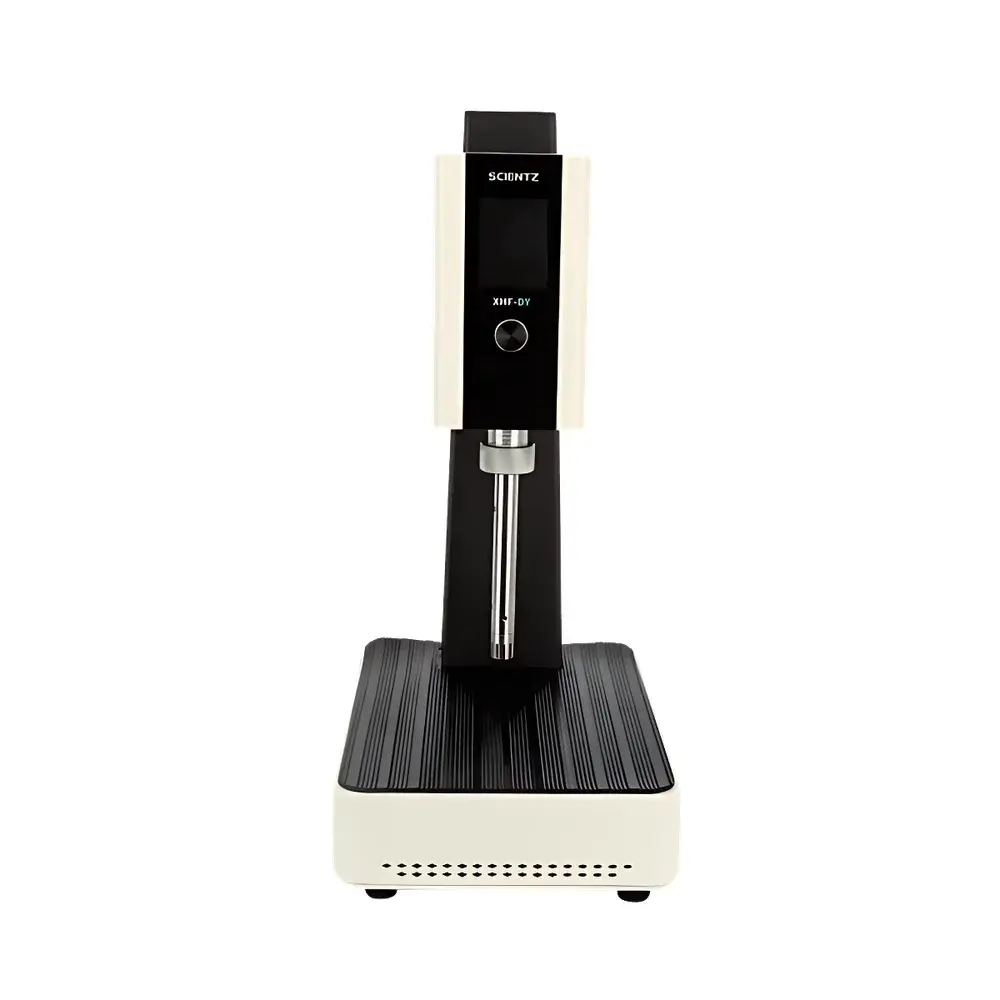
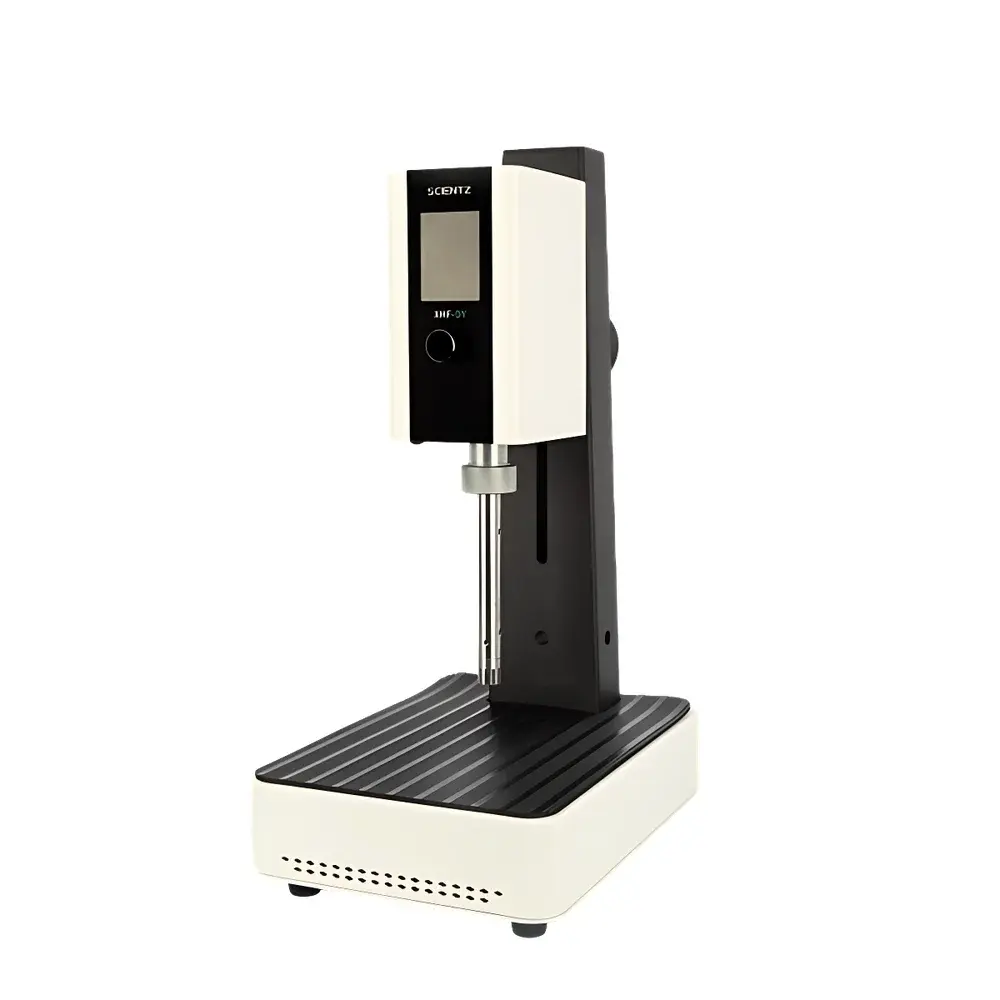
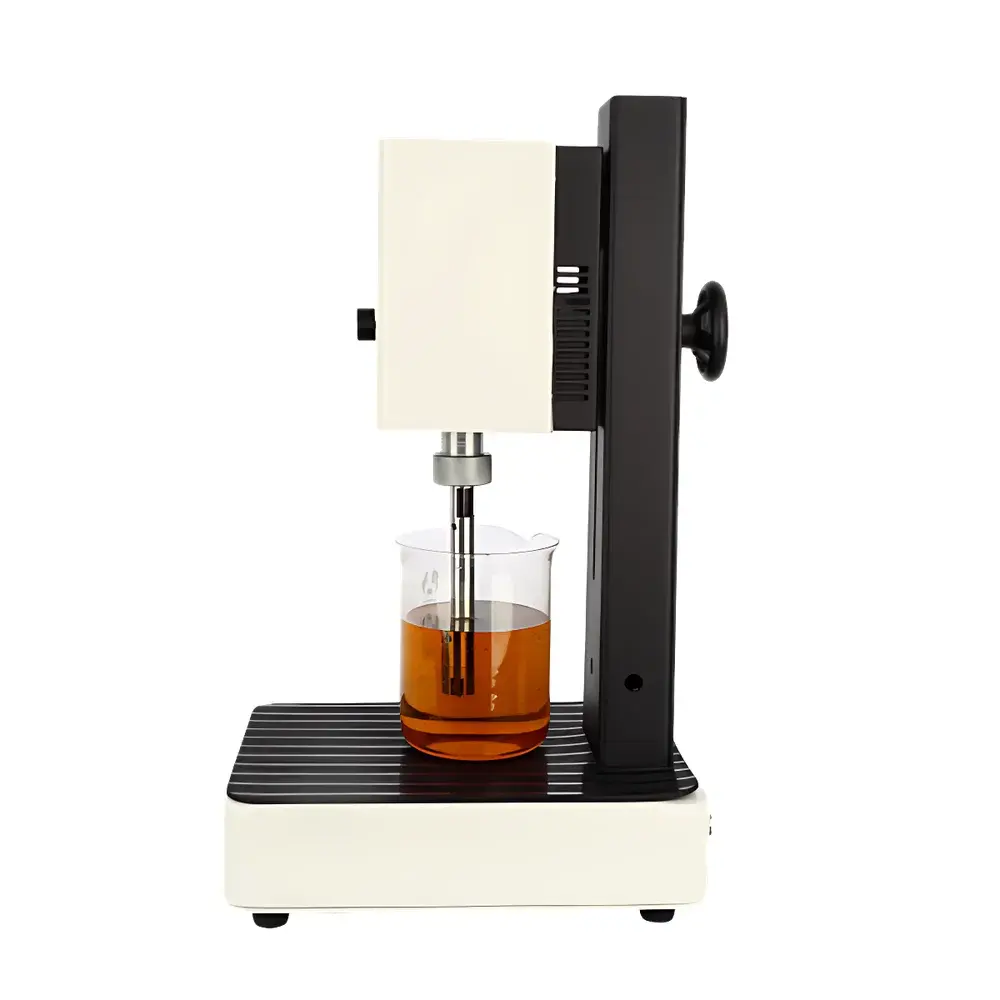
Scientz XHF-DY Benchtop High-Speed Disperser (In-Line Homogenizer)
| Brand | Scientz |
|---|---|
| Origin | Zhejiang, China |
| Manufacturer Type | Direct Manufacturer |
| Instrument Type | Benchtop Homogenizer |
| Instrument Category | Adjustable High-Speed Disperser |
| Sample Volume Range | 3 mL – 1000 mL |
| Output Power | 360 W |
| Speed Range | 2800–28000 rpm, Continuously Variable |
| Drive Mechanism | Electronically Controlled Micro High-Speed Motor with Interchangeable梅花-Type Rotor-Stator Assembly |
Overview
The Scientz XHF-DY Benchtop High-Speed Disperser is an in-line homogenizer engineered for precision mechanical disruption and dispersion of heterogeneous samples across life science, pharmaceutical, food, and cosmetic research laboratories. It operates on the principle of high-shear rotor-stator fluid dynamics: a rapidly rotating梅花-shaped (multi-lobed) rotor generates intense hydrodynamic cavitation and turbulent shear forces within the sample chamber, enabling efficient cell lysis, tissue homogenization, emulsification, and phase dispersion. Unlike ultrasonic or bead-based methods, this disperser delivers reproducible mechanical energy transfer without introducing exogenous contaminants or thermal artifacts—making it particularly suitable for heat-sensitive biomolecules, lipids, and labile extracts. Its compact benchtop footprint and direct-drive architecture ensure stability during extended operation at maximum rotational speeds.
Key Features
- Continuously variable speed control from 2800 to 28000 rpm, calibrated and digitally stabilized to maintain setpoint accuracy ±2% across the full range.
- Interchangeable rotor-stator assemblies with standardized梅花-type geometry optimized for scalable shear delivery—compatible with both narrow-bore tubes (3–50 mL) and wide-mouth containers (up to 1000 mL).
- Adjustable vertical positioning system allows precise immersion depth control of the dispersing head relative to vessel bottom, ensuring optimal vortex formation and minimizing air entrainment or splashing.
- Non-volatile parameter memory retains last-used speed setting and runtime configuration upon power cycle, supporting GLP-compliant workflow continuity.
- Thermally robust motor housing with integrated airflow cooling maintains operational integrity during prolonged use at rated 360 W output, meeting IEC 61000-4-2 ESD immunity standards.
- Tool-free probe attachment enables rapid sterilization-compatible disassembly and cleaning—validated for autoclaving at 121 °C for 20 minutes (per ISO 17664).
Sample Compatibility & Compliance
The XHF-DY accommodates viscous, fibrous, and particulate-laden samples—including mammalian tissues, plant roots, microbial pellets, lipid emulsions, polymer suspensions, and cosmetic base formulations. It complies with general laboratory safety requirements per EN 61010-1:2019 and supports traceable operation under ISO/IEC 17025-accredited environments when paired with documented calibration procedures. While not intrinsically certified for GMP manufacturing, its design facilitates audit readiness: all user-accessible components are traceable via serial-numbered hardware logs, and speed settings can be recorded manually or exported via optional RS-232 interface for 21 CFR Part 11–aligned data capture systems.
Software & Data Management
The XHF-DY operates as a standalone instrument with analog-digital hybrid speed regulation—no proprietary software required for basic function. However, its RS-232 port (optional accessory) permits integration into LIMS or ELN platforms for automated logging of run parameters (speed, duration, date/time stamp). When used in regulated QC labs, operators may implement manual logbooks compliant with ALCOA+ principles (Attributable, Legible, Contemporaneous, Original, Accurate), with periodic verification against NIST-traceable tachometer calibration standards.
Applications
- Tissue homogenization: Rapid mechanical lysis of liver, brain, muscle, or leaf tissue for downstream RNA/DNA/protein extraction—validated for compatibility with TRIzol® and QIAzol® reagents.
- Microbial cell disruption: Efficient Gram-negative and yeast cell wall breakage prior to plasmid isolation or enzyme release, without requiring lysozyme pretreatment.
- Emulsion formulation: Preparation of oil-in-water and water-in-oil nanoemulsions for topical delivery systems, with droplet size distribution controllable via speed ramping and dwell time modulation.
- Extraction optimization: Accelerated solid-liquid extraction of polyphenols, alkaloids, or terpenes from botanical matrices using organic-aqueous solvent blends.
- Quality control mixing: Homogeneous suspension of insoluble APIs or excipients in pre-formulation studies, supporting USP uniformity of dosage units testing protocols.
FAQ
Is the XHF-DY suitable for sterile processing?
Yes—rotor-stator probes are autoclavable; however, the main unit housing must remain outside the sterilizer. Full sterilization requires probe removal and separate autoclaving at 121 °C for 20 min.
Can it handle high-viscosity samples above 5000 mPa·s?
It is optimized for low-to-medium viscosity fluids (<2000 mPa·s); for higher viscosities, reduce speed incrementally and monitor motor load to avoid thermal overload.
Does it meet FDA 21 CFR Part 11 requirements?
The base unit does not include electronic signature or audit trail functionality; compliance requires external data acquisition software with validated electronic record controls.
What maintenance intervals are recommended?
Inspect rotor-stator alignment and bearing play every 200 operating hours; replace O-rings annually or after 50 autoclave cycles.
Is technical support available in English for international users?
Yes—Scientz provides multilingual documentation and remote troubleshooting assistance through authorized regional distributors, with response SLAs defined per service agreement.



