
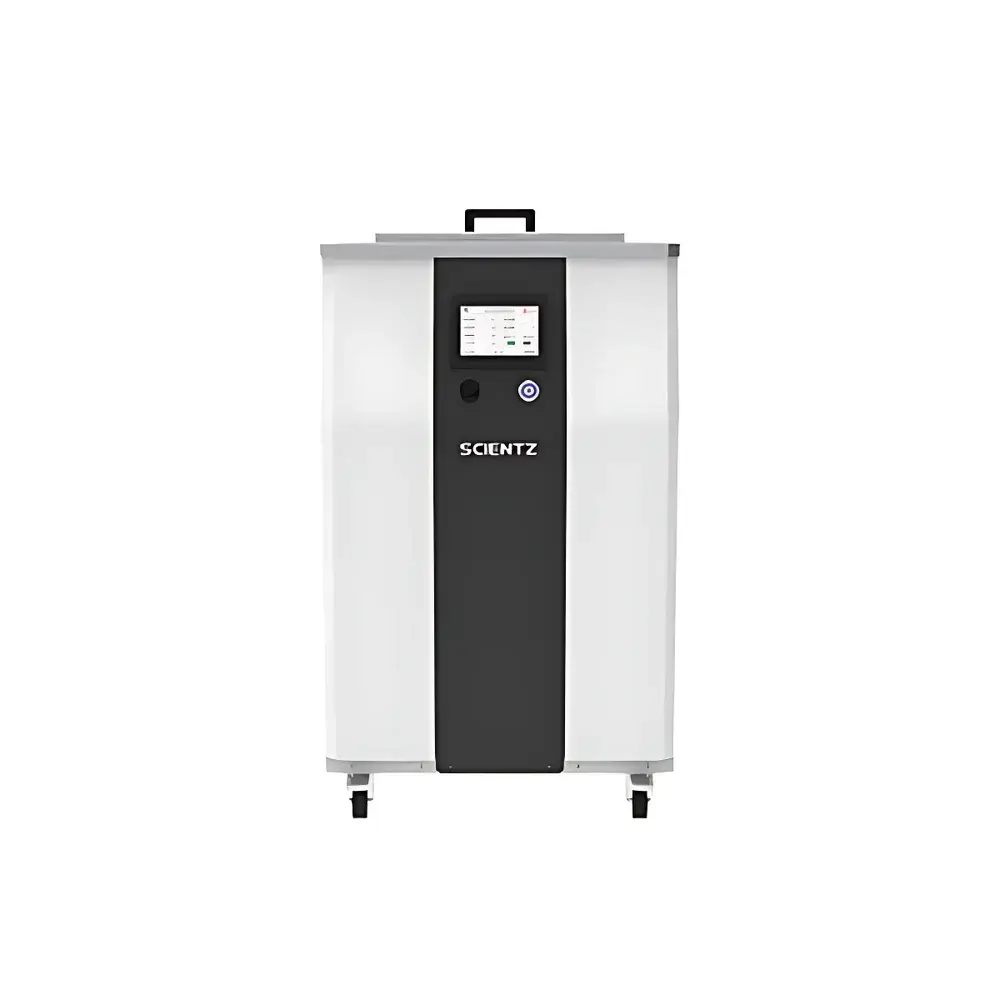
Ningbo Scientz SBL-15DT Benchtop Ultrasonic Cleaner with Heated Bath
| Brand | Scientz |
|---|---|
| Origin | Zhejiang, China |
| Manufacturer Type | Direct Manufacturer |
| Instrument Type | General-Purpose Ultrasonic Cleaner |
| Tank Capacity | 15 L |
| Ultrasonic Frequency | 40 kHz |
| Ultrasonic Power Output | 480 W |
| Power Adjustment | Not Available |
| Temperature Control Range | Adjustable up to 80 °C |
| Timer Range | 1–9999 min |
| Sound-Dampening Lid | Included |
| Drain & Fill Fitting | Equipped |
Overview
The Ningbo Scientz SBL-15DT is a benchtop ultrasonic cleaner engineered for precision cleaning in academic, pharmaceutical, clinical, and industrial laboratories. It operates on the principle of acoustic cavitation: high-frequency mechanical vibrations (40 kHz) generated by piezoelectric transducers are transmitted through the cleaning medium—typically aqueous or solvent-based solutions—inducing rapid formation and violent collapse of microscopic vacuum bubbles. This transient cavitation event produces localized shockwaves and microstreaming effects exceeding 1000 atm pressure and 5000 K transient temperatures at bubble implosion sites, enabling efficient removal of particulate contaminants, organic residues, biofilms, and adsorbed hydrocarbons from complex geometries—including blind holes, capillary channels, porous surfaces, and microstructured components. Unlike manual scrubbing or immersion soaking, ultrasonic cleaning delivers uniform energy distribution across submerged samples without mechanical abrasion, preserving surface integrity of delicate optics, calibration standards, microfluidic devices, and surgical instruments.
Key Features
- Stainless steel tank (304 grade) with 15 L usable volume, optimized for consistent acoustic field distribution and corrosion resistance.
- Digital touchscreen interface with real-time display of elapsed time, set temperature, and actual bath temperature—enabling precise process repeatability.
- Integrated heating system with PID-controlled thermal regulation, adjustable from ambient +5 °C to 80 °C, supporting enhanced solubilization of waxy, greasy, or polymerized residues.
- Sound-dampening lid with ergonomic latch mechanism reduces airborne noise to ≤55 dB(A) at 1 m distance—meeting ISO 7779 and ANSI S1.13 laboratory noise guidelines.
- Drain valve and fill port facilitate rapid solution exchange and compatibility with closed-loop recirculation systems for solvent recovery applications.
- Automatic shutdown with memory retention: power interruption preserves last-used time, temperature, and operational mode settings upon restoration.
Sample Compatibility & Compliance
The SBL-15DT accommodates standard laboratory consumables including borosilicate glassware (vials, cuvettes, Petri dishes), stainless steel tools, silicone tubing, PTFE-coated fixtures, and anodized aluminum components. It is routinely employed in pre-analytical sample preparation workflows compliant with ISO 15189 (medical laboratories), ASTM D2603 (ultrasonic cleaning validation), and USP (cleaning of analytical equipment). While not certified as a medical device sterilizer per ISO 17664 or EN ISO 15883, its validated cleaning cycles support GMP-aligned residue removal protocols when coupled with appropriate detergents (e.g., Alconox, Liquinox) and rinse verification (conductivity/residue swab testing). The unit complies with IEC 61010-1:2010 safety requirements for electrical equipment used in laboratory environments.
Software & Data Management
The SBL-15DT operates via embedded firmware without external PC dependency. All operational parameters—including timer duration, target temperature, and cycle initiation—are logged internally with timestamped records retained for ≥1000 cycles. Audit trail functionality meets basic GLP documentation requirements; however, full 21 CFR Part 11 compliance (electronic signatures, user access controls, immutable logs) requires integration with third-party laboratory information management systems (LIMS) via RS-232 or optional Ethernet module (sold separately). Calibration certificates for temperature sensor (±0.5 °C accuracy) and timer (±0.1% deviation) are available upon request.
Applications
- Cleaning of HPLC vials, GC autosampler inserts, and ICP-MS nebulizer components prior to trace-metal analysis.
- De-gassing of mobile phases and buffer solutions to prevent pump cavitation and column voiding.
- Pre-treatment of TEM grids and SEM stubs to eliminate hydrocarbon contamination affecting imaging resolution.
- Routine decontamination of reusable pipette tips, centrifuge rotors, and electrophoresis combs in molecular biology labs.
- Surface preparation of metal coupons prior to corrosion testing (ASTM G1, G31) or adhesion studies.
- Supporting ISO 14644-1 cleanroom maintenance by removing sub-micron particles from laminar flow hoods and pass-through chambers.
FAQ
What cleaning solutions are compatible with the SBL-15DT?
Aqueous alkaline detergents, ethanol/water mixtures (≤70%), and low-surface-tension solvents (e.g., isopropanol, acetone) may be used. Avoid halogenated hydrocarbons or strong oxidizers unless confirmed compatible with 304 stainless steel and transducer encapsulation materials.
Can the unit operate continuously for extended periods?
Yes—duty cycle is rated for continuous operation up to 8 hours per session. For >4-hour runs, periodic cooling intervals (≥15 min) are recommended to maintain transducer longevity and thermal stability.
Is the temperature sensor calibrated traceable to NIST standards?
Factory calibration uses reference thermistors traceable to national metrology institutes. NIST-traceable calibration reports are provided as an optional service with documented uncertainty budgets.
Does the SBL-15DT meet CE or UL certification requirements?
The unit carries CE marking under the EU Machinery Directive 2006/42/EC and EMC Directive 2014/30/EU. UL listing is not held; however, design conforms to UL 61010-1 equivalent safety architecture.
How often should the ultrasonic tank be descaled?
In hard-water regions, descaling with 5% citric acid solution every 2–4 weeks prevents calcium carbonate buildup on transducer surfaces and maintains acoustic coupling efficiency.
Related Products



