
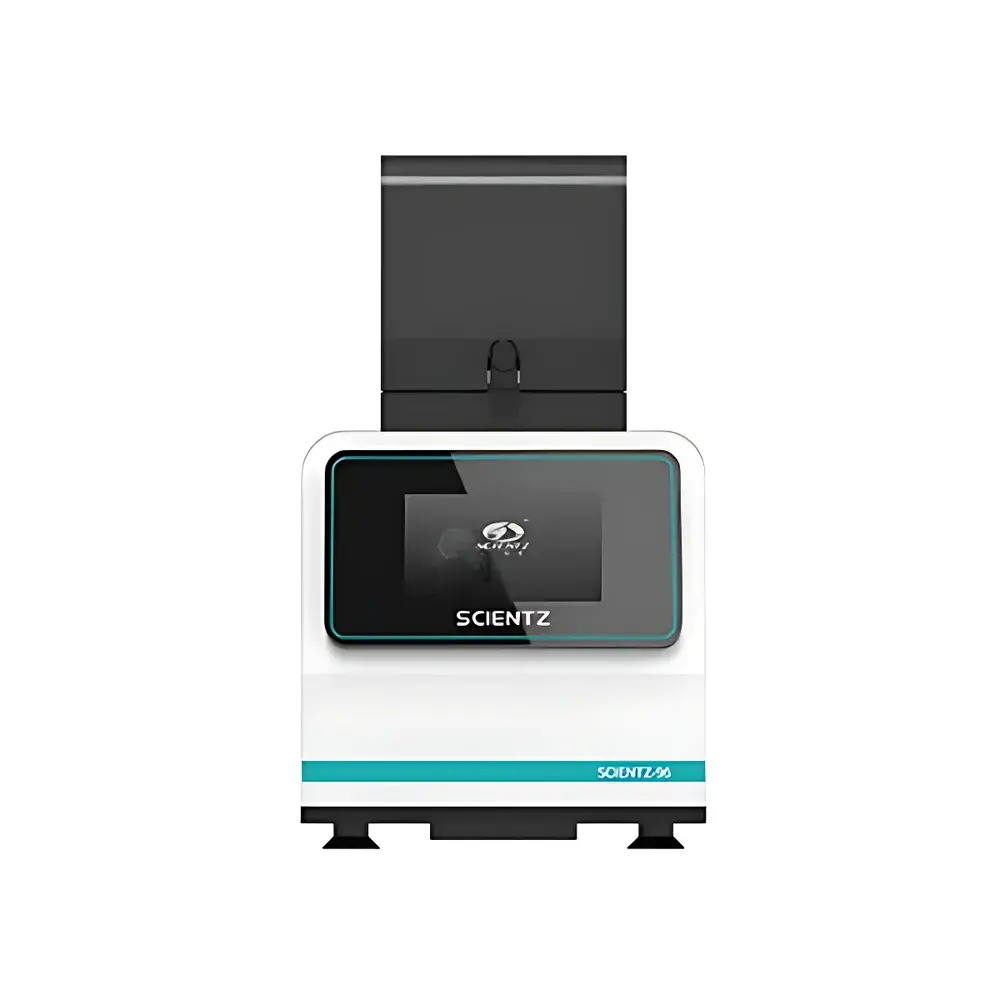
Scientz SCIENTZ-96 High-Throughput Tissue Grinder
| Brand | Scientz |
|---|---|
| Origin | Zhejiang, China |
| Manufacturer Type | Direct Manufacturer |
| Country of Origin | China |
| Model | SCIENTZ-96 |
| Pricing | Upon Request |
Overview
The Scientz SCIENTZ-96 High-Throughput Tissue Grinder is an engineered vertical-axis oscillation system designed for rapid, reproducible, and contamination-controlled mechanical homogenization of biological and non-biological samples. It operates on the principle of high-frequency reciprocating vertical vibration, inducing controlled collision forces between grinding beads and sample material sealed within individual centrifuge tubes. This mechanism delivers consistent shear and impact energy—critical for efficient cellular lysis and subcellular disruption—while preserving labile biomolecules such as native RNA, genomic DNA, and functional proteins. Unlike rotor-stator or bead-beating systems with horizontal agitation, the SCIENTZ-96’s vertically aligned motion minimizes heat accumulation and ensures uniform energy distribution across all 96 positions simultaneously. Its architecture supports fully enclosed processing, eliminating aerosol generation and enabling safe handling of pathogenic, volatile, or temperature-sensitive specimens under standard biosafety level 2 (BSL-2) laboratory conditions.
Key Features
- 96-position parallel processing capacity with programmable vibration frequency (typically 100–1800 rpm), amplitude control, and cycle timing (1 sec to 99 min 59 sec)
- Full-seal tube-based operation: each sample remains isolated in its designated tube throughout grinding, preventing cross-contamination and enabling trace-level analyte recovery
- Integrated safety interlock system with electromagnetic door lock and automatic motor cutoff upon lid opening—compliant with IEC 61000-4-2 ESD protection and EN 61000-3-2 harmonic current limits
- Low-noise enclosure (<55 dB(A) at 1 m distance) achieved via dual-layer acoustic damping and precision-balanced drive assembly
- Pre-cooling compatibility: aluminum adapter blocks support direct placement of pre-chilled tubes (−80 °C compatible) without condensation interference or thermal shock to motor components
- Modular bead material selection: optimized compatibility with stainless steel, hardened steel, tungsten carbide, agate, sintered alumina, zirconia, and PTFE grinding media—each characterized by defined hardness (HV/Mohs), density, wear profile, and elemental leaching potential
Sample Compatibility & Compliance
The SCIENTZ-96 accommodates a broad spectrum of sample matrices without requiring protocol redesign: soft animal tissues (liver, brain, kidney), fibrous plant materials (roots, stems, seeds), microbial cultures (E. coli, yeast, spores), environmental solids (soil, sludge, sediment), pharmaceutical tablets, polymer pellets (PE, PS), and forensic specimens (hair, bone fragments). All grinding protocols are compatible with downstream molecular workflows validated per ISO/IEC 17025 requirements for testing laboratories. The instrument meets general electrical safety standards (GB 4793.1–2019 / IEC 61010-1), and its closed-tube configuration aligns with Good Laboratory Practice (GLP) documentation needs for audit-trail integrity. While not inherently FDA 21 CFR Part 11–certified, its parameter logging capability supports integration into compliant LIMS environments when paired with validated third-party data acquisition software.
Software & Data Management
The built-in microprocessor controller provides intuitive parameter configuration via tactile keypad and LCD interface. Users can store up to 20 custom programs with independent settings for speed, duration, pause intervals, and repeat cycles. Real-time operational status—including elapsed time, remaining time, and active program ID—is displayed continuously. No proprietary PC software is required for basic operation; however, optional RS-232 or USB serial output enables connection to external loggers or laboratory information management systems (LIMS) for automated run record capture. All parameter changes are timestamped and retained in non-volatile memory, supporting traceability in regulated environments where procedural consistency must be demonstrable during internal audits or regulatory inspections.
Applications
This system is routinely deployed in academic, clinical, and industrial laboratories for nucleic acid extraction prior to qPCR, RNA-Seq, and NGS library preparation; protein solubilization for Western blotting and ELISA; metabolite release from plant tissues for LC-MS analysis; microbiome sample homogenization prior to 16S rRNA sequencing; and forensic evidence processing where chain-of-custody integrity is essential. Published applications include detection of circulating tumor cells in colorectal cancer patient blood (Guo et al., *J Mol Med*, 2004), keratinocyte mRNA profiling in gastrointestinal oncology studies (Guo et al., *J Gastroenterol Hepatol*, 2013), and antimicrobial compound screening from botanical extracts (Xu & Yang, *Mod Chin Med Res Pract*, 2014). Its throughput advantage significantly reduces hands-on time in multi-sample cohort studies and high-volume diagnostic screening pipelines.
FAQ
What types of grinding beads are recommended for RNA isolation?
Zirconia (ZrO₂) or sintered alumina beads are preferred for RNA work due to low metal ion leaching and minimal RNase activation risk. Avoid stainless steel when working with sensitive transcripts.
Can the SCIENTZ-96 be used for cryogenic grinding?
Yes—pre-cooled tubes (down to −80 °C) may be loaded directly into the adapter block. The instrument does not provide active cooling, so samples must be pre-chilled externally.
Is method validation support available for GLP-compliant labs?
Scientz provides technical documentation including mechanical specifications, electrical safety certifications, and bead compatibility tables—sufficient for internal IQ/OQ protocol development. Full PQ validation requires user-defined acceptance criteria and performance testing.
How is cross-contamination prevented between samples?
Each sample resides in a physically isolated tube; no shared fluid pathways or rotating shaft contact exist. Bead loading and tube sealing are manual user responsibilities—no automated dispensing or washing functions are included.
What maintenance is required for long-term reliability?
Annual inspection of drive belt tension, bearing lubrication status, and door interlock calibration is recommended. No routine consumables beyond replacement grinding beads and tube adapters are needed.



