
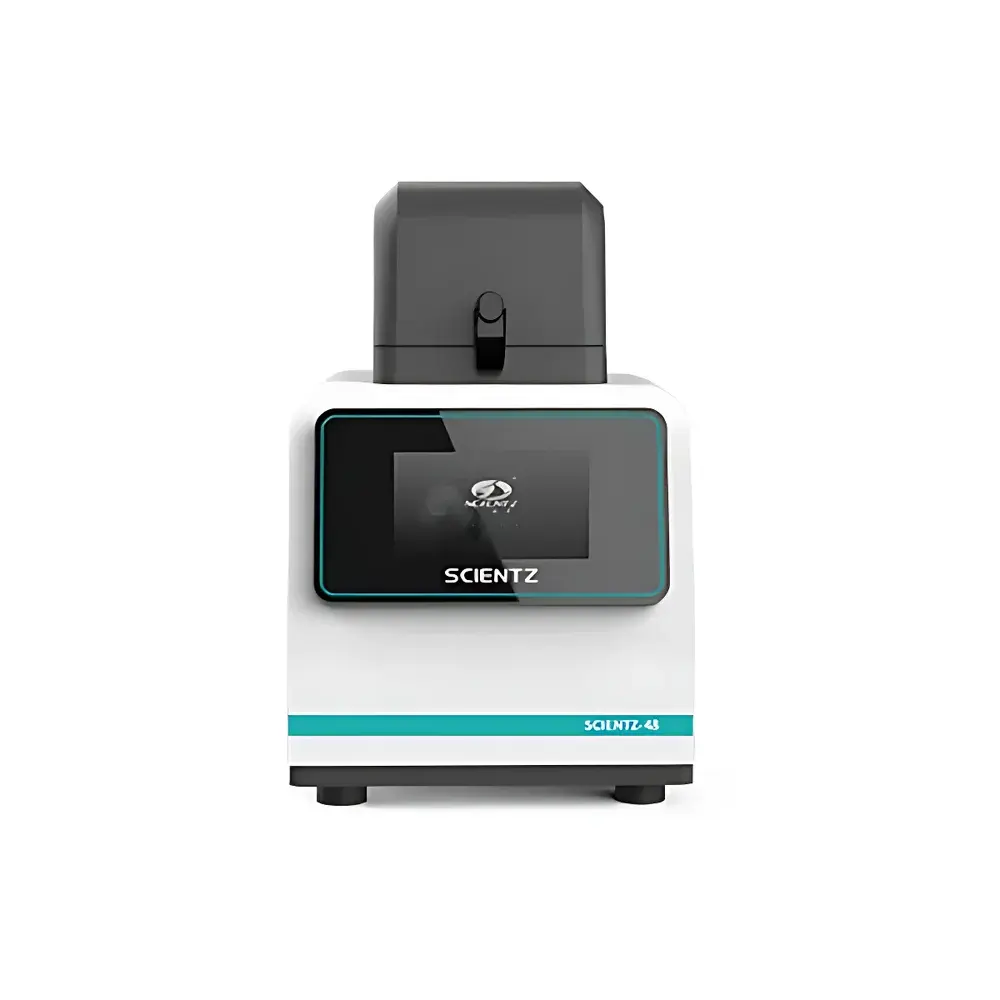
Scientz SCIENTZ-48 High-Throughput Tissue Grinder
| Brand | Scientz |
|---|---|
| Origin | Zhejiang, China |
| Manufacturer Type | Direct Manufacturer |
| Product Origin | Domestic (China) |
| Model | SCIENTZ-48 |
| Pricing | Available Upon Request |
Overview
The Scientz SCIENTZ-48 High-Throughput Tissue Grinder is an engineered vertical oscillation homogenizer designed for rapid, reproducible mechanical lysis of biological and non-biological samples under controlled cryogenic or ambient conditions. It operates on the principle of high-frequency reciprocating impact and shear forces generated by the collision between grinding beads and sample material inside sealed centrifuge tubes. This mechanism enables efficient disruption of cellular membranes, extracellular matrices, and resilient structural components—facilitating downstream isolation of intact nucleic acids (DNA/RNA), proteins, metabolites, and other intracellular biomolecules. Unlike rotor-stator or blade-based homogenizers, the SCIENTZ-48 avoids localized heat generation and foam formation, preserving thermolabile analytes and minimizing oxidative degradation. Its vertically oriented motion ensures uniform energy distribution across all tube positions, eliminating positional bias commonly observed in horizontal shaker-based systems.
Key Features
- 48-sample parallel processing capacity with standardized 0.2–2.0 mL tube compatibility (including 96-well deep-well plates via optional adapters)
- Programmable digital controller supporting adjustable frequency (100–1800 rpm), time (1 s–99 min 59 s), and cycle count (1–99 cycles) with pause intervals
- Hermetically sealed grinding chamber with interlocked safety door and automatic motor cutoff upon lid opening—compliant with IEC 61000-4-2 ESD protection and EN 61000-3-2 harmonic current limits
- Low-noise operation (<55 dB(A) at 1 m distance) achieved through precision-balanced eccentric drive assembly and vibration-damping silicone feet
- Cryogenic-ready design: accommodates pre-chilled tubes and dry ice/liquid nitrogen cooling without condensation ingress or thermal shock to internal mechanisms
- Modular bead selection support: validated compatibility with stainless steel, hardened steel, tungsten carbide, zirconia, alumina, agate, and PTFE grinding media—each characterized for density, hardness (HV/Mohs), wear resistance, and elemental leaching profile
Sample Compatibility & Compliance
The SCIENTZ-48 demonstrates broad-spectrum applicability across life science, environmental, agricultural, and materials research domains. Validated sample types include mammalian tissues (brain, liver, kidney, muscle, bone), plant organs (roots, leaves, seeds), microbial cultures (E. coli, yeast, filamentous fungi), forensic specimens, soil/sediment matrices, pharmaceutical tablets, polymer pellets (PE, PS), and composite textiles. All grinding protocols adhere to ISO 17025:2017 requirements for method validation in accredited testing laboratories. When used in regulated environments—including clinical diagnostics or GMP-compliant bioprocessing—the instrument supports audit-ready documentation when paired with timestamped parameter logs and user-access-controlled software (see Software & Data Management). No regulatory exclusions apply per USP , ASTM D5231-19 (soil DNA extraction), or ISO 20673:2019 (microbial cell disruption).
Software & Data Management
While the base SCIENTZ-48 operates via embedded microcontroller with LCD interface, optional USB-connected PC software enables advanced protocol management, remote monitoring, and electronic record retention. The software generates CSV-formatted operation logs containing date/time stamps, user ID, selected parameters, actual run metrics (frequency deviation ±2 rpm, duration accuracy ±0.1 s), and error codes (e.g., imbalance detection, overtemperature warning). These logs meet FDA 21 CFR Part 11 requirements for electronic signatures and audit trails when deployed with institutional IT validation frameworks. Raw data export supports integration into LIMS platforms via standard ODBC drivers. No cloud connectivity or proprietary file formats are employed—ensuring full data sovereignty and alignment with GDPR and HIPAA-compliant infrastructure policies.
Applications
This system serves as a core preprocessing tool in multi-omics workflows: enabling high-yield RNA extraction for single-cell sequencing library prep; facilitating chromatin shearing prior to ChIP-seq; supporting metagenomic DNA recovery from complex environmental matrices; and preparing homogeneous suspensions for nanoparticle dispersion analysis. In quality control settings, it standardizes sample homogenization for pharmacopeial assays (e.g., USP dissolution testing of extended-release formulations). Industrial applications include polymer blend homogeneity assessment, catalyst powder dispersion for catalytic activity screening, and mineralogical sample preparation for XRD/XRF analysis. Published use cases span colorectal cancer CTC detection (J Mol Med 2004), skin antifungal compound screening (Mod Chin Med Res Pract 2014), and low-cholesterol fermented sausage development (Agric Process 2011)—all requiring consistent, scalable, and contamination-free lysis.
FAQ
What tube sizes are supported?
Standard configurations accept 0.2 mL, 0.5 mL, 1.5 mL, and 2.0 mL microcentrifuge tubes. Custom adapters enable 96-well plate processing (200 µL/well) and 5–10 mL tube racks.
Can the SCIENTZ-48 be used for protein extraction without denaturation?
Yes—when operated at ≤4°C with chilled buffers and short-duration cycles (e.g., 3 × 30 s at 1200 rpm), it preserves native conformation for co-immunoprecipitation and enzymatic activity assays.
Is cross-contamination prevented between samples?
Each tube undergoes independent motion within its designated slot; no shared fluid pathways exist. Bead-to-bead transfer is physically impossible due to sealed tube architecture and vertical oscillation vector.
How is calibration verified?
Frequency accuracy is factory-validated using laser tachometry traceable to NIST standards. Users may perform periodic verification using external optical tachometers—no recalibration tools required.
Does the system comply with GLP/GMP documentation requirements?
When used with the optional software module and institutional SOPs, it satisfies ALCOA+ principles (Attributable, Legible, Contemporaneous, Original, Accurate, Complete, Consistent, Enduring, Available) for regulated data integrity.



