
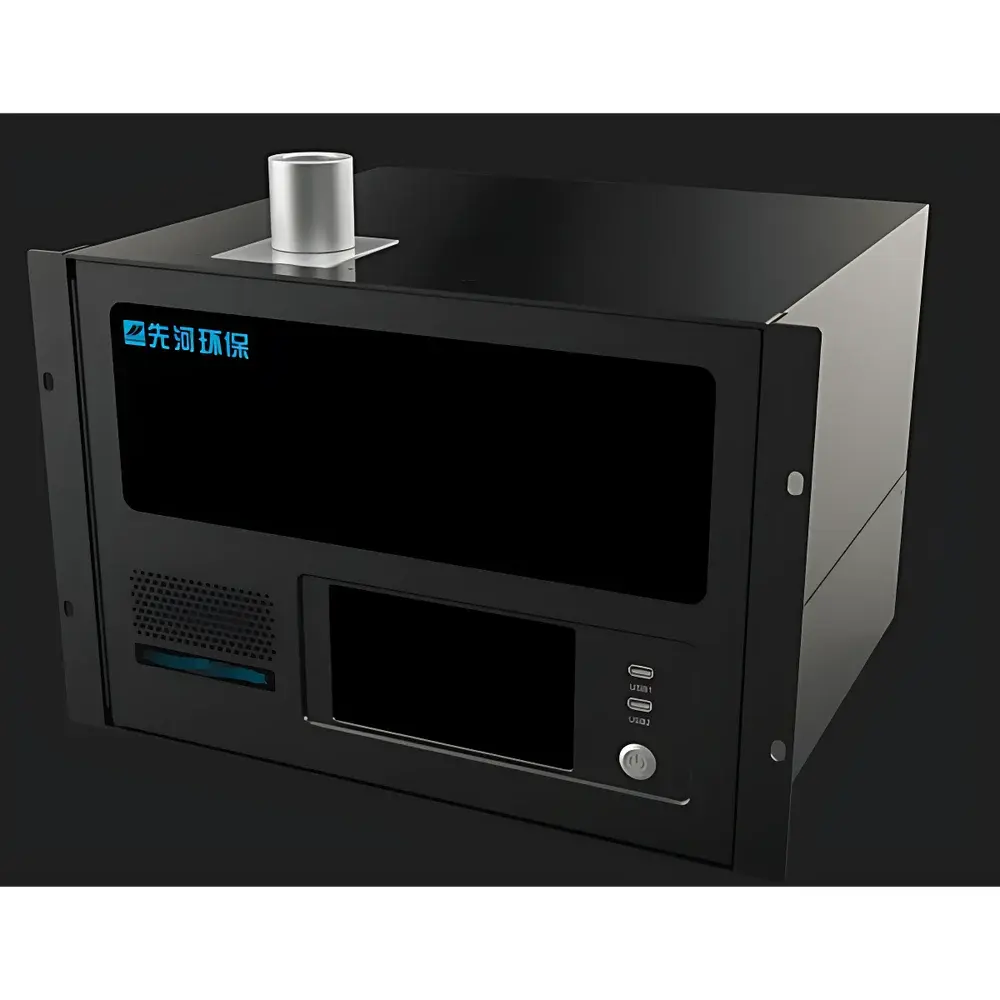
SAIL HERO XHPM2000E PM10 Ambient Particulate Matter Monitor
| Brand | SAIL HERO |
|---|---|
| Origin | Hebei, China |
| Manufacturer Type | Manufacturer |
| Country of Origin | China |
| Model | XHPM2000E |
| Measurement Method | Beta-ray Absorption (β-ray) with Dynamic Heating System |
| Measured Parameter | PM₁₀ |
| Measurement Range | 0–0.1, 0.2, 1, 2, 5, or 10 mg/m³ (user-selectable full-scale) |
| Sampling Interval | 30 min to 1 h (configurable) |
| Sample Flow Rate | 16.7 L/min ±2.5% |
| Limit of Detection (24-h avg) | 1 µg/m³ |
| Compliance | EPA EQPM-0805-154 (equivalent), HJ 653–2013, HJ 93–2013, HJ 978–2018 |
Overview
The SAIL HERO XHPM2000E PM10 Ambient Particulate Matter Monitor is a certified continuous ambient air quality monitoring instrument engineered for regulatory-grade measurement of inhalable particulate matter with aerodynamic diameter ≤10 µm. It operates on the beta-ray absorption principle: a calibrated 14C radioactive source emits beta particles through a continuously advancing tape medium; particulate mass deposited on the tape attenuates the beam proportionally to mass loading. A high-stability scintillation detector quantifies attenuation, enabling real-time mass concentration calculation. Integrated dynamic heating maintains consistent sample temperature and relative humidity during sampling—critical for minimizing volatile artifact losses and ensuring compliance with Chinese national standards HJ 653–2013 (performance requirements) and HJ 93–2013 (cut-point verification). The system is designed for unattended, long-term deployment in fixed-site ambient air monitoring stations, mobile laboratories, and regional network nodes.
Key Features
- Single-channel co-located sampling and measurement architecture eliminates filter tape transport-induced mechanical hysteresis and backtracking error—enhancing measurement reproducibility across extended operational cycles.
- Field-validated PM10 inlet and sharp-cut cyclone separator, independently verified by the Institute of Environmental Health Engineering, Chinese Center for Disease Control and Prevention, meeting ISO 7708:1995 and GB/T 15432–1995 cut-point specifications.
- Hermetically sealed sampling train with multi-stage flanged interface design ensures ingress protection against rain, dust, and condensation when integrated into standard environmental monitoring shelters.
- Compliant radiation safety architecture: 14C source activity strictly adheres to China’s Ministry of Ecology and Environment (MEE) licensing requirements for Class V sealed radioactive sources (GB 18871–2002), with full documentation traceability and annual source leak testing protocols.
- 7-inch capacitive touch display with intuitive Chinese GUI, local time-synchronized data logging, and onboard diagnostics—including flow sensor calibration status, tape tension monitoring, and beta source decay compensation.
- Modular hardware design supports field-swappable components (e.g., pump assembly, beta detector module) to minimize downtime during maintenance or recalibration.
Sample Compatibility & Compliance
The XHPM2000E is validated for ambient outdoor air matrices under typical urban, suburban, and rural conditions. It accommodates variable aerosol hygroscopicity and loading rates without requiring manual filter changes over 30-day intervals (standard tape length). All critical performance parameters—including cut-point efficiency, flow accuracy, and detection limit—are verified per MEE-certified test protocol HJ 978–2018 and accredited by the China National Environmental Monitoring Center (CNEMC) Quality Supervision and Inspection Center for Environmental Monitoring Instruments. The instrument meets electromagnetic compatibility (EMC) requirements per GB/T 18268.1–2010 and environmental operating specifications (−30 °C to +50 °C, 10–90% RH non-condensing). It is certified under the China Environmental Protection Industry Association (CEPIA) Environmental Product Certification Program (Certificate No. CEP-XXXXX).
Software & Data Management
Embedded firmware supports dual-mode data output: RS-232/485 serial communication (MODBUS RTU) and optional Ethernet TCP/IP (HTTP/FTP). Raw beta counts, flow-corrected mass values, tape position timestamps, and diagnostic flags are logged at user-defined intervals (default: 1-min resolution). Data files conform to MEE’s “Environmental Air Quality Automatic Monitoring Data Transmission Technical Specification” (HJ 212–2017), enabling seamless integration with provincial and national air quality data platforms (e.g., CNEMC’s AQMS). Audit-trail functionality records all configuration changes, calibration events, and source replacement dates—supporting GLP-aligned record retention for up to 18 months onboard. Remote firmware updates and parameter reconfiguration are supported via authenticated HTTPS interface.
Applications
- Regulatory compliance monitoring for national ambient air quality standards (GB 3095–2012) at Tier-1 and Tier-2 monitoring sites.
- Source apportionment support studies where high-temporal-resolution PM10 trends correlate with meteorological and traffic emission data.
- Long-term trend analysis in ecological assessment programs, including background station networks and transboundary pollution tracking.
- Validation reference for low-cost sensor networks requiring periodic collocation and bias correction.
- Indoor-outdoor penetration factor studies in near-roadway or industrial buffer zone environments.
FAQ
Is the 14C beta source subject to international transport restrictions?
Yes—the source is classified as UN2911, Class 7 radioactive material. Shipment requires IAEA SSR-6-compliant packaging, prior notification to destination country’s competent authority, and adherence to national import licensing (e.g., MEE approval in China, NRC or Agreement State authorization in the U.S.).
Does the instrument support PM2.5 measurement?
No—the XHPM2000E is configured exclusively for PM10 per its certified inlet and cyclone design. A separate model (XHPM2000D) is available for PM2.5.
How often is tape replacement required under typical urban conditions?
At average PM10 concentrations of 50 µg/m³ and 1-hour sampling intervals, the standard 20-m tape lasts approximately 25–30 days. Low-concentration rural deployments may extend this to 60+ days.
Can the dynamic heating temperature be adjusted by the user?
No—operating temperature is factory-set to 50 °C ±2 °C to ensure optimal volatility control per HJ 653–2013; adjustment is disabled in field firmware to preserve metrological integrity.
What calibration traceability does the instrument provide?
All factory calibrations are traceable to NIM (National Institute of Metrology, China) mass standards. Field span checks use NIST-traceable PM10 reference aerosols (e.g., Arizona Test Dust, ISO 12103-1 A2) following HJ 93–2013 Annex B procedures.
Related Products







