
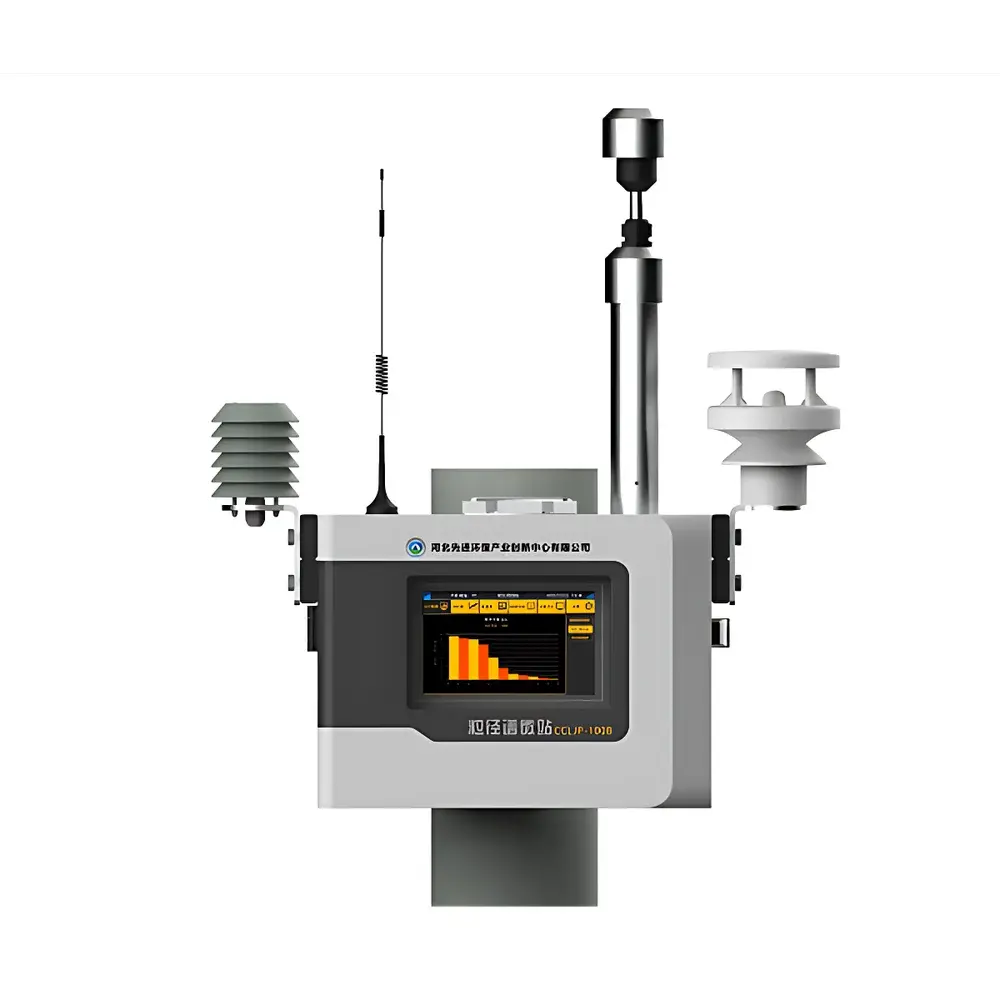
SAIL HERO CCLJP-100B Atmospheric Particle Size Spectrometer
| Brand | SAIL HERO |
|---|---|
| Origin | Hebei, China |
| Manufacturer Type | Original Equipment Manufacturer (OEM) |
| Product Origin | Domestic (China) |
| Model | CCLJP-100B |
| Pricing | Upon Request |
| Measurement Principle | Optical Light Scattering |
| Particle Size Range | 0.3–20 µm |
| Number of Size Channels | 12 |
Overview
The SAIL HERO CCLJP-100B Atmospheric Particle Size Spectrometer is a fixed-site, real-time ambient aerosol monitoring instrument engineered for high-fidelity characterization of airborne particulate matter (PM) size distribution in outdoor environments. It operates on the principle of multi-angle, calibrated optical light scattering—where particles drawn through a controlled laminar flow path interact with a stable laser source, generating scattered light intensity signals proportional to particle diameter and refractive index. These signals are processed via pulse-height analysis to assign individual particles to one of twelve pre-defined logarithmic size bins spanning 0.3 µm to 20 µm. Unlike single-point PM mass estimators (e.g., beta attenuation or tapered element oscillating microbalance), the CCLJP-100B delivers granular number concentration data per channel, enabling quantitative reconstruction of both number- and mass-weighted size distributions (e.g., dN/dlogDp and dM/dlogDp), essential for source apportionment modeling and regulatory compliance reporting.
Key Features
- Twelve-channel optical particle counter with validated sizing resolution across 0.3–20 µm, traceable to NIST-traceable polystyrene latex (PSL) standards;
- Pump-assisted isokinetic sampling with dynamic heating of the inlet manifold (up to 50 °C) to suppress hygroscopic growth artifacts and minimize humidity-induced bias in sub-2.5 µm measurements;
- Integrated zero-point auto-calibration algorithm that executes periodic background subtraction during low-aerosol periods, mitigating long-term photodetector drift and maintaining baseline stability over extended unattended operation;
- Self-cleaning optical path design featuring pulsed airflow and hydrophobic lens coating, reducing maintenance frequency and sustaining optical throughput consistency over >6 months of continuous deployment;
- Embedded industrial-grade touchscreen HMI (7-inch capacitive display) supporting local visualization of real-time size-resolved counts, calculated PM1.0/PM2.5/PM10/TSP mass concentrations (via Mie theory-based conversion), and system diagnostics;
- Modular expansion architecture supporting optional co-located sensors for meteorological parameters (temperature, relative humidity, barometric pressure, wind speed/direction) and gaseous pollutants (SO2, NO2, NO, CO, O3, TVOC) via standardized RS-485/Modbus RTU interfaces.
Sample Compatibility & Compliance
The CCLJP-100B is designed for continuous, unattended monitoring of ambient air in urban, industrial, and construction site environments. Its inlet geometry and flow control meet ISO 29463-3:2017 requirements for aerosol sampling representativeness under variable wind conditions. Size bin calibration adheres to ISO 21501-4:2018 for light-scattering particle counters. When deployed in networks, the instrument supports data formatting compliant with China’s HJ 653–2013 and EU’s AQ Directive (2008/50/EC) reporting frameworks. Firmware includes audit-trail logging (user actions, calibration events, firmware updates) aligned with GLP principles for environmental monitoring applications.
Software & Data Management
Data acquisition and remote management are handled via SAIL HERO’s proprietary EnviroLink™ Edge Gateway software, which runs onboard Linux OS. The system outputs time-stamped, size-resolved count data at 1-minute intervals in CSV and JSON formats, with configurable MQTT/HTTP(S) push to central platforms (e.g., cloud-based dashboards or SCADA systems). All communications are secured using TLS 1.2+ encryption. Local storage retains ≥30 days of raw channel data and metadata. Remote firmware updates and parameter reconfiguration are supported via authenticated HTTPS API endpoints, ensuring operational continuity during regulatory audits or method validation exercises.
Applications
- Urban air quality management: Differentiating traffic-related ultrafine particles (2.5 µm) to inform emission control strategies;
- Construction site compliance monitoring: Quantifying fugitive dust emissions by size fraction to verify effectiveness of water suppression or wind barriers;
- Industrial fence-line monitoring: Detecting process-specific particle signatures (e.g., metal fumes at 0.05–0.5 µm; cement kiln dust at 1–10 µm);
- Source apportionment studies: Feeding size distribution inputs into positive matrix factorization (PMF) or chemical mass balance (CMB) models;
- Health impact assessment: Correlating fine-mode particle number concentrations with respiratory hospital admission rates in epidemiological cohort studies.
FAQ
Does the CCLJP-100B comply with U.S. EPA or EU reference method equivalency requirements?
The instrument is not certified as a Federal Reference Method (FRM) or Federal Equivalent Method (FEM) device under 40 CFR Part 53. It is intended for supplemental monitoring, trend analysis, and high-density network deployment—not regulatory-grade compliance measurement.
Can size channel boundaries be user-defined or reconfigured?
No. The 12-channel binning structure (logarithmically spaced from 0.3 µm to 20 µm) is factory-calibrated and fixed to ensure metrological traceability and inter-unit comparability.
What is the recommended maintenance interval for optical cleaning and flow verification?
Optical path self-cleaning operates continuously; full preventive maintenance—including flow rate verification with a primary calibrator and lens inspection—is recommended every 6 months under typical urban deployment conditions.
Is raw scatter signal data accessible for offline Mie inversion?
Raw pulse-height histograms are not exposed via standard interfaces. Only processed channel counts and derived mass concentrations are output. Custom firmware enabling raw signal export requires prior contractual agreement and technical review.
How does the instrument handle condensation in high-humidity environments?
The heated inlet (adjustable 30–50 °C) maintains sample air above dew point throughout the sensing zone. Combined with an embedded humidity-compensated Mie lookup table, this reduces RH-dependent bias to <±8% across 30–95% RH at 25 °C.
Related Products







