
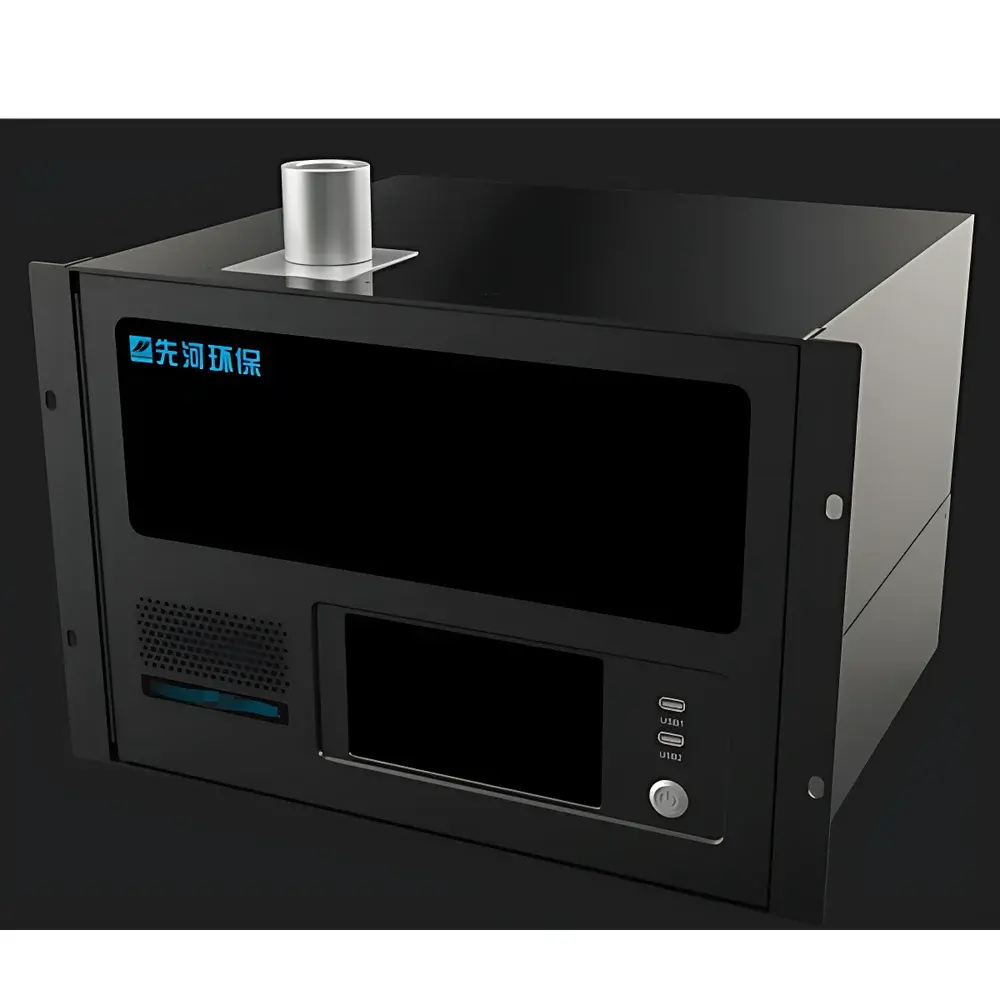
SAIL HERO XHPM2000E Beta-Ray Attenuation PM2.5 Continuous Ambient Air Monitor
| Brand | SAIL HERO |
|---|---|
| Origin | Hebei, China |
| Manufacturer Type | Original Equipment Manufacturer (OEM) |
| Country of Origin | China |
| Model | XHPM2000E |
| Measurement Principle | Beta-ray attenuation with dynamic heating system |
| Measured Parameter | PM₂.₅ mass concentration |
| Measurement Range | 0–0.1, 0.2, 1, 2, 5, or 10 mg/m³ (user-selectable full-scale ranges) |
| Measurement Cycle | 30 min to 60 min (configurable) |
| Sampling Flow Rate | 16.7 L/min ±2.5% |
| Limit of Detection (24-hr avg) | 5 µg/m³ |
| Compliance | Certified per Chinese EPA requirements for radioactive source management, HJ 653–2013, HJ 93–2013, and GB/T 34672–2017 |
| Regulatory Approvals | CEPAA Environmental Product Certification, CNEMC Calibration & Performance Verification Report, CIPAC Technical Appraisal Certificate for PM₂.₅ Separation Inlet |
Overview
The SAIL HERO XHPM2000E is a regulatory-grade, continuous ambient air monitoring instrument engineered for precise, long-term quantification of fine particulate matter (PM₂.₅) mass concentration in outdoor environments. It operates on the beta-ray attenuation principle—where a calibrated β-particle source (typically 14C) emits low-energy electrons through a continuously advancing quartz or glass fiber tape; particle deposition attenuates the beam intensity proportionally to mass loading. A photodetector measures the transmitted radiation, and mass concentration is calculated via the Beer–Lambert relationship, corrected in real time using dynamic heating control to minimize humidity-induced bias. Unlike oscillating filter systems, the XHPM2000E employs a unidirectional tape transport mechanism within a single integrated sampling–measurement channel, eliminating mechanical hysteresis and positional repeatability errors associated with filter repositioning. Its design adheres to the core metrological requirements defined in HJ 653–2013 (Technical Specification for Ambient Air PM Monitoring Instruments) and aligns functionally with ISO 20877:2021 (Air quality — Measurement of PM₁₀ and PM₂.₅ mass concentrations — Beta attenuation method).
Key Features
- Integrated dynamic heating system maintains tape temperature above dew point during sampling, significantly reducing hygroscopic artifact in humid conditions without compromising particle integrity.
- Single-path flow architecture ensures zero dead volume between inlet and measurement zone—minimizing particle loss, wall deposition, and residence-time variability.
- Stainless-steel, multi-stage flanged inlet interface provides IP65-rated environmental sealing and prevents rainwater infiltration under operational station roof mounting.
- Compliant PM₂.₅ sharp-cut cyclone separator (validated by the Institute of Environmental Health Engineering, Chinese Center for Disease Control and Prevention) meets the aerodynamic diameter cutoff criteria (D₅₀ = 2.5 µm ±0.2 µm, σg ≤ 1.2) specified in ISO 10699 and HJ 93–2013.
- Embedded ARM-based controller with 7-inch capacitive touchscreen, localized Chinese GUI, and embedded diagnostics—including flow calibration traceability, tape tension monitoring, and source activity decay compensation.
- Radioactive source housing conforms to national Class V sealed source licensing requirements (MEP Order No. 42), including lead-shielded encapsulation, interlocked access doors, and mandatory annual leakage testing documentation.
Sample Compatibility & Compliance
The XHPM2000E is validated for ambient outdoor air matrices across urban, suburban, industrial, and background monitoring sites. It accepts standard 47-mm or 50-mm diameter quartz fiber tapes compliant with ASTM D6216 and ISO 12103-1 (A2 test dust). The instrument’s inlet configuration supports co-location with reference-grade TEOM or gravimetric samplers per US EPA EQOA protocol. All hardware and firmware meet electromagnetic compatibility (EMC) Class B limits (GB/T 18268.1–2010), and data output complies with HJ 212–2017 communication protocol for integration into provincial and national environmental information platforms. Full audit trail functionality—including operator logins, parameter changes, calibration events, and error flags—is retained for GLP-aligned QA/QC reporting.
Software & Data Management
Firmware v3.2+ supports dual-mode data export: Modbus TCP (port 502) for SCADA integration and ASCII-formatted serial output (RS-232/485) with configurable delimiter and timestamp format (ISO 8601). Internal storage retains ≥30 days of 1-hour averaged PM₂.₅ values, flow logs, temperature/humidity sensor readings, and system health metrics. Remote maintenance is enabled via TLS-secured SSH tunneling; no cloud dependency or proprietary vendor servers are required. Raw beta-count data and tape position timestamps are preserved for retrospective reprocessing—critical for method validation studies and regulatory discrepancy investigations.
Applications
- National and municipal ambient air quality monitoring networks (AAQMN) requiring Tier 1 reference-equivalent performance.
- Source apportionment studies where temporal resolution and inter-instrument comparability are essential.
- Long-term trend analysis in epidemiological cohort studies (e.g., exposure–response modeling).
- Verification of regional emission control policy effectiveness (e.g., post-coal-to-gas conversion PM reduction assessment).
- Calibration transfer and field validation of lower-cost optical PM sensors via collocated deployment.
FAQ
Does the XHPM2000E require annual radioactive source recertification?
Yes—per MEP Order No. 42, users must submit biannual leakage test reports and maintain an up-to-date registration certificate with provincial ecological environment departments.
Can the instrument operate continuously at sub-zero temperatures?
It is rated for –20 °C to +50 °C ambient operation; internal thermal management sustains tape heater and detector stability down to –15 °C, with optional heated inlet extension for sustained Arctic deployment.
Is the PM₂.₅ separation inlet interchangeable with other models?
No—the cyclone is mechanically and aerodynamically tuned to the XHPM2000E’s flow profile and pressure drop characteristics; substitution voids certification and invalidates compliance reporting.
What data formats are supported for third-party platform ingestion?
HJ 212–2017 XML schema, CSV with header row, and Modbus register mapping documentation are provided in the technical annex.
How is calibration traceability maintained?
Primary calibration uses NIST-traceable gravimetric standards (SRM 2783); field verification follows HJ 653–2013 zero/span check protocols with certified ozone-free zero air and polydisperse PSL aerosol challenge.







