
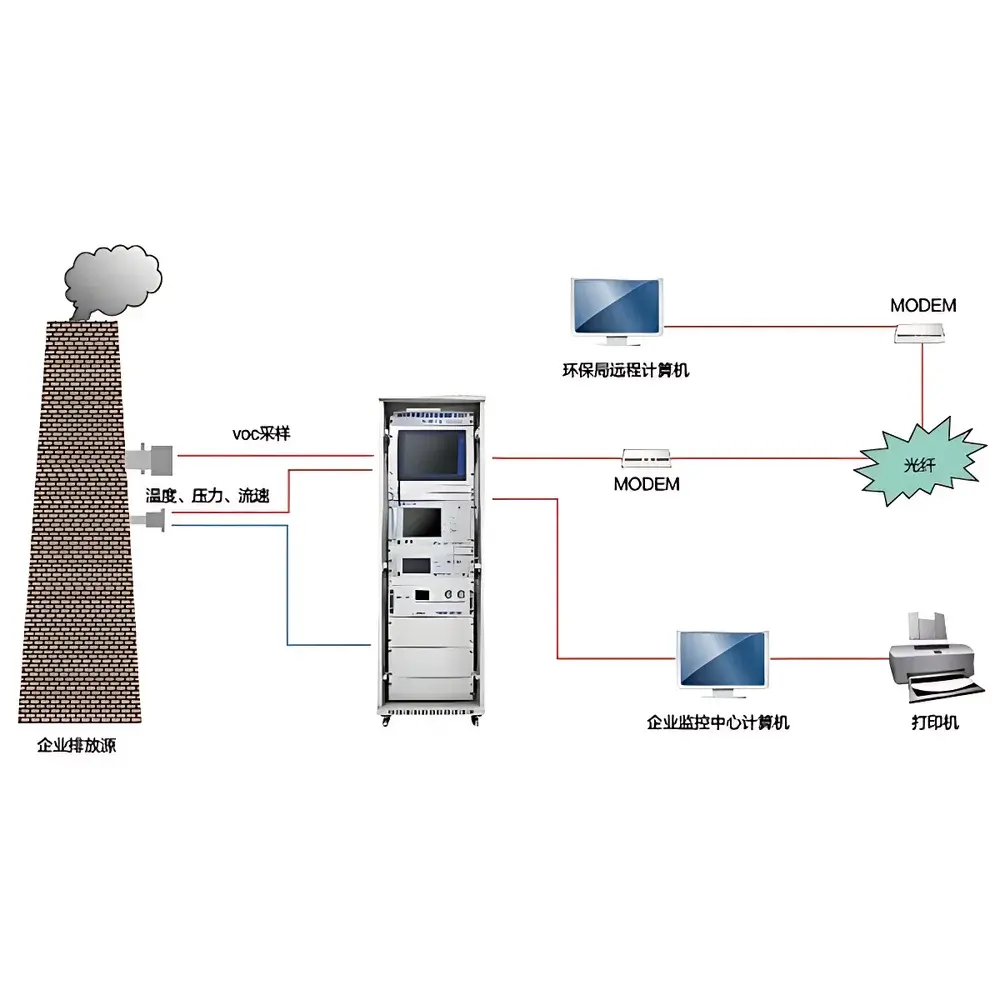
SAIL HERO XHVOC40 Fixed-Source Volatile Organic Compounds (VOCs) Continuous Emission Monitoring System
| Brand | SAIL HERO |
|---|---|
| Origin | Hebei, China |
| Manufacturer Type | Original Equipment Manufacturer (OEM) |
| Country of Origin | China |
| Model | XHVOC40 |
| Pricing | Available Upon Request |
Overview
The SAIL HERO XHVOC40 Fixed-Source Volatile Organic Compounds (VOCs) Continuous Emission Monitoring System is an industrial-grade analytical platform engineered for regulatory-compliant, real-time quantification of VOCs in stack emissions from stationary sources. It operates on the principle of gas chromatography–flame ionization detection (GC-FID), optionally enhanced with thermal desorption and pre-concentration modules for trace-level analysis. The system is designed to meet stringent environmental monitoring requirements under national emission standards (e.g., China’s HJ 1013–2018, HJ 75–2017, and HJ 76–2017), while supporting international alignment with ISO 16000-6, EPA Method TO-17, and EN 13649-1 for VOC speciation and quantification. Its core function is to deliver continuous, unattended measurement of non-methane hydrocarbons (NMHC), total hydrocarbons (THC), methane (CH₄), and targeted aromatic compounds—including benzene, toluene, ethylbenzene, xylenes (o-, m-, p-), and styrene—enabling source apportionment, compliance verification, and process optimization.
Key Features
- Modular GC-FID architecture with dual-column switching capability for simultaneous NMHC/THC and speciated VOC analysis
- Integrated heated sampling line (up to 180 °C) and particulate filtration to prevent condensation and clogging in high-humidity or high-dust flue gas streams
- Automated calibration verification using certified standard gases (CH₄, C₃H₈, benzene, toluene) at user-defined intervals (e.g., every 24 h)
- Real-time data acquisition with ≤15-minute cycle time per analysis cycle, supporting both 15-min average reporting and 1-hour integrated averages
- Robust enclosure rated IP54 with internal temperature and humidity control for stable operation in ambient conditions ranging from −20 °C to +50 °C
- Onboard diagnostics including flow rate monitoring, detector response validation, and leak detection via pressure decay testing
Sample Compatibility & Compliance
The XHVOC40 accommodates a wide range of flue gas matrices typical of industrial combustion and chemical processing applications—including high-moisture (up to 20% v/v), high-temperature (≤200 °C post-dilution), and corrosive environments (e.g., presence of SO₂, NOₓ, HCl). Sample conditioning includes catalytic methanation for selective NMHC determination and optional cryo-trapping for PAMS (Photochemical Assessment Monitoring Stations) compound analysis. The system complies with China’s Technical Specifications for Continuous Emission Monitoring Systems (CEMS) for VOCs (HJ 1013–2018), as well as general requirements for CEMS performance evaluation (HJ 75–2017). It supports audit-ready data logging aligned with GLP principles and provides timestamped raw chromatograms, calibration logs, and maintenance records for regulatory review.
Software & Data Management
The embedded monitoring software (XHVOC-Suite v3.x) provides full remote configuration, real-time chromatogram visualization, peak integration, and automated report generation in PDF/CSV formats. All data are stored locally on industrial-grade SSD with ≥30-day retention; optional cloud synchronization enables secure access via TLS-encrypted web portal. Audit trails record all user actions—including method changes, calibration events, and manual interventions—with immutable timestamps. The system supports export of data compliant with China’s National Emission Permit Management Platform (NEPMP) and is extensible for integration into enterprise SCADA or DCS systems via Modbus TCP or OPC UA protocols. Data integrity safeguards include electronic signatures, role-based access control (RBAC), and configurable retention policies meeting local archiving mandates.
Applications
The XHVOC40 is deployed across regulated industrial sectors where VOC emissions are subject to permit limits and routine inspection. Primary use cases include continuous monitoring of catalytic cracking units and fluidized bed reactors in petroleum refining; off-gas streams from polymer synthesis, solvent recovery, and distillation columns in fine chemical manufacturing; drying and curing exhaust in automotive painting lines and coil coating facilities; printing solvent emissions in flexographic and gravure operations; and reactor vent streams in pharmaceutical API synthesis. It is also applied in compliance verification for wood furniture finishing, rubber vulcanization, and metal surface treatment processes—where formaldehyde, acetone, methanol, and other oxygenated VOCs may be specified as additional analytes under site-specific permits.
FAQ
Does the XHVOC40 support measurement of ozone precursors beyond the standard PAMS list?
Yes—custom method development is available for up to 50 additional VOCs, including isoprene, terpenes, and carbonyl compounds, subject to GC column selection and detector sensitivity validation.
Can the system operate without on-site operator intervention for extended periods?
Yes—the XHVOC40 is certified for unattended operation up to 30 days between maintenance cycles, provided ambient conditions remain within specification and calibration gases are replenished accordingly.
Is the data output compatible with third-party environmental data platforms?
Yes—standardized XML and CSV exports conform to China’s HJ 212–2017 communication protocol; custom API integration is supported upon request.
What is the minimum detection limit (MDL) for benzene under typical operating conditions?
The MDL is ≤0.5 ppb (v/v) for benzene when configured with thermal desorption pre-concentration and optimized GC parameters.
How does the system handle interference from methane in NMHC measurements?
Methane is selectively removed via catalytic oxidation prior to FID detection, ensuring NMHC values reflect only non-methane carbon species as defined in HJ 38–2017.







