
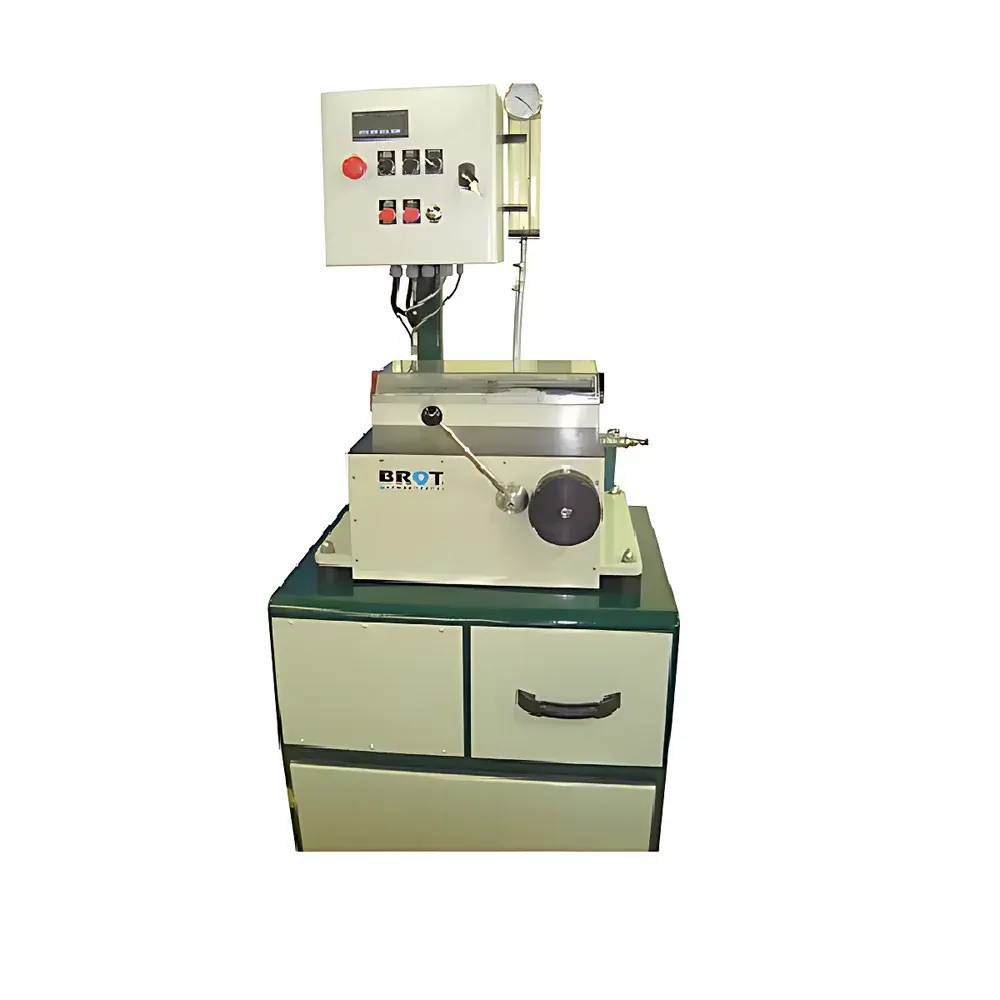
BROT-LAB Model 1.03.13A Optical Visual Single-Slide Precision Grinder
| Brand | French BROT-LAB |
|---|---|
| Origin | France |
| Model | 1.03.13A |
| Dimensions (L×W×D) | 600 × 920 × 1320 mm |
| Grinding Disc Count | 1 |
| Disc Diameter | 150 mm |
| Rotational Speed | 2800 rpm |
| Thickness Control Resolution | 5 µm per scale division |
| Target Final Thickness | 30–45 µm |
| Power Supply | 3-phase, 220–380 V, 50 Hz, 1 kVA |
| Motor | 0.75 HP |
| Cooling Fluid Inlet/Outlet | Ø12 mm / Ø25 mm |
| Weight | 117 kg |
Overview
The BROT-LAB Model 1.03.13A Optical Visual Single-Slide Precision Grinder is a purpose-engineered instrument for the automated, high-accuracy preparation of optically transparent thin sections—primarily for petrographic and geological microscopy. Unlike conventional grinding systems requiring multiple manual repositioning steps, this unit integrates real-time polarized light observation with closed-loop thickness control to achieve single-pass thinning from ~150 µm down to a precisely defined final thickness of 30–45 µm. Its core principle relies on controlled abrasive removal via a rotating diamond-impregnated disc (Ø150 mm), synchronized with optical feedback from an integrated polarized viewing system. This enables continuous visual monitoring of birefringence intensity and interference color shifts—particularly critical for quartz-rich samples—allowing operators to correlate gray-scale contrast directly with residual thickness. The system is engineered for reproducibility in ISO/IEC 17025-accredited geoscience laboratories and complies with ASTM D7571-21 (Standard Practice for Preparation of Thin Sections for Petrographic Analysis) and USP guidelines for optical sample integrity.
Key Features
- Integrated polarized light observation module with coaxial illumination path, enabling real-time assessment of optical anisotropy during grinding
- Manual micrometric thickness adjustment with 5 µm graduation and tactile feedback, calibrated against certified reference standards
- Vibration-damped, self-aligning spindle assembly ensuring runout ≤ 5 µm at 2800 rpm for planar uniformity
- Programmable vacuum chuck with adjustable suction pressure (0.4–0.7 bar) for secure, non-damaging fixation of brittle rock specimens (e.g., shale, basalt, granite)
- Automated coolant delivery system with recirculating sediment trap (30 L capacity), compatible with water, oil-based slurries, or proprietary polishing reagents
- Ergonomic left-rotating lever mechanism for precise angular engagement of specimen to grinding surface, minimizing edge chipping
- Digital readout interface (2020 firmware revision) logging operational parameters including cumulative grinding time, coolant flow rate, and motor load history
Sample Compatibility & Compliance
The 1.03.13A accommodates standard thin-section formats—including metric sizes 27×46 mm, 28×48 mm, 30×45 mm, 40×60 mm, and 45×60 mm—as well as imperial variants (1″×1.75″, 1″×3″, 1.5″×3″, 2″×3″). It processes silicate-rich rocks (quartzite, sandstone, schist), carbonate matrices (limestone, dolomite), and fine-grained igneous specimens (rhyolite, obsidian) without delamination. For fluid inclusion studies, it achieves consistent 30–45 µm thickness with surface roughness Ra < 0.05 µm post-polish—meeting requirements for transmitted-light microthermometry per IMA Commission on Ore Mineralogy protocols. All mechanical and electrical components conform to CE EN 61000-6-2 (EMC immunity) and EN 60204-1 (safety of machinery). The vacuum and coolant subsystems are validated for GLP-compliant documentation traceability.
Software & Data Management
While the 1.03.13A operates primarily via analog-digital hybrid controls, its 2020 firmware update introduces timestamped parameter logging accessible via USB export. Logged metadata includes start/stop timestamps, total grinding duration, average rotational speed stability (±2 rpm deviation), vacuum pressure profile, and coolant temperature drift (±0.5°C resolution). Exported CSV files are structured for direct import into LIMS platforms supporting ASTM E1461-22 data schema. Audit trails comply with FDA 21 CFR Part 11 requirements when paired with user-authenticated external storage—no embedded electronic signatures are generated internally. Firmware updates require authenticated access through BROT-LAB’s authorized service portal.
Applications
- Petrographic thin section preparation for transmitted-light microscopy, including identification of mineral assemblages, grain boundary analysis, and deformation microstructures
- Preparation of fluid inclusion host thin sections for microthermometric analysis and Raman spectroscopy
- Controlled thinning of ceramic composites and sintered metallographic samples where phase continuity must be preserved
- Standardization of reference material thickness across inter-laboratory round-robin studies under IUGS Petrological Code guidelines
- Teaching laboratory deployment: enables students to observe real-time birefringence evolution during grinding, reinforcing crystal-optical theory
FAQ
Does the 1.03.13A support automated endpoint detection?
No—it relies on operator interpretation of polarized light response; no optical sensor-based auto-shutoff is implemented.
Can the machine process non-rock samples such as polymers or biological tissues?
Not recommended; the grinding force and cooling regime are optimized for mineral hardness (Mohs 5–7); softer materials risk smearing or thermal degradation.
Is the vacuum system compatible with conductive carbon-coated specimens?
Yes—vacuum pressure is adjustable down to 0.4 bar, sufficient for fragile coated samples without compromising adhesion.
What maintenance intervals are specified for the diamond grinding disc?
BROT-LAB recommends disc replacement after 200–250 hours of cumulative operation or upon measurable reduction in grinding rate (>15% increase in time to reach 30 µm).
Is third-party calibration certification available?
Yes—BROT-LAB’s authorized service centers provide ISO/IEC 17025-accredited calibration reports covering thickness control linearity, rotational speed accuracy, and vacuum pressure repeatability.



