
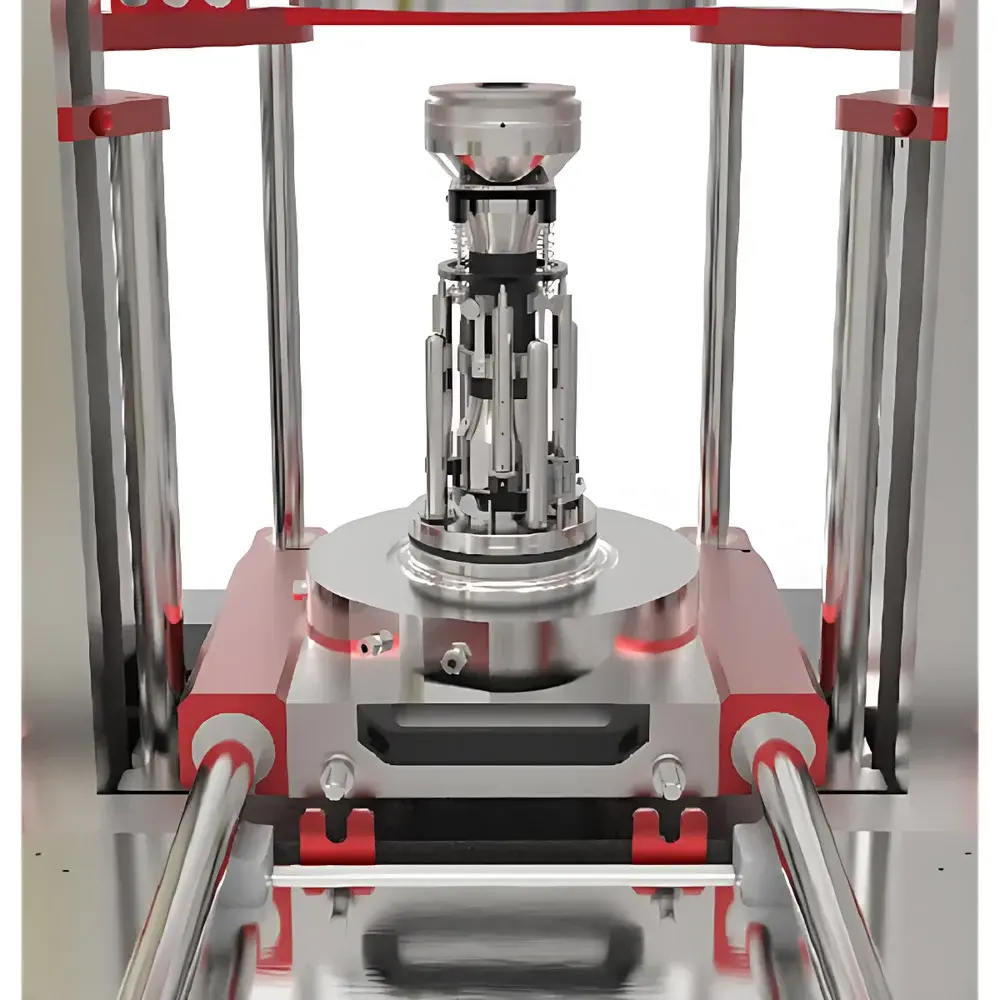
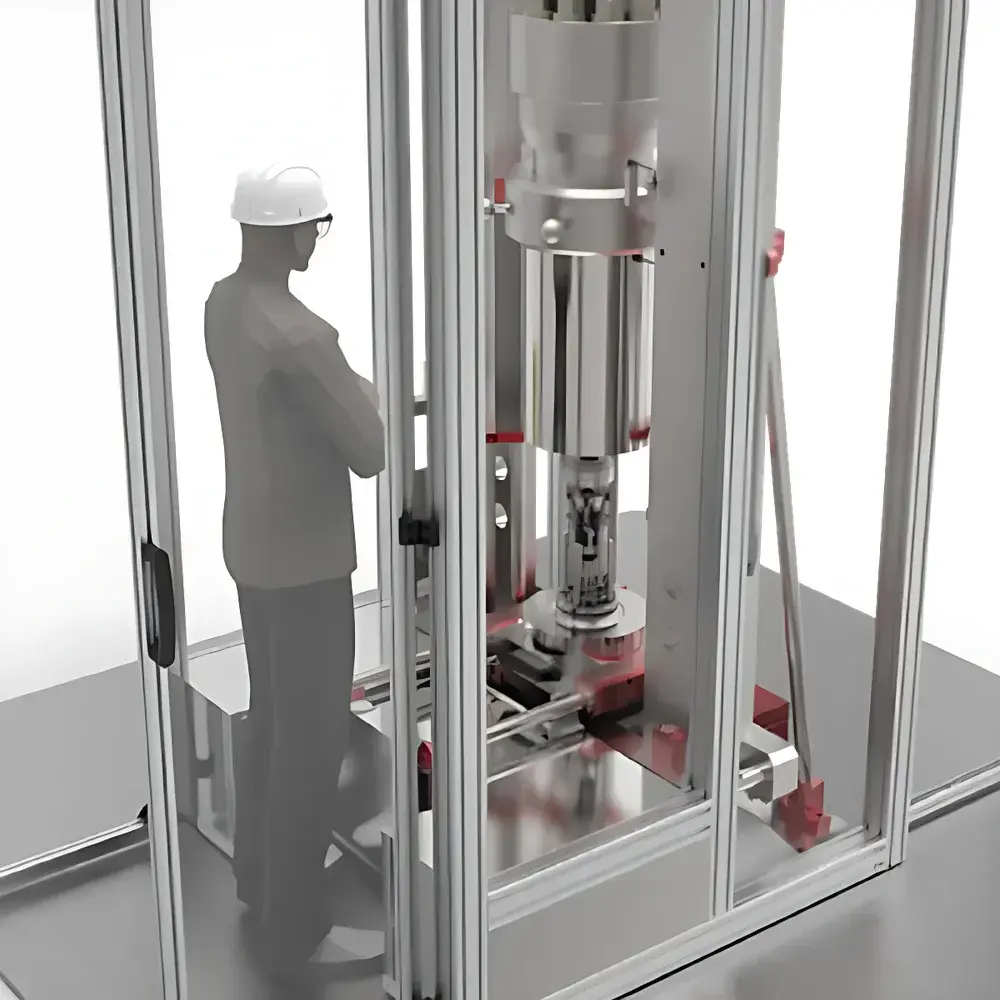
Irian GC TRIAX-200 Rock Triaxial Mechanical Testing System
| Brand | Irian |
|---|---|
| Origin | France |
| Manufacturer Type | Authorized Distributor |
| Product Origin | Imported |
| Model | GC TRIAX-200 |
| Axial Load Capacity | Up to 2000 kN |
| Axial Displacement Range | 15 mm |
| Specimen Height Range | 70–110 mm |
| Confining Pressure Capacity | Up to 150 MPa |
| Temperature Range | Ambient to 200 °C |
| Wetted Parts Material Options | Stainless Steel or Hastelloy® |
Overview
The Irian GC TRIAX-200 Rock Triaxial Mechanical Testing System is a high-fidelity, servo-controlled geomechanical testing platform engineered for quantitative characterization of rock and geomaterials under controlled stress, pore pressure, temperature, and fluid-flow conditions. Based on the classical triaxial compression principle—where axial load is applied to a cylindrical specimen confined by independently regulated radial (confining) pressure—the GC TRIAX-200 enables precise simulation of in-situ crustal stress states. Its proprietary self-balancing hydraulic frame eliminates parasitic bending moments and ensures true uniaxial alignment during loading, critical for measuring brittle fracture onset, strain localization, and post-peak softening behavior with high reproducibility. The system integrates a high-pressure injection pump for dynamic pore-fluid pressurization (e.g., water, brine, CO₂, or hydrocarbons), supporting coupled mechanical–hydraulic–thermal (THM) experimental protocols aligned with reservoir geomechanics, CCS integrity assessment, and nuclear waste repository research.
Key Features
- Self-balancing dual-cylinder hydraulic frame architecture minimizes frame compliance and lateral deflection, ensuring <0.1% deviation from ideal axial loading alignment across full load range.
- Independent high-precision confining pressure control up to 150 MPa via servo-regulated hydraulic intensifiers, compatible with both liquid and supercritical fluid media.
- Integrated high-pressure injection pump enables real-time pore pressure ramping, step-hold sequences, and permeability transient analysis (e.g., pulse-decay, steady-state flow).
- 48-channel hermetically sealed electrical feedthroughs support concurrent acquisition of acoustic emission (AE), ultrasonic velocity (P- and S-wave), strain gauge, thermocouple, and pore pressure transducer signals.
- Dedicated ultrasonic transducer integration bay accommodates standard 1 MHz–5 MHz broadband transducers with adjustable axial spacing and coupling fluid ports.
- Optional automated high-pressure valve manifold enables programmable multi-step fluid switching (e.g., brine → CO₂ → N₂) without depressurization, reducing experimental cycle time and contamination risk.
- Temperature-controlled environmental chamber (ambient to 200 °C) with PID-regulated heating and forced-air cooling maintains ±0.5 °C stability during long-duration creep or thermal-mechanical tests.
Sample Compatibility & Compliance
The GC TRIAX-200 accepts standard rock core specimens (diameter: 25–50 mm; height: 70–110 mm) as defined in ASTM D7012, ISO 14689-1, and ISRM suggested methods. Custom specimen geometries—including notched cylinders for fracture toughness (KIc) evaluation and hollow cylinders for true triaxial stress path testing—are supported via optional fixtures. All wetted components comply with NACE MR0175/ISO 15156 for sour service environments. The system meets electromagnetic compatibility (EMC) requirements per EN 61326-1 and carries CE marking for laboratory equipment safety (2014/30/EU, 2014/35/EU). Data acquisition and control firmware supports audit-trail generation compliant with GLP and 21 CFR Part 11 when paired with validated software configurations.
Software & Data Management
The GC TRIAX-200 operates under Irian’s TRIAX Control Suite—a modular, Windows-based application built on deterministic real-time kernel architecture. It provides synchronized control of axial load, confining pressure, pore pressure, temperature, and auxiliary instrumentation at up to 1 kHz sampling rate. Built-in scripting (Python API) enables user-defined test protocols, including stress-path cycling, constant-strain-rate loading with feedback compensation, and closed-loop permeability regulation. Raw data streams are stored in HDF5 format with embedded metadata (specimen ID, calibration coefficients, operator ID, timestamp, environmental conditions). Export modules support direct conversion to ASTM-compliant CSV, MATLAB .mat, and Parquet formats. Optional IQ/OQ documentation packages and electronic signature workflows are available for regulated laboratories requiring GMP validation.
Applications
- Constitutive modeling of shale, sandstone, granite, and salt under reservoir-relevant stress–temperature–pore pressure conditions.
- Time-dependent deformation analysis: tertiary creep, stress relaxation, and viscoelastic parameter identification.
- Hydro-mechanical coupling studies: effective stress law validation, Skempton’s coefficient determination, and permeability evolution during dilation.
- Fracture mechanics: crack initiation threshold (CI), crack damage threshold (CD), and fracture energy quantification via digital image correlation (DIC)-integrated setups.
- CO₂–rock interaction experiments: chemically induced weakening, mineral dissolution kinetics, and caprock seal integrity assessment under reactive flow.
- Geothermal reservoir simulation: thermal cracking onset, thermal conductivity anisotropy, and thermo-poroelastic coefficient measurement.
FAQ
What is the maximum allowable aspect ratio for specimens tested in the GC TRIAX-200?
The recommended height-to-diameter ratio is 2.0–2.5, consistent with ISRM guidelines for minimizing end-effect artifacts. Ratios up to 3.0 are permissible with appropriate end-cap friction mitigation (e.g., PTFE sleeves or lubricated steel platens).
Can the system perform true triaxial (σ₁ ≠ σ₂ ≠ σ₃) tests?
The GC TRIAX-200 is configured for conventional triaxial (σ₂ = σ₃) testing. True triaxial capability requires the optional TRIAX-TT add-on module, which replaces the isotropic confining jacket with three orthogonal servo-controlled pressure vessels.
Is ultrasonic velocity measurement integrated by default?
Ultrasonic transducer mounting hardware and signal conditioning channels are standard; however, transducers, pulser-receivers, and velocity analysis algorithms are supplied as configurable options based on frequency range and material attenuation requirements.
How is calibration traceability maintained?
Load cells, pressure transducers, and displacement sensors are factory-calibrated against NIST-traceable standards. Certificate of Calibration (CoC) with uncertainty budgets is provided; annual recalibration services include on-site verification and adjustment per ISO/IEC 17025-accredited procedures.






