
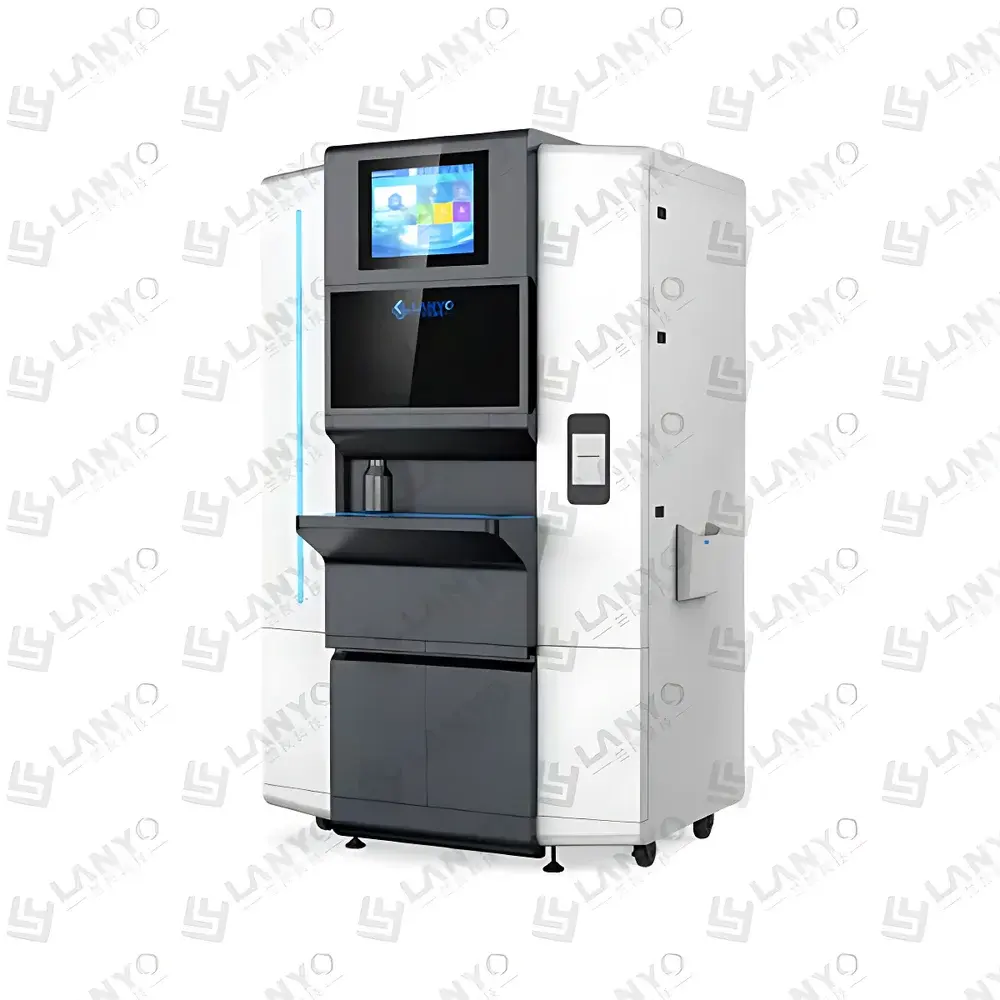
LANYO FASP-01 Fully Automated Soil Sample Preparation Workstation
| Brand | LANYO |
|---|---|
| Model | FASP-01 |
| Origin | Beijing, China |
| Application | Soil, sediment, and dry solid environmental samples |
| Sieve Options | 10 mesh / 60 mesh / 100 mesh / 200 mesh (per GB/T 6003.1–2022) |
| Sample Throughput | 500–3000 g per run |
| Cycle Time | ~25 min per sample |
| Grinding Architecture | Two-stage non-metallic jaw crushing (coarse), followed by suspension-impact fine grinding |
| Mixing Method | 3D vibrational tumbling mixing (flip-and-lift principle) |
| Contamination Control | Full non-metallic wetted path |
| Cleaning Protocol | Tri-mode automated cleaning — rotary brush sweep + compressed air blow-off + vacuum suction with HEPA-filtered exhaust |
| Data Integrity | RFID & QR-code sample tracking |
| Compliance Standards | HJ/T 166–2004, GB 17378.5–2007, NY/T 395–2012, DZ/T 0130.4–2006, HJ/T 20–1998, EJ/T 428–1989, LY/T 1210–1999 |
Overview
The LANYO FASP-01 Fully Automated Soil Sample Preparation Workstation is an integrated, standards-driven solution engineered for high-throughput, trace-metal-safe preparation of soil, sediment, and dry solid environmental matrices. Designed in alignment with China’s national environmental monitoring strategy—emphasizing automation-first workflows, full traceability, and metrological rigor—the FASP-01 replaces manual “pestle-and-mortar” protocols with a deterministic, closed-loop process grounded in mechanical reproducibility and contamination control. Its core architecture implements a sequential, multi-stage workflow: dry-sample loading → two-stage non-metallic grinding (coarse jaw crushing followed by suspension-impact fine comminution) → 3D vibrational homogenization → precision sieving (10–200 mesh, compliant with GB/T 6003.1–2022) → gravimetric subsampling → tri-mode automated cleaning. Unlike legacy systems relying on metallic grinding media or open-bench handling, the FASP-01 maintains an entirely non-metallic sample pathway—from feed hopper to collection vial—eliminating exogenous Fe, Cr, Ni, or Zn contamination critical for heavy metal speciation, isotopic analysis, and regulatory compliance (e.g., EPA Method 6020B, ISO 11466, USP /). The system operates without external compressed air or chilled water, making it suitable for decentralized labs with constrained utility infrastructure.
Key Features
- Non-metallic grinding train: Ceramic-coated jaw plates and polymer impact elements ensure zero elemental leaching during both coarse and fine comminution stages.
- Two-stage grinding logic: Primary coarse grinding preserves particle microstructure integrity; secondary suspension-impact grinding delivers narrow particle size distribution (PSD) with minimal heat generation and attrition-induced amorphization.
- 3D volumetric mixing: Patented flip-and-lift vibrational motion ensures homogeneous redistribution of the entire post-sieve mass—not just surface layers—enhancing representativeness for subsampling and analytical repeatability.
- Automated, validated cleaning cycle: Synchronized rotary brush sweeping, pulsed air purge, and HEPA-filtered vacuum suction remove >99.8% residual particulate between runs (validated per ISO 17025 clause 5.9.1).
- Integrated gravimetric module: High-resolution load cell (±0.01 g) enables real-time mass feedback during subsampling and weight-based fraction retention.
- Full digital provenance: Each sample carries dual RFID tag and QR code; every actuator movement, sensor reading, and timing event is timestamped and cryptographically logged in local SQLite database, exportable as CSV or PDF audit package.
Sample Compatibility & Compliance
The FASP-01 accepts air-dried soil, marine sediment, agricultural topsoil, geological core fragments, and industrial solid waste—provided moisture content remains below 15% w/w. It does not support wet, oily, or highly fibrous matrices without prior drying. All operational parameters—including sieve selection, grinding duration, vibration amplitude, and cleaning sequence—are locked to pre-validated methods derived from HJ/T 166–2004, GB 17378.5–2007, and NY/T 395–2012. The system supports GLP/GMP-aligned data integrity through immutable audit trails, user-level access control (admin/operator modes), and electronic signature capability compliant with FDA 21 CFR Part 11 Annex 11 requirements. Calibration certificates for internal load cells and timing modules are issued annually and archived within the onboard system.
Software & Data Management
The FASP-01 runs LANYO SmartPrep OS v3.2—a deterministic, real-time Linux-based firmware with no third-party dependencies. The 10.1-inch capacitive touchscreen displays live process status (grinding torque, sieve dwell time, mixing RMS acceleration, vacuum pressure decay), and allows method selection via drag-and-drop workflow templates. All raw logs (including sensor diagnostics) are stored locally for ≥18 months and exportable via USB or Ethernet. Optional cloud sync (via TLS 1.3-encrypted MQTT) enables centralized lab-wide QC dashboards. Report generation adheres to ISO/IEC 17025:2017 clause 7.8.2: each output includes sample ID, operator ID, instrument serial number, method version, start/end timestamps, pass/fail flags for all QC checkpoints (e.g., sieve blockage detection, mass balance error < ±0.5%), and digital signature field.
Applications
- Regulatory environmental monitoring: Soil screening under China’s “Soil Pollution Prevention and Control Action Plan”, provincial ecological monitoring networks, and national soil census programs.
- Third-party testing laboratories: High-volume contract analysis requiring ISO/IEC 17025 accreditation, particularly for heavy metals (As, Cd, Pb, Hg), nutrient profiling (P, K, organic matter), and emerging contaminants (PFAS, microplastics).
- Research institutions: Reproducible sample conditioning for XRD, SEM-EDS, ICP-MS, and sequential extraction studies where particle morphology and redox state preservation are critical.
- Field-deployable mobile labs: Compact footprint (W620 × D710 × H1580 mm) and low power draw (<1.8 kW, 220 V AC) enable integration into containerized or vehicle-mounted platforms.
- Geotechnical and agricultural extension services: Standardized preparation for pH, CEC, and texture analysis across heterogeneous regional datasets.
FAQ
Does the FASP-01 support wet or frozen soil samples?
No. Samples must be air-dried to ≤15% moisture content prior to loading. Wet or frozen matrices risk clogging the sieve stack and compromising grinding efficiency.
Can sieve mesh sizes be changed manually between runs?
Yes. The modular sieve cassette system allows tool-free replacement of 10/60/100/200 mesh screens in <90 seconds. All configurations are pre-registered in firmware and auto-recognized via embedded NFC tags.
Is remote diagnostics or software update capability available?
Yes. Firmware updates and log retrieval can be performed over secure SSH or via authenticated web portal. Remote troubleshooting requires prior written authorization per ISO/IEC 27001 Annex A.8.2.3.
How is cross-contamination verified between samples?
Each cleaning cycle undergoes real-time vacuum pressure decay monitoring. Residual mass is quantified via post-clean gravimetric check; results are logged and trigger automatic hold if >0.05 g remains.
What calibration documentation is provided at installation?
Factory calibration certificates for load cell (ISO/IEC 17025-accredited), timer circuit (traceable to NIM Beijing), and motor encoder (angular position accuracy ±0.1°) are delivered with instrument handover report.



