
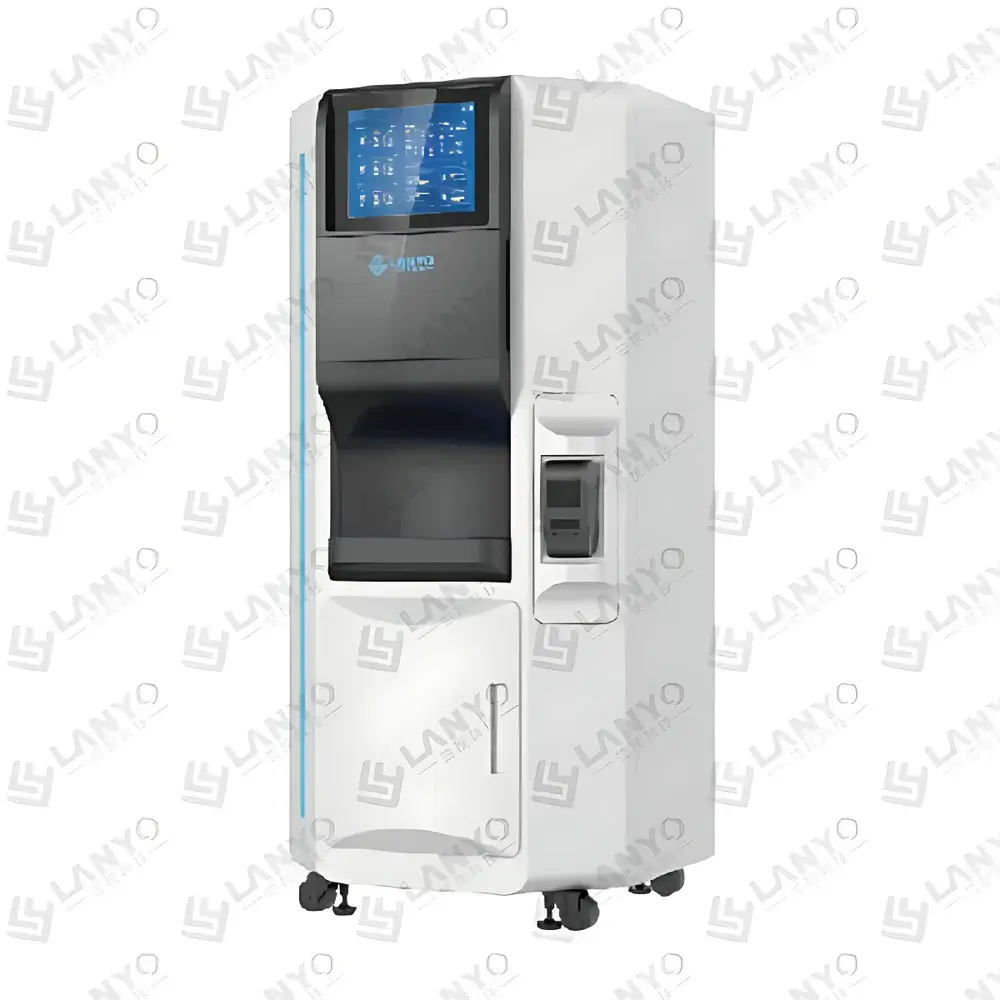
LANYO FASP-CG Fully Automated Coarse Grinding Sample Preparation System
| Brand | LANYO |
|---|---|
| Origin | Beijing, China |
| Model | FASP-CG |
| Application | Soil sample preparation per HJ/T 166-2004, NY/T 1121.1-2006, and related national standards |
| Sample throughput | 500–3000 g (dry basis) |
| Sieve aperture | 2 mm (10 mesh, per GB/T 6003.1-2022) |
| Grinding architecture | Dual-stage non-metallic grinding system |
| Contamination control | Metal-free grinding & handling path |
| Automation scope | Integrated coarse grinding, sieving, homogenization, weighing, aliquoting, vial loading, and in-situ cleaning |
| Data traceability | Full digital log with timestamped process events and auto-generated compliance reports |
| Vial capacity | 1–6 × 500 mL amber glass bottles with label-ready caps |
| Compliance framework | Supports GLP-aligned workflows, audit-ready electronic records, and 21 CFR Part 11–compatible data integrity (when deployed with validated software environment) |
Overview
The LANYO FASP-CG Fully Automated Coarse Grinding Sample Preparation System is an engineered solution for standardized, high-integrity soil sample processing in environmental monitoring laboratories. Designed specifically to meet the mandatory requirements of HJ/T 166-2004 (Technical Specification for Soil Environmental Monitoring), NY/T 1121.1-2006 (Soil Testing — Part 1: Sampling, Processing and Storage), and additional regulatory frameworks including DZ/T 0130.4-2006 and EJ/T 428-1989, the FASP-CG ensures full-volume, non-selective preparation of air-dried soil samples down to a nominal 2 mm particle size (10 mesh). Unlike manual or semi-automated approaches—prone to operator variability, over-grinding, dust exposure, and cross-contamination—the FASP-CG implements a closed-loop, metal-free mechanical workflow grounded in deterministic process control. Its core architecture follows the principle of “no discard, no bias”: all incoming material is processed through dual-stage coarse grinding, followed by precise 2 mm sieving (per GB/T 6003.1-2022), dynamic homogenization, gravimetric subsampling, and traceable packaging. This eliminates human-mediated error sources while preserving sample representativeness and geochemical integrity.
Key Features
- Metal-free sample pathway: All contact surfaces—including grinding elements, sieves, chutes, and mixing chambers—are fabricated from certified non-metallic materials (e.g., high-density polyethylene, ceramic-reinforced polymers) to prevent leaching or adsorption of analytes such as heavy metals, ensuring zero exogenous contamination.
- Dual-stage coarse grinding mechanism: First stage reduces bulk aggregates; second stage applies controlled impact and shear to achieve consistent 2 mm liberation without excessive fines generation—critical for compliance with HJ/T 166-2004’s “no over-grinding” directive.
- Integrated 2 mm sieving module: Equipped with a tension-calibrated, stainless-steel–framed 10-mesh sieve conforming to GB/T 6003.1-2022 dimensional tolerances and open-area specifications.
- Automated gravimetric partitioning: Built-in precision load cell (±0.1 g repeatability) enables programmable mass-based subsampling and direct transfer into pre-labeled 500 mL amber glass vials.
- Multi-mode cleaning cycle: Combines motorized brush contact, vacuum-assisted particulate removal, and replaceable HEPA-grade filtration to decontaminate internal pathways between samples—validated per ISO 17025 clause 5.9.1 for carryover prevention.
- Full digital process logging: Every operational event—including feed weight, grinding duration, sieve retention time, homogenization RPM, final mass, vial ID assignment, and cleaning sequence—is timestamped, encrypted, and stored locally with export capability (CSV/Excel).
Sample Compatibility & Compliance
The FASP-CG accepts only air-dried, non-cohesive soil matrices with moisture content ≤15% w/w and maximum particle dimension <50 mm. It is validated for use with agricultural topsoil, forest floor horizons, sediment-affected soils, and low-organic-content industrial site samples. The system supports regulatory alignment across multiple domains: it satisfies the “full-sample processing” requirement in China’s Soil Pollution Prevention and Control Action Plan (2016); enables traceable execution of the China National Environmental Monitoring Centre’s Technical Guidance on Soil Sample Preparation and Transfer (Document No. Tu Zi [2018] 407); and facilitates adherence to ISO/IEC 17025:2017 clause 7.2.2 (method validation) and clause 7.7 (sampling and sample treatment). When operated within a validated IT environment, its electronic record system meets ALCOA+ principles (Attributable, Legible, Contemporaneous, Original, Accurate) and provides foundational support for 21 CFR Part 11 compliance in international contract laboratories.
Software & Data Management
The FASP-CG operates via a dedicated embedded control interface with role-based access (operator, supervisor, administrator). Process parameters are configured through predefined SOP templates aligned with HJ/T 166-2004 Annex B and NY/T 395-2012 Section 4.3. All raw logs are stored in SQLite format with SHA-256 hash integrity verification. Audit trails capture user login/logout, parameter changes, manual overrides, and error recovery actions. Exported reports include sample ID, batch ID, start/end timestamps, equipment ID, calibration status of weighing module, sieve certification number, and cleaning validation flag. Data files are compatible with LIMS integration via RESTful API (JSON payload) or scheduled SFTP push.
Applications
- Regulatory soil monitoring programs (national soil census, farmland quality assessment, ecological redline surveys)
- Site-specific risk characterization under GB 36600-2018 (Soil Environmental Quality Risk Control Standard for Soil Contamination of Agricultural Land)
- Method validation and proficiency testing for accredited environmental testing laboratories (CNAS-CL01:2018)
- Long-term soil archive preparation where physical stability and chemical fidelity are critical
- Research-grade soil fractionation studies requiring inter-batch reproducibility in particle-size distribution
FAQ
Does the FASP-CG comply with Chinese national standards for soil sample preparation?
Yes. It fulfills all procedural requirements specified in HJ/T 166-2004, NY/T 1121.1-2006, and Document No. Tu Zi [2018] 407—including mandatory full-volume processing, 2 mm sieve specification, avoidance of metal contamination, and documentation of each preparation step.
Can the system handle wet or clay-rich soils?
No. The FASP-CG requires air-dried samples with moisture content ≤15% w/w and free-flowing texture. High-clay or cohesive samples must undergo prior drying and disaggregation per NY/T 1121.1-2006 Section 5.2 before loading.
Is the 2 mm sieve certified to GB/T 6003.1-2022?
Yes. Each installed sieve carries a factory calibration certificate referencing GB/T 6003.1-2022 tolerance classes and is replaced at defined service intervals (every 200 cycles or per annual metrological verification).
How is data integrity ensured during electronic record generation?
All process events are written immutably to flash memory with sequential numbering and cryptographic hashing. User actions require multi-factor authentication, and report exports include digital signatures verifying origin and temporal integrity.
What maintenance is required to sustain compliance?
Scheduled maintenance includes bi-weekly brush wear inspection, quarterly sieve tension verification, semi-annual load cell calibration using NIST-traceable weights, and annual firmware update with version-controlled release notes—all documented in the system’s built-in maintenance log.



