
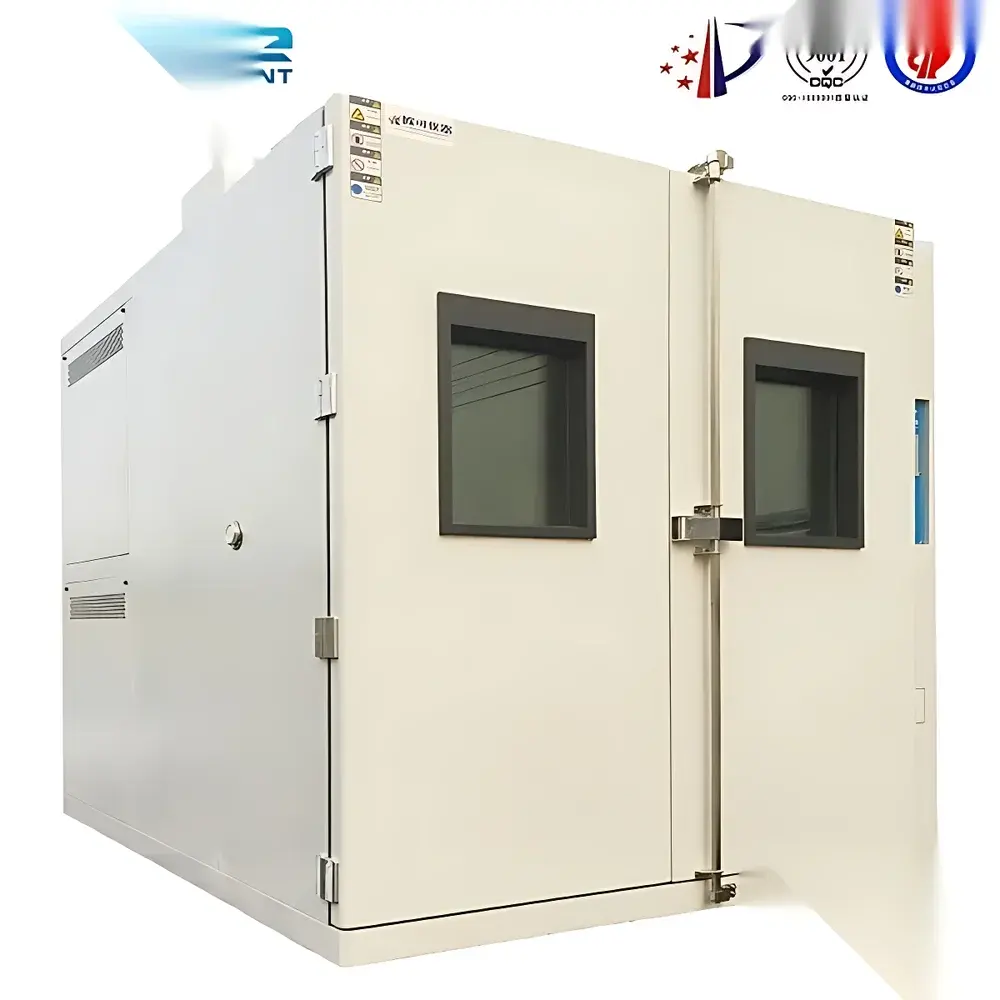
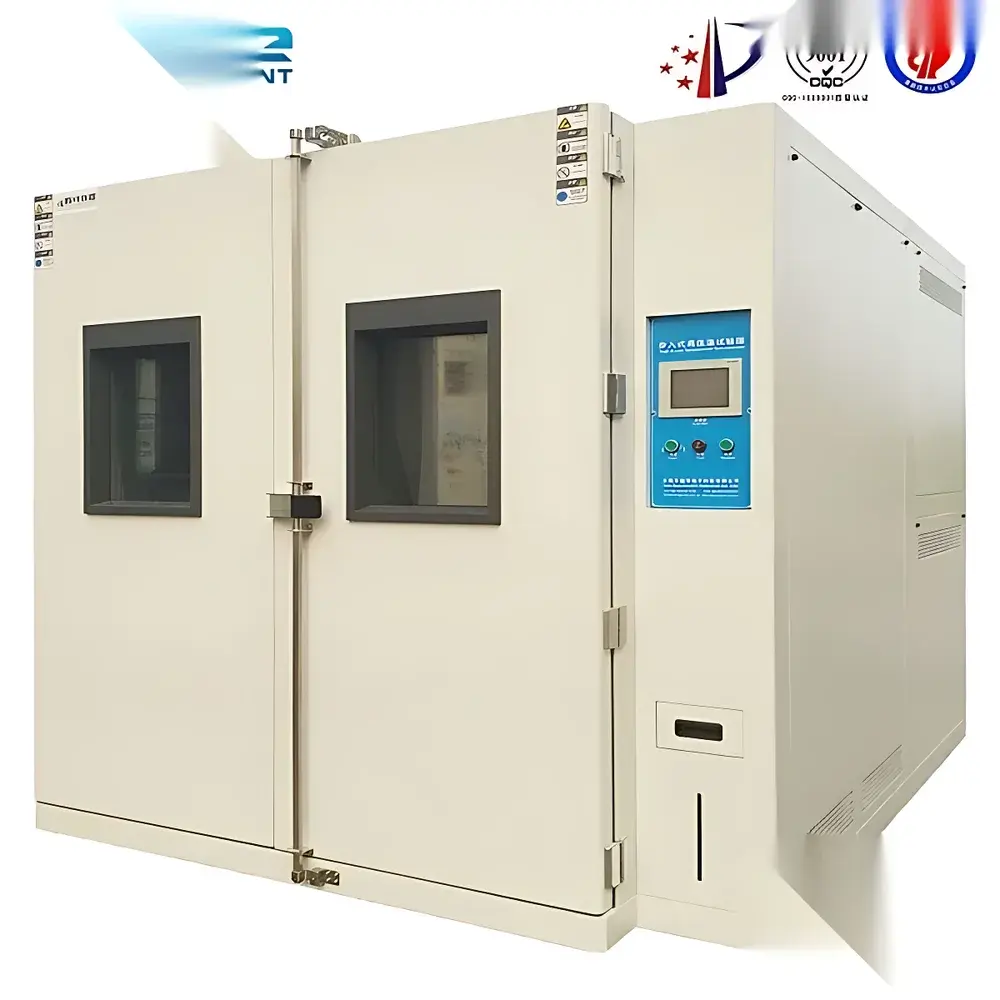
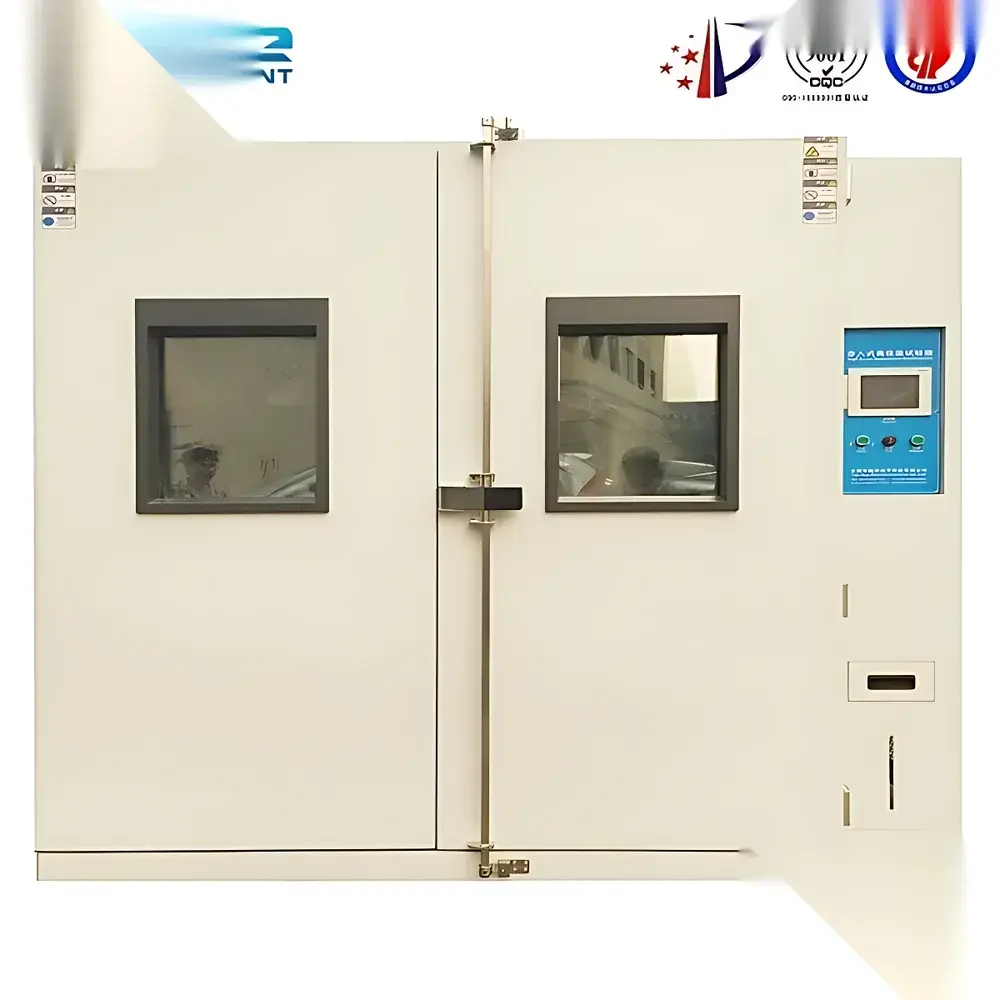
Custom-Built Large-Scale Environmental Test Chamber for Temperature and Humidity Cycling
| Temperature Range | -40 °C to +100 °C |
|---|---|
| Humidity Range | 20–98 %RH (optional down to 5 %RH) |
| Temperature Uniformity | ≤ ±0.5 °C |
| Temperature Deviation | ≤ ±2 °C |
| Humidity Deviation | +2 to –3 %RH |
| Ramp Rate | 0.5–1.2 °C/min |
| Control System | Microprocessor-based PID + SSR + Timer |
| Compliance | IEC 60068-2, ISO 16750-4, ASTM D4332, GB/T 2423.1/2/3/4 |
| Refrigerant | R404A/R507 (ODP = 0, compliant with EU F-Gas Regulation) |
Overview
The Custom-Built Large-Scale Environmental Test Chamber for Temperature and Humidity Cycling is an engineered solution for validating product reliability under extreme and dynamically controlled climatic conditions. Designed for walk-in configuration, it operates on the principle of forced-air convection combined with dual-stage refrigeration, precision steam humidification, and dehumidification via cold-finger or desiccant-assisted systems. Its architecture supports continuous operation across wide thermal and hygrometric gradients—critical for automotive component validation, aerospace avionics qualification, battery module stress testing, and long-duration accelerated aging per IEC 60068-2-1 (cold), -2 (dry heat), -14 (temperature change), and -30 (damp heat cyclic). The chamber’s structural integrity, insulation performance (≥0.35 W/m²·K), and air distribution design ensure spatial uniformity meeting ISO 16750-4 Class C requirements for automotive electronics testing environments.
Key Features
- Walk-in configuration with fully customizable internal dimensions (height ≥2.2 m, floor area ≥4 m² typical; scalable per client specification)
- Dual-refrigeration circuit with cascade low-temp capability (down to –60 °C optional) and high-efficiency scroll compressors
- Steam-type humidification system with stainless-steel boiler and PID-controlled water level management
- Microprocessor-based controller featuring 7-inch color LCD touchscreen, intuitive menu navigation, and multi-language interface (English, German, Chinese)
- Comprehensive safety architecture: over-temperature cut-off, compressor high-pressure shutdown, phase-loss protection, ground-fault detection, motor overload relay, and automatic power isolation upon fault detection
- Real-time alarm logging with timestamped event history and root-cause code display (e.g., “E04: Humidifier Dry-Run”, “E17: Chamber Door Open During Cycle”)
- Integrated RS485/Modbus RTU port for SCADA integration; optional Ethernet/WiFi module for remote monitoring and control
Sample Compatibility & Compliance
The chamber accommodates full-system assemblies—including EV battery packs (up to 1.5 m × 1.2 m × 0.8 m), telecom base station cabinets, military-grade enclosures, and medical diagnostic equipment. Internal airflow velocity is maintained at 1.2–1.8 m/s with turbulence <15%, ensuring minimal convective interference during sensor calibration or thermal imaging. All models are manufactured in accordance with ISO 9001:2015 quality management standards and undergo factory acceptance testing per EN 61000-6-2/-6-4 (EMC immunity/emission). Optional GMP-compliant validation packages include IQ/OQ documentation, traceable NIST-calibrated sensors, and 21 CFR Part 11–enabled audit trails for pharmaceutical stability chambers.
Software & Data Management
The embedded controller supports up to 99 programmable test profiles, each with 999 segments (ramp/soak/humidity ramp). Data logging resolution is 1 s, stored internally for ≥30 days (16 GB flash memory). Export formats include CSV, PDF reports, and XML-compatible structured logs. Optional PC software provides real-time graphing, statistical process control (SPC) charts (X-bar/R), deviation heatmaps, and automated report generation aligned with ISO/IEC 17025 clause 7.8. For regulated industries, the optional validated software package includes electronic signatures, user role-based access control (admin/operator/auditor), and immutable audit trail records compliant with FDA 21 CFR Part 11 Annex 11 requirements.
Applications
- Automotive: Thermal shock cycling of ADAS ECUs per ISO 16750-4; humidity soak testing of infotainment displays
- Energy Storage: Calendar and cycle life evaluation of Li-ion battery modules under variable RH/temperature profiles
- Aerospace: Environmental stress screening (ESS) of flight-critical PCBAs per MIL-STD-810H Method 502.7
- Medical Devices: Accelerated aging of polymer housings and sterilization packaging per ISO 11607-1
- Industrial Electronics: Burn-in verification of industrial PLCs and inverters per IEC 60721-3-3 Class 3K5
FAQ
Can this chamber be configured for rapid temperature transitions (e.g., 10 °C/min)?
Standard ramp rates range from 0.5 to 1.2 °C/min; higher rates require enhanced refrigeration capacity, larger heater banks, and reinforced insulation—available as a custom engineering option subject to thermal load analysis.
Is humidity control stable at sub-zero temperatures?
Yes—below 0 °C, humidity is managed via dew-point control using chilled-mirror hygrometry; RH values below 20 % at –40 °C are achievable with optional desiccant dehumidification module.
Does the system support third-party data acquisition hardware?
All analog (4–20 mA, 0–10 V) and digital (Modbus TCP/RTU, CANopen) interfaces are exposed via terminal blocks and documented in the I/O manual; no proprietary protocol lock-in.
What documentation is provided for regulatory audits?
Standard delivery includes FAT report, calibration certificates (traceable to NPL/NIST), electrical safety test report (IEC 61010-1), and CE Declaration of Conformity; GxP-ready validation kits available upon request.



