
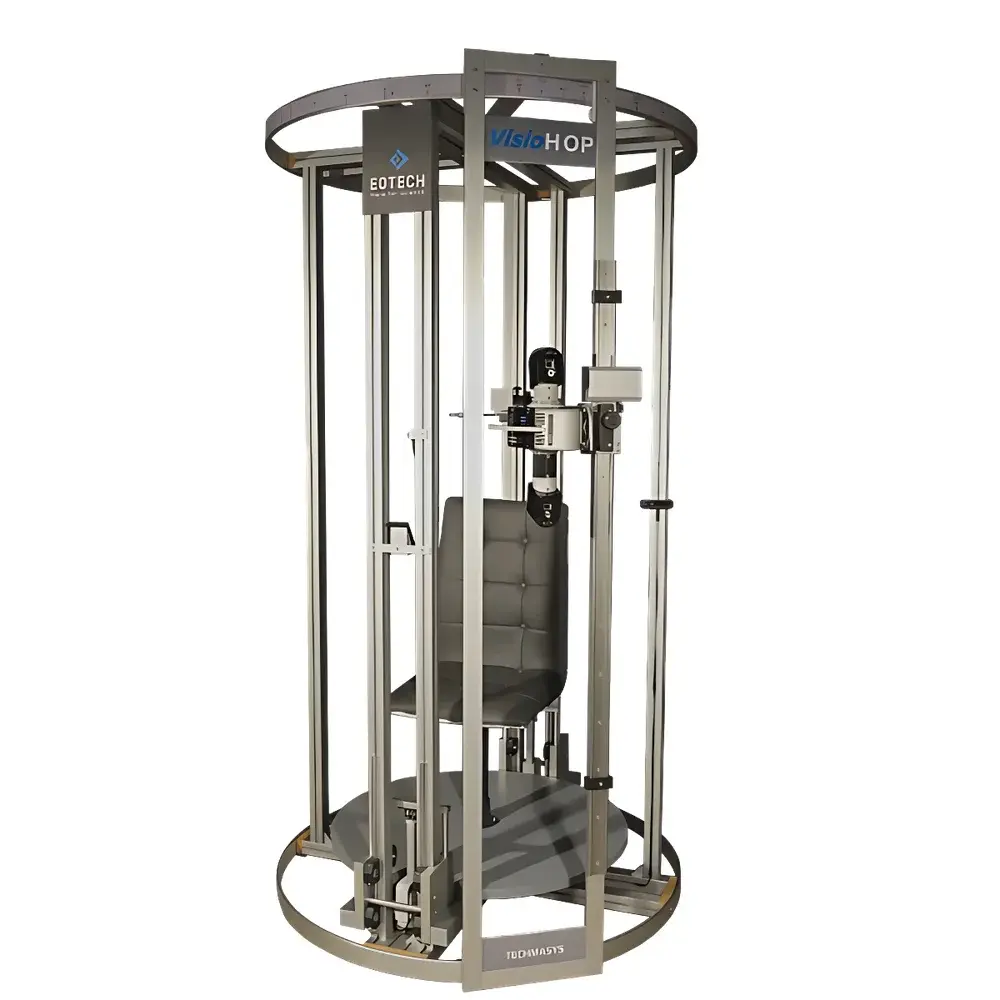
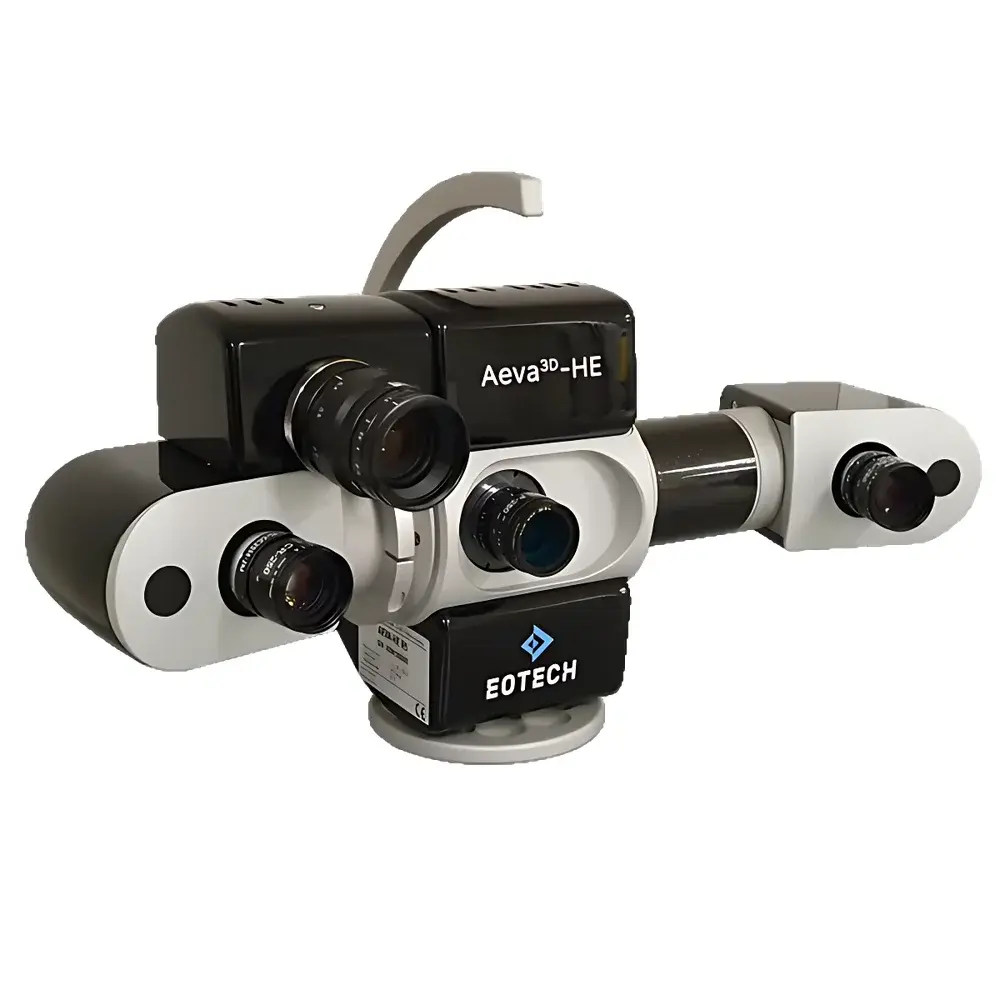
EOTECH AEVA-HE Skin Rapid Optical Imaging System
| Brand | EOTECH |
|---|---|
| Origin | France |
| Manufacturer Type | Authorized Distributor |
| Origin Category | Imported Instrument |
| Model | AEVA-HE |
| Pricing | Available Upon Request |
Overview
The EOTECH AEVA-HE Skin Rapid Optical Imaging System is a non-contact, high-resolution 3D optical metrology platform engineered for objective, quantitative assessment of skin surface topography across localized regions, full-face, and full-body anatomical areas. It operates on the principle of structured light projection—specifically, high-contrast stripe pattern illumination—combined with stereo photogrammetry to reconstruct sub-millimeter-scale surface geometry. Unlike conventional 2D imaging or tactile profilometry, the AEVA-HE captures spatially registered, depth-resolved morphological data without physical contact, eliminating compression artifacts and inter-operator variability. The system is designed for longitudinal clinical and cosmetic research applications where reproducibility, geometric fidelity, and traceable measurement uncertainty are critical—particularly in efficacy evaluation of topical actives, barrier repair agents, anti-aging formulations, and post-procedural recovery monitoring.
Key Features
- Non-contact 3D surface acquisition using calibrated stripe projection and dual-camera stereo triangulation
- Sub-100 µm lateral resolution and <50 µm depth accuracy under standardized illumination and pose conditions
- Modular integration with the Visio 4D positioning rig to enforce repeatable subject positioning and field-of-view alignment across longitudinal sessions
- Automated registration of multi-session datasets via anatomical landmark detection and iterative closest point (ICP) surface matching
- Real-time visualization of elevation maps, roughness parameters (Sa, Sq), volume metrics (e.g., wrinkle volume, pore volume), and curvature-derived indices
- Rugged industrial-grade housing compliant with ISO 13485-aligned manufacturing practices and CE marking for Class I medical device accessories
Sample Compatibility & Compliance
The AEVA-HE accommodates diverse anatomical sites—including forehead, periorbital region, cheek, neck, dorsal forearm, and abdominal skin—without requiring coupling gels, contrast agents, or skin preparation beyond standard cleansing. Its optical design minimizes specular reflection artifacts through polarized illumination management and adaptive exposure control. Data outputs comply with ASTM E2917-22 (Standard Practice for Quantitative Assessment of Skin Topography Using 3D Imaging) and support GLP-compliant study documentation. All image metadata—including calibration timestamps, environmental sensor logs (ambient temperature/humidity), and operator ID—are embedded in DICOM-SR or vendor-neutral JSON-LD format, enabling audit-ready traceability per FDA 21 CFR Part 11 requirements when deployed with validated software workflows.
Software & Data Management
The proprietary AEVA Studio software suite provides end-to-end processing: raw stereo image capture → dense point cloud generation → mesh reconstruction → parametric quantification. It includes preconfigured analysis protocols aligned with ISDB (International Society for Bioengineering and Dermatology) consensus guidelines for wrinkle, pore, and texture assessment. Export options include CSV (for statistical packages such as SAS or R), STL (for 3D printing validation), and annotated PNG/TIFF overlays with scale bars and coordinate grids. Audit trails record all user-initiated actions—including parameter edits, ROI redefinition, and export events—with immutable timestamps and digital signature verification. Integration with LIMS and electronic data capture (EDC) platforms is supported via HL7 FHIR APIs and configurable webhooks.
Applications
- Clinical evaluation of anti-wrinkle and firming actives across 4-, 8-, and 12-week protocols
- Objective quantification of pore size distribution and sebum-induced occlusion dynamics
- Post-laser resurfacing or microneedling recovery tracking via serial elevation map differencing
- Comparative assessment of transdermal delivery systems using topographic change as a surrogate endpoint
- Standardized baseline mapping for dermatological trials involving atopic dermatitis, psoriasis, or ichthyosis
- Regulatory submission support for CE Marking and FDA cosmetic ingredient notifications requiring instrumental evidence of structural impact
FAQ
What is the typical acquisition time per anatomical site?
A full-face scan requires ≤12 seconds; localized regions (e.g., crow’s feet, nasolabial fold) take 3–5 seconds. Acquisition speed is independent of subject motion due to global shutter synchronization.
Can AEVA-HE be used on pigmented or tanned skin?
Yes—the system incorporates dynamic exposure compensation and spectral filtering optimized for melanin-rich epidermis, validated across Fitzpatrick skin types IV–VI per ISO 20462-3.
Is calibration required between sessions?
System-level calibration is performed annually by EOTECH-certified engineers; daily verification uses NIST-traceable ceramic reference targets included with each shipment.
Does the software support multi-center trial harmonization?
Yes—AEVA Studio includes cross-site calibration transfer protocols and automated batch normalization against central reference datasets, ensuring inter-site coefficient of variation (CV) remains <4.2% for Sa and <6.8% for volume parameters.
What regulatory standards does the AEVA-HE meet for clinical use?
It conforms to IEC 62304 (software lifecycle), ISO 14971 (risk management), and EN 60601-1 (electrical safety); clinical validation studies follow CONSORT and STROBE reporting frameworks.




