
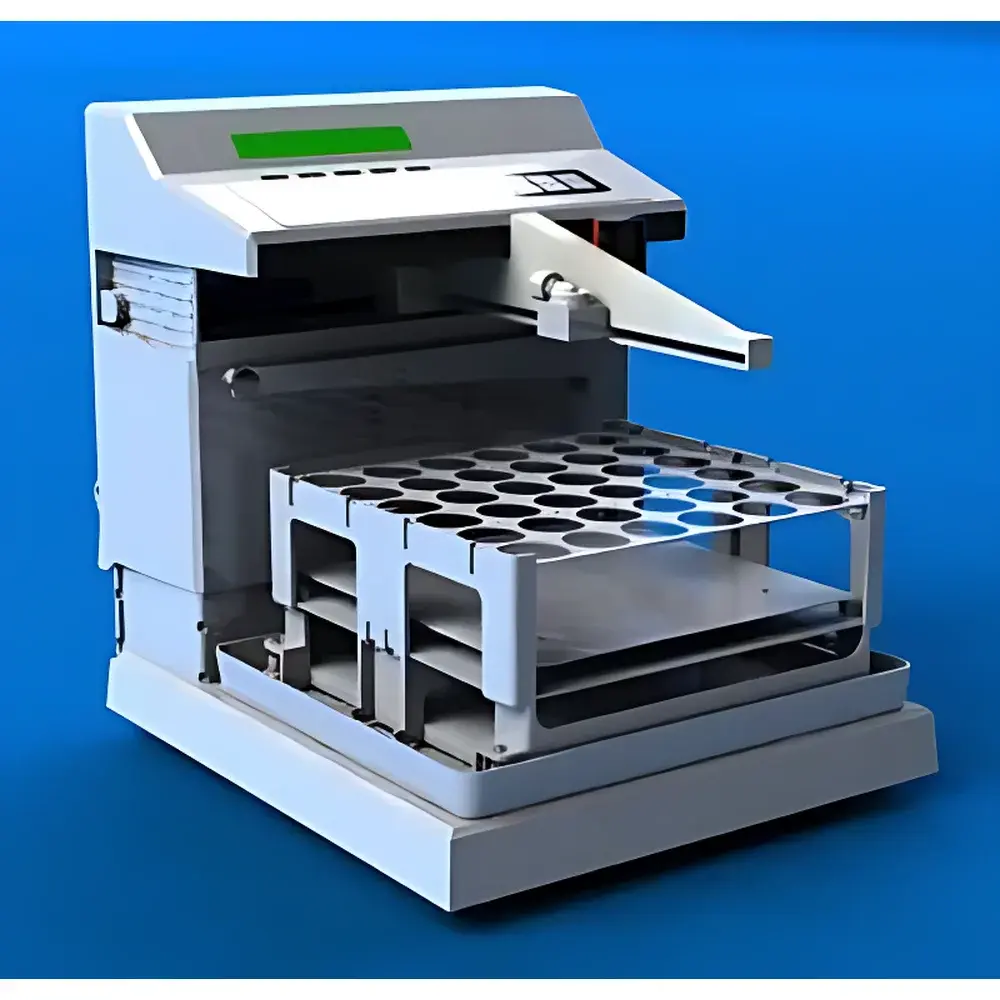
Laballiance FC Jr. Fraction Collector
| Brand | Laballiance |
|---|---|
| Origin | USA |
| Model | FC Jr |
| Dimensions | 28 cm (W) × 27 cm (H) × 31 cm (D) |
| Weight | 4.7 kg |
| Temperature Range | 0–40 °C |
| Step Timer Range | 1 s – 99 h 59 min 59 s |
| Drop Counter Range | 1–999,999 |
| Volume Counter Range | 1–999,999 units |
| Peak Detection Modes | Slope-based and/or plateau-based triggering, combinable with time windows |
| Time Windows per Program | Up to 10 |
| Tube Exchange Time (center-to-center) | 200–450 µs (dependent on tube diameter) |
| Program Storage | 9 full collection protocols with internal battery-backed memory |
| Interface | RS232 for LC system integration |
| Collection Modes | Time-based, drop-count-based, volume-based, and peak-triggered (UV/absorbance signal) |
| Collection Patterns | Linear (left-to-right) or spiral |
| Tube Holder Options | Compatible with 12–25 mm diameter tubes |
| Compliance | Designed for GLP-compliant chromatographic workflows |
Overview
The Laballiance FC Jr. Fraction Collector is a compact, microprocessor-controlled fraction collector engineered for integration into analytical and preparative liquid chromatography (LC) systems. It operates on the principle of synchronized event-driven collection—accepting external TTL or analog signals from UV detectors, conductivity meters, or mass spectrometers to trigger precise fractionation based on elution profiles. Its architecture supports both standalone operation and fully automated coordination via RS232 communication with HPLC/UHPLC controllers, enabling reproducible, unattended fraction isolation in research, quality control, and purification laboratories. Designed for robust daily use in regulated environments, the FC Jr. delivers high positional repeatability and low carryover risk through optimized valve actuation timing and gravity-fed tube positioning.
Key Features
- Four programmable collection modes: time-based, drop-count-based, volume-based, and peak-triggered (slope/plateau detection), each configurable with user-defined thresholds and hysteresis.
- Flexible collection geometry: selectable linear (left-to-right) or spiral distribution across tube racks—minimizing cross-contamination and optimizing solvent dispersion during high-throughput runs.
- Embedded non-volatile memory stores up to nine complete collection protocols, retaining settings during power loss thanks to integrated battery backup.
- Precision tube indexing with center-to-center exchange times ranging from 200 to 450 microseconds—calibrated dynamically according to selected tube diameter (12–25 mm) to ensure mechanical stability and positional accuracy.
- RS232 interface enables bidirectional communication with major LC platforms (e.g., Waters, Agilent, Shimadzu), supporting remote start/stop, real-time status polling, and synchronized method loading.
- Compact footprint (28 × 27 × 31 cm) and lightweight design (4.7 kg) facilitate benchtop deployment beneath detectors or within confined fume hood spaces without compromising accessibility or serviceability.
Sample Compatibility & Compliance
The FC Jr. accepts a broad spectrum of container formats—including standard 12–25 mm round-bottom and conical tubes, microcentrifuge tubes (0.5–2.0 mL), and large-capacity glass or polypropylene Erlenmeyer flasks (up to nine 500 mL vessels). Its modular rack system permits rapid reconfiguration between analytical-scale (e.g., 96-well plate emulation) and preparative-scale workflows. From a regulatory standpoint, the instrument complies with general electrical safety standards (UL/CSA 61010-1) and is routinely deployed in laboratories adhering to ISO/IEC 17025, USP , and FDA 21 CFR Part 11 requirements—particularly when operated with validated chromatography data systems (CDS) that enforce electronic signatures, audit trails, and secure parameter locking.
Software & Data Management
While the FC Jr. operates autonomously via front-panel controls, its RS232 port allows seamless integration into enterprise-level CDS environments. When connected to compliant software (e.g., Empower, Chromeleon, or OpenLab), collection events are timestamped, logged with detector signal metadata, and associated with corresponding chromatographic runs. Internal memory retains protocol parameters—including time windows, slope thresholds, and tube map coordinates—for post-run reconstruction and traceability. All stored programs support version-controlled export/import via serial terminal utilities, facilitating method transfer across instruments and laboratory sites without manual re-entry.
Applications
- Preparative HPLC purification of natural products, peptides, and synthetic intermediates—enabling targeted isolation of UV-active fractions for subsequent NMR or MS analysis.
- Automated fractionation in size-exclusion chromatography (SEC) and ion-exchange chromatography (IEX) for protein characterization and aggregate profiling.
- Method development support: rapid screening of gradient conditions by collecting parallel fractions under varying elution windows.
- Quality assurance of excipients and active pharmaceutical ingredients (APIs), where reproducible fraction recovery supports impurity mapping per ICH Q5 and Q6 guidelines.
- Environmental analysis workflows involving SPE-LC coupling, where timed fraction collection aligns with contaminant retention windows (e.g., PAHs, PCBs).
FAQ
Can the FC Jr. be triggered by analog UV signals from third-party detectors?
Yes—it accepts 0–10 V analog inputs and TTL pulses, allowing compatibility with most commercial UV-Vis, fluorescence, and conductivity detectors without proprietary interface modules.
Is peak detection adjustable for noisy baselines?
Yes—users define independent slope sensitivity (mV/s), minimum plateau duration (ms), and baseline deviation tolerance, preventing false triggers during gradient re-equilibration or pump pulsation.
Does it support 21 CFR Part 11 compliance out of the box?
The hardware itself does not include electronic signature or role-based access controls; however, when integrated with validated CDS software and documented SOPs, it contributes to a compliant fraction collection subsystem.
What maintenance is required for long-term reliability?
Routine cleaning of the rotor seal and tubing path every 200 hours of operation; annual verification of tube positioning accuracy using supplied calibration jig and digital calipers.
Can multiple FC Jr. units be daisy-chained via RS232?
No—each unit requires a dedicated serial port or USB-to-serial adapter; multi-instrument coordination must be managed at the host CDS level using discrete COM port assignments.
Related Products




