
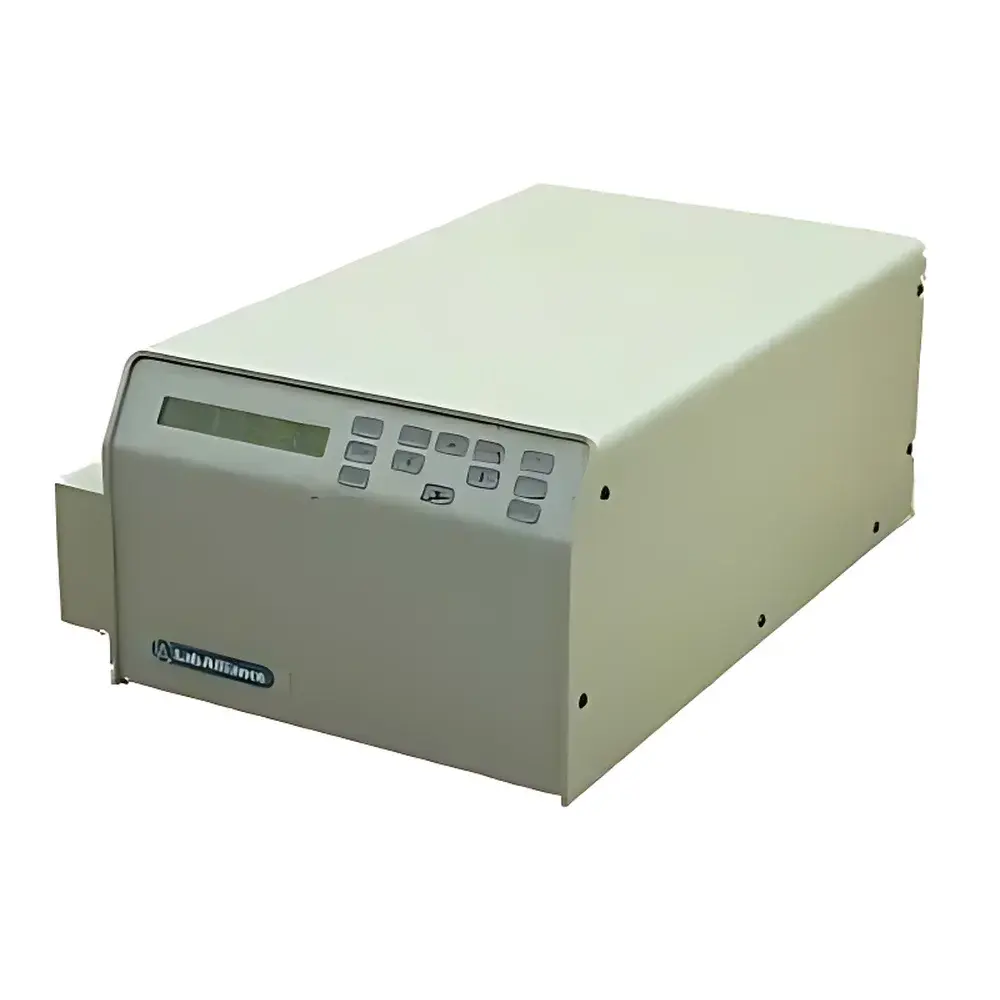
Laballiance Model 305 Programmable Fluorescence Scanning Detector
| Brand | Laballiance |
|---|---|
| Origin | USA |
| Model | 305 |
| Optical Design | Dual monochromator with concave holographic diffraction gratings |
| Excitation/Emission Wavelength Range | 200–600 nm (Ex & Em) |
| Wavelength Accuracy | ±2 nm @ 248 nm Ex / 398 nm Em |
| Wavelength Precision | <0.5 nm |
| Spectral Bandwidth Options | 8, 20, or 30 nm |
| Light Source | Pulsed xenon lamp (20 Hz or 100 Hz selectable) |
| Flow Cell | Biocompatible quartz/Teflon/Kalrez/PEEK, 8 µL detection volume, max pressure 200 psi (14 bar) |
| Sensitivity | 2 µg/L anthracene in methanol, S/N > 1500 @ 284 nm Ex / 398 nm Em |
| Scan Speed | Up to 100 steps/sec |
| step resolution | 2, 4, 8, 16, or 32 nm |
| Stored Spectra Capacity | Up to 60 emission spectra |
| Dynamic Range | 0.01–500 FUFS (Fluorescence Units Full Scale) with 15 programmable gain levels |
| Analog Output | 20-bit D/A converter, full-scale range adjustable |
| Detection Modes | Fluorescence, phosphorescence, chemiluminescence |
| Method Storage | 4 user-defined method files, each supporting up to 10 time-programmed wavelength transitions, with inter-file linking capability |
| Operating Environment | 10–40 °C, 5–95% RH (non-condensing) |
| Dimensions & Weight | 7" H × 12" W × 16" D, 24 lbs (11 kg) |
| Power Supply | 220 VAC, 50/60 Hz, max 2 A |
Overview
The Laballiance Model 305 Programmable Fluorescence Scanning Detector is a high-performance, dual-monochromator fluorescence detector engineered for integration with high-performance liquid chromatography (HPLC) and ultra-high-performance liquid chromatography (UHPLC) systems. It operates on the principle of synchronous and sequential excitation-emission spectral scanning, enabling precise identification and quantification of native or derivatized fluorescent analytes across complex matrices. Its optical architecture—featuring concave holographic diffraction gratings and stepper-motor-driven monochromators—delivers exceptional stray-light rejection, high photometric stability, and reproducible wavelength positioning critical for regulatory-compliant analysis. Designed for laboratories requiring trace-level sensitivity without sacrificing selectivity, the Model 305 supports fluorescence, phosphorescence, and chemiluminescence detection modalities, making it suitable for applications ranging from pharmaceutical impurity profiling to environmental polycyclic aromatic hydrocarbon (PAH) monitoring.
Key Features
- Dual monochromator optical path with concave holographic gratings ensures low stray light (<0.0005% at 254 nm), high wavelength repeatability (<0.5 nm precision), and extended dynamic range (0.01–500 FUFS).
- Pulsed xenon lamp (20 Hz or 100 Hz selectable) provides broad-spectrum UV-Vis output (200–800 nm) without ozone generation, coupled with real-time lamp energy normalization to suppress baseline drift and electronic noise.
- Three programmable spectral bandwidths (8, 20, 30 nm) allow optimization of signal-to-noise ratio versus selectivity based on analyte spectral profile and matrix complexity.
- Time-programmable excitation (Exλ) and emission (Emλ) wavelengths enable gradient spectral acquisition during chromatographic runs—eliminating manual stop-flow optimization and accelerating method development.
- Onboard storage for up to 60 full emission spectra, accessible via LCD display or external data acquisition systems, supports post-run spectral deconvolution and peak purity assessment.
- Biocompatible flow cell constructed from high-purity fused silica, PEEK, Kalrez®, and PTFE features an 8 µL detection volume and 200 psi (14 bar) pressure rating—compatible with standard HPLC and UHPLC operating conditions.
- 20-bit analog output and digital control interface support seamless integration with third-party chromatography data systems (CDS) and compliance with FDA 21 CFR Part 11 audit trail requirements when paired with validated software environments.
Sample Compatibility & Compliance
The Model 305 is routinely deployed in regulated environments where analytical rigor and documentation integrity are mandatory. Its performance aligns with key pharmacopeial standards including USP (Spectrophotometry and Light-Scattering), EP 2.2.25 (Fluorescence Spectrophotometry), and ASTM D5503 (Determination of Polynuclear Aromatic Hydrocarbons by HPLC with Fluorescence Detection). The detector’s stable lamp output, calibrated wavelength accuracy, and reproducible gain staging facilitate GLP and GMP-compliant validation protocols. Its non-ozone-producing xenon source meets OSHA and ISO 14001 ambient air quality guidelines for laboratory instrumentation. All hardware interfaces—including analog voltage output, TTL-compatible remote start/stop, and zero-reset signals—are designed for compatibility with legacy and modern CDS platforms under ICH Q2(R2) method validation frameworks.
Software & Data Management
While the Model 305 operates as a standalone detector with embedded firmware, its full operational potential is realized through integration with chromatography data systems supporting analog input acquisition and time-programmed event triggering. Four independent method files—each configurable with up to ten time-scheduled Ex/Em transitions—can be chained sequentially, enabling multi-analyte spectral optimization within a single run. Signal normalization options include fixed-response-factor scaling and real-time unit-to-unit response calibration, ensuring consistent reporting across instruments and laboratories. Raw spectral data (intensity vs. wavelength) is stored in ASCII format for export to third-party chemometric tools (e.g., MATLAB, Unscrambler®) for multivariate curve resolution or second-order calibration. Audit-ready operation is supported via external timestamp synchronization and hardware-triggered data logging compatible with 21 CFR Part 11–compliant CDS installations.
Applications
- Pharmaceutical QC/QA: Quantification of fluorescent impurities (e.g., genotoxic nitrosamines), assay of vitamin B2 (riboflavin), and stability-indicating methods for photolabile compounds.
- Environmental Analysis: Trace detection of PAHs (e.g., anthracene, benzo[a]pyrene) in soil extracts, wastewater, and airborne particulate matter per EPA Method 8310 and ISO 17993.
- Clinical & Biomarker Research: Measurement of catecholamines (epinephrine, norepinephrine), porphyrins, and NADH/NADPH in biological fluids using derivatization-free or o-phthalaldehyde-based protocols.
- Food & Beverage Safety: Screening of mycotoxins (aflatoxin B1), chlorophyll degradation products, and synthetic dyes (e.g., fluorescein sodium) in fortified dairy and juice matrices.
- Materials Science: Characterization of fluorescent polymer additives, quantum dot dispersions, and luminescent nanomaterials in solvent-based formulations.
FAQ
Does the Model 305 support post-column derivatization workflows?
Yes—the detector’s biocompatible flow cell and wide dynamic range accommodate both pre- and post-column derivatization systems, including online o-phthalaldehyde (OPA), naphthylisocyanate (NIC), or iodine-based reactions.
Can emission spectra be acquired during gradient elution without compromising chromatographic resolution?
Yes—its real-time scanning mode acquires spectra at up to 100 steps per second with user-selectable step resolution (2–32 nm), minimizing dwell time impact while preserving peak shape fidelity.
Is wavelength calibration traceable to NIST standards?
The instrument includes factory-applied calibration using certified holmium oxide and didymium filters; users may perform routine verification per ASTM E275 and ISO/IEC 17025 internal calibration procedures.
What maintenance intervals are recommended for the xenon lamp and flow cell?
Xenon lamp lifetime exceeds 2,000 hours at 20 Hz pulsing; flow cell cleaning is recommended after every 500 injections with proteinaceous or viscous samples, using 10% acetonitrile/water followed by 100% organic solvent flushes.
How is data integrity ensured during long-duration unattended runs?
All spectral acquisitions are timestamped and stored with metadata (lamp energy, gain setting, bandwidth, Ex/Em values); power-fail recovery retains the last 10 minutes of buffered spectral data.
Related Products



