
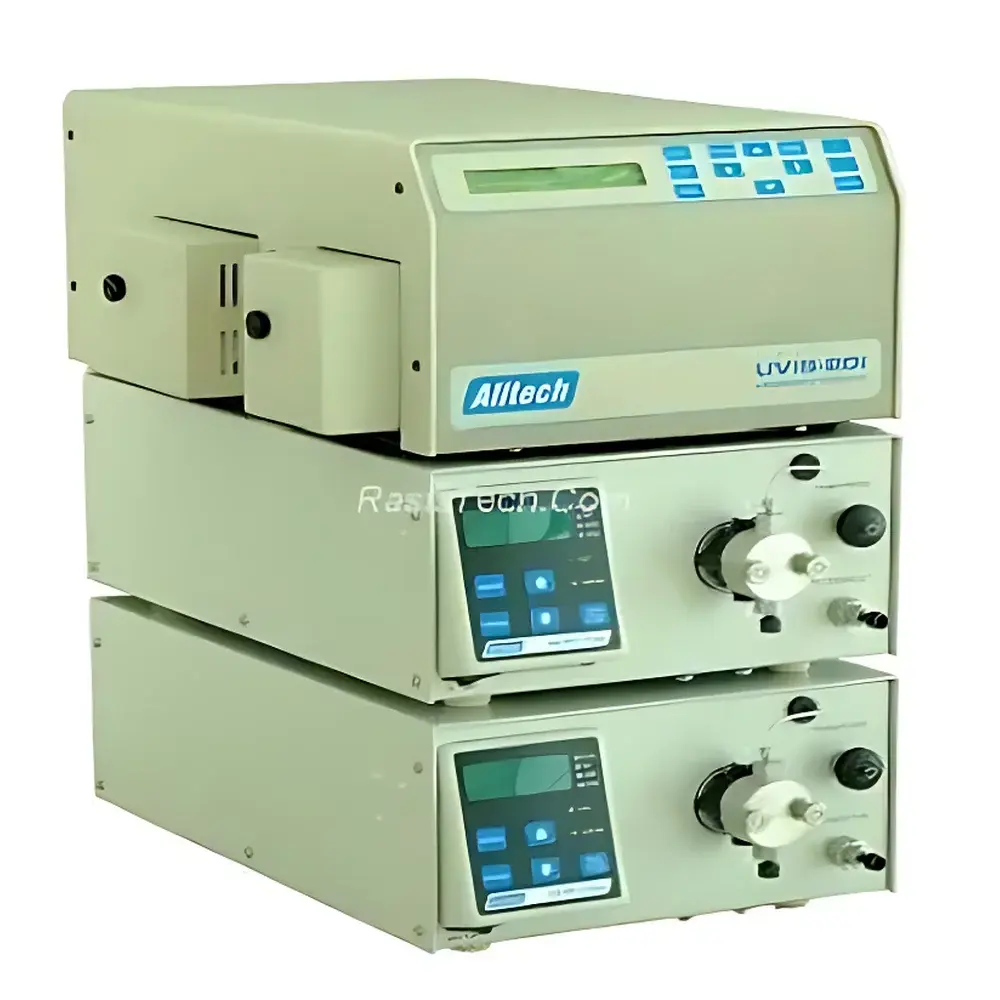
LabAlliance SSI Series 340 Preparative Liquid Chromatography System
| Brand | LabAlliance |
|---|---|
| Origin | USA |
| Model | SSI/LabAlliance 340 |
| Flow Rate | Up to 40 mL/min |
| Detector | UV201 Variable Wavelength Detector with Adjustable Flow Cell (0–3 mm pathlength) |
| Pump Type | Dual-piston syringe pump with integrated low-pulse dampener |
| Sample Introduction | Rheodyne 3725(i) manual injection valve |
| Construction | Stainless steel fluidic path |
| Compliance | Designed for GLP-compliant preparative workflows |
| Software Control | Fully automated system control via dedicated chromatography software |
Overview
The LabAlliance SSI Series 340 Preparative Liquid Chromatography System is an engineered solution for scalable, reproducible purification of organic and pharmaceutical compounds across milligram-to-gram quantities. Built upon proven high-pressure liquid chromatography (HPLC) architecture, the system operates on isocratic elution principles—ideal for laboratories requiring robust, cost-effective separation of structurally similar analytes where gradient complexity is unnecessary. Its core design integrates a dual-piston syringe pump, stainless-steel fluidic pathway, and a variable-pathlength UV detector to ensure consistent retention time stability, minimal band broadening, and high recovery yields. The system is purpose-built for semi-preparative and entry-level preparative applications—including synthetic chemistry support, natural product isolation, and early-stage API purification—where throughput, operational reliability, and regulatory traceability are prioritized over ultra-high-resolution gradient methods.
Key Features
- High-pressure isocratic pumping system delivering stable flow rates up to 40 mL/min with pulse-dampened output, enabling consistent loading across varied column dimensions (e.g., 10–50 mm ID)
- UV201 variable-wavelength detector with SS-Kalrez flow cell offering adjustable optical pathlength (0–3 mm), supporting both high-sensitivity detection for trace fractions and high-capacity monitoring for concentrated eluates
- Rheodyne 3725(i) manual injection valve configured for loop-based, column-integrated sample introduction—minimizing dead volume and ensuring precise, repeatable injection volumes from 0.1 to 5 mL
- Modular chassis constructed with electropolished 316 stainless steel wetted parts, compliant with USP Class VI materials requirements and resistant to common organic solvents (acetonitrile, methanol, THF, DCM, ethyl acetate)
- Self-cleaning pump head architecture reduces seal wear and extends mean time between maintenance (MTBM) to >6,000 hours under typical lab usage conditions
- Compact footprint (W × D × H: 60 × 55 × 45 cm) facilitates integration into fume hoods or shared instrumentation rooms without compromising service access
Sample Compatibility & Compliance
The Series 340 accommodates both liquid samples introduced directly via syringe pump-assisted loading and solid samples pre-loaded onto disposable or reusable cartridges—enabling rapid method transfer from analytical to preparative scale. It supports reversed-phase (C18, C8, phenyl-hexyl), normal-phase (silica, cyano), and ion-exchange media across column lengths from 50 to 250 mm. All hardware components meet ASTM F899 standards for stainless steel biocompatibility and are compatible with ISO 9001-certified quality management environments. When operated with audit-trail-enabled software (optional upgrade), the system satisfies FDA 21 CFR Part 11 requirements for electronic records and signatures—making it suitable for GMP-aligned purification workflows in contract development and manufacturing organizations (CDMOs).
Software & Data Management
Control and data acquisition are managed through LabAlliance’s native ChromaSoft™ Prep Suite—a Windows-based application supporting real-time pressure/flow/UV monitoring, method storage, and fraction trigger logic based on absorbance thresholds or time windows. Raw data files are saved in vendor-neutral .csv and .dx format for post-acquisition analysis in third-party tools (e.g., OpenChrom, Chromeleon). The software includes built-in calibration wizards for flow rate verification and UV lamp intensity validation, with logs automatically timestamped and user-ID tagged. Optional network licensing enables centralized instrument scheduling and remote diagnostics via secure HTTPS interface—supporting multi-user labs operating under GLP documentation standards.
Applications
- Purification of reaction mixtures following cross-coupling, amidation, or heterocycle synthesis—achieving >95% purity at 10–500 mg scale
- Isolation of bioactive natural product fractions from crude plant extracts using silica or diol columns
- Desalting and buffer exchange of peptides and oligonucleotides prior to lyophilization or formulation studies
- Recycling of chiral intermediates via enantioselective separations on immobilized polysaccharide phases (e.g., Chiralpak AD-H, AS-H)
- Stability-indicating method development for forced degradation products in pharmaceutical impurity profiling
FAQ
Can the Series 340 be upgraded to gradient capability?
No—the Series 340 is a fixed-isocratic platform by design. Gradient functionality requires the Series 400 or higher-tier systems equipped with dual solvent selection valves and proportioning modules.
What column hardware interfaces does it support?
Standard 1/4″-28 UNF fittings for stainless-steel columns; optional Swagelok®-compatible adapters available for PEEK or glass-packed columns.
Is the UV201 detector compliant with pharmacopeial wavelength accuracy requirements?
Yes—the detector undergoes factory calibration against NIST-traceable holmium oxide and didymium filters, meeting USP and EP 2.2.25 specifications for wavelength verification.
How is system suitability verified before a purification run?
Built-in system suitability tests include backpressure profiling at multiple flow rates, baseline noise assessment (<0.5 mAU RMS), and peak symmetry evaluation using uracil or acetophenone test injections.
Does the system support 21 CFR Part 11 compliance out-of-the-box?
Audit trail, electronic signature, and role-based access control require ChromaSoft™ Prep Suite v3.2 or later with validated installation package—available as a qualified software option.




