
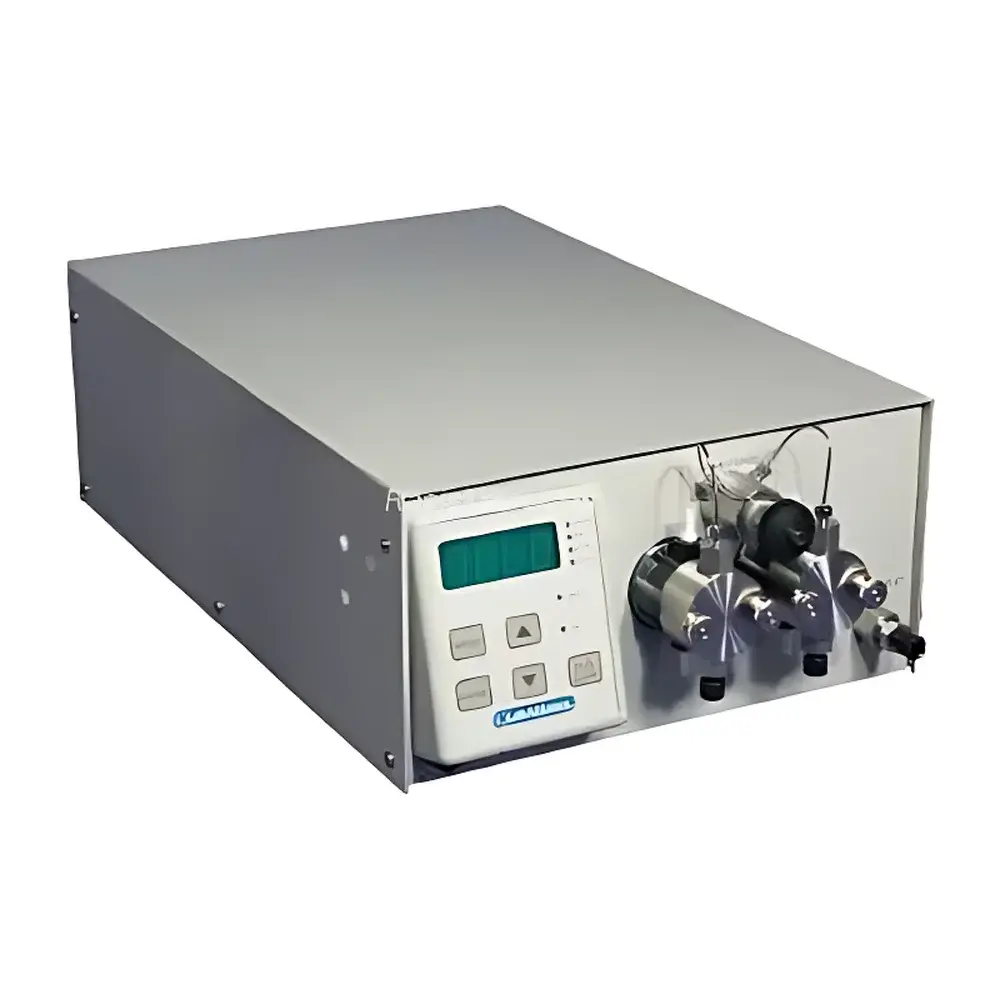
Laballiance Model CP Constant-Pressure Pump
| Brand | Laballiance |
|---|---|
| Origin | USA |
| Manufacturer Type | Authorized Distributor |
| Origin Category | Imported |
| Model | Model CP |
| Price | Upon Request |
| Flow Rate | 0.01–12 mL/min or 0.01–24 mL/min |
| Maximum Pressure | 9,990 psi (689 bar) |
| Flow Accuracy | ±2% |
| Flow Precision | 0.075% RSD |
| Pressure Accuracy | ±1% of Full Scale |
| Dimensions | 6" H × 11" W × 18" D (152 × 279 × 457 mm) |
| Weight | 30 lb (14 kg) |
| Interface | RS-232, 0–10 V analog input, 0–10 kHz frequency input, TTL start/stop trigger |
Overview
The Laballiance Model CP Constant-Pressure Pump is an engineered solution for high-precision, low-pulsation column packing in analytical and preparative liquid chromatography. Unlike conventional pneumatic or single-piston systems, the Model CP employs a dual-piston positive displacement architecture driven by a digitally controlled stepper motor, enabling true constant-pressure operation across a wide dynamic range. Its core function is to maintain user-defined backpressure during slurry packing of HPLC, UHPLC, and preparative columns—regardless of column internal diameter (from 1/16″ to 1/2″), bed length, or particle size (2–10 µm spherical silica or polymer-based media). By decoupling pressure control from flow rate, the pump dynamically adjusts volumetric delivery to sustain setpoint pressure, thereby minimizing mechanical stress on fragile particles and preventing fracture-induced void formation, channeling, or bed heterogeneity. This principle directly supports ISO 13877 (chromatographic column performance testing) and aligns with USP requirements for column reproducibility and stability.
Key Features
- Dual-piston head design reduces pressure ripple to <0.5% peak-to-peak, critical for uniform bed density in sub-2 µm particle packings.
- Four operational modes: Constant-Pressure, Max-Flow, Rapid Packing, and Standard—each optimized for specific slurry rheology and column geometry.
- Real-time pressure monitoring with programmable upper/lower thresholds; audible and visual alerts trigger when limits are breached.
- Front-panel LED interface with intuitive keypad navigation—single-button “Max Flow” activation for solvent exchange without mode reconfiguration.
- Integrated high-speed purge valve enables rapid system flushing between packing cycles, reducing cross-contamination risk in multi-column workflows.
- Motor fault detection circuitry halts operation upon encoder loss, phase error, or thermal overload—ensuring hardware protection and data integrity.
- Analog (0–10 V DC) and frequency (0–10 kHz) remote inputs allow seamless integration into automated packing stations or PLC-controlled environments.
Sample Compatibility & Compliance
The Model CP is validated for use with all common chromatographic slurries—including silica, hybrid organic-inorganic, polymeric, and monolithic stationary phases—in aqueous, organic, and mixed solvent systems. Its stainless-steel fluid path (316 SS) ensures compatibility with aggressive solvents (e.g., THF, chloroform, concentrated acids/bases) and prevents leaching or corrosion-related contamination. The pump meets CE electromagnetic compatibility (EMC) Directive 2014/30/EU and conforms to IEC 61000-6-2/6-3 immunity and emission standards. For regulated laboratories, its RS-232 interface supports audit-trail-capable data logging when paired with compliant third-party software, satisfying FDA 21 CFR Part 11 requirements for electronic records and signatures when implemented within a validated environment.
Software & Data Management
The included Quick-Set PC application (Windows-compatible) provides full instrument control via RS-232. It auto-detects COM port configuration or permits manual assignment. Users can define and save pressure/flow profiles as ASCII text files (.txt), including timestamps, setpoints, and real-time sensor readings at user-specified intervals (100 ms to 10 s resolution). Profile playback enables repeatable method execution across shifts or operators. All logged data include metadata: operator ID, date/time stamp, model serial number, and firmware version—supporting GLP-compliant documentation. No proprietary drivers or cloud dependencies are required; raw data export is native and format-agnostic.
Applications
- Precision packing of analytical HPLC columns (2.1–4.6 mm ID) with sub-3 µm particles for high-resolution separations.
- Preparative column fabrication (10–50 mm ID) requiring consistent bed homogeneity over extended lengths (>25 cm).
- Method development labs validating column lot-to-lot reproducibility per ASTM D7219 (chromatographic column qualification).
- Contract manufacturing organizations (CMOs) producing GMP-grade columns under documented SOPs.
- Academic core facilities supporting method transfer studies where column efficiency (N/m), asymmetry (As), and pressure rise kinetics must be tightly controlled.
FAQ
What distinguishes constant-pressure mode from constant-flow mode in column packing?
Constant-pressure mode maintains a fixed backpressure while allowing flow rate to vary inversely with slurry resistance—preventing particle fracture during initial bed compression. Constant-flow mode applies fixed volumetric delivery, which risks pressure spikes and particle damage as the bed consolidates.
Can the Model CP be integrated into a fully automated column packing station?
Yes—via TTL start/stop triggers, analog voltage input for flow modulation, and RS-232 command protocol (ASCII-based SCPI subset), enabling synchronization with robotic slurry dispensers, column ovens, or vision-based alignment systems.
Is firmware upgradable in the field?
Yes—firmware updates are delivered as .hex files and applied through the Quick-Set software using standard RS-232 communication; no hardware modification is required.
Does the pump support gradient-compatible packing protocols?
While not a gradient pump per se, its pressure-regulated delivery allows sequential slurry introduction under stable pressure—enabling layered packing strategies for mixed-mode or tandem columns when coordinated with external valve manifolds.
What maintenance intervals are recommended for optimal long-term accuracy?
Piston seals should be inspected every 500 hours of operation; replacement is advised at 1,000-hour intervals or after exposure to abrasive slurries (e.g., >5% w/v silica). Calibration verification (flow and pressure) is recommended quarterly per ISO/IEC 17025 guidelines.



