
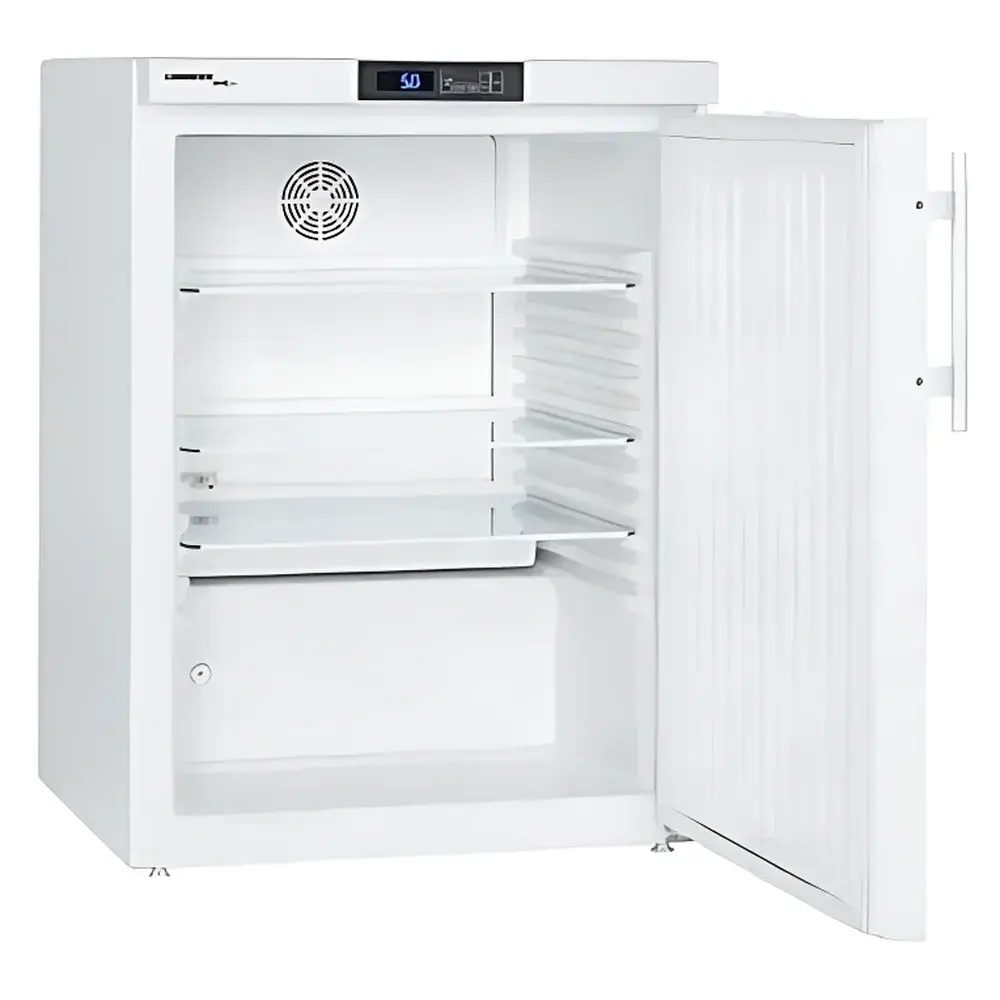
Liebherr LKUv 1610 Laboratory Refrigerator
| Brand | Liebherr |
|---|---|
| Origin | Austria |
| Model | LKUv 1610 |
| Refrigeration Temperature Range | +3°C to +16°C |
| Effective Volume | 140 L |
| Internal Dimensions (W×D×H) | 440 × 435 × 670 mm |
| External Dimensions (W×D×H) | 597 × 615 × 825 mm |
| Cooling Method | Forced-air (Fan-cooled) |
| Energy Consumption | 0.747 kWh/24h |
| Temperature Uniformity | ±3°C |
| Temperature Control Resolution | 0.1°C |
| PT100 Sensor Port | Ø10 mm |
| Door Opening Angle | 90° |
Overview
The Liebherr LKUv 1610 is a precision-engineered, European-manufactured laboratory refrigerator designed for stable, reliable cold storage of temperature-sensitive biological and chemical materials in regulated research and quality control environments. Built upon Liebherr’s six-decade heritage in scientific refrigeration, the LKUv 1610 employs forced-air circulation to ensure uniform temperature distribution across its 140 L internal volume—critical for preserving integrity of reagents, antibodies, cell culture media, serum, enzymes, tissue specimens, and diagnostic assay kits. Its operational range of +3°C to +16°C is optimized for applications requiring non-frozen, above-zero cold preservation—distinct from general-purpose domestic refrigeration—and aligns with ISO 15190:2020 and CLSI GP35-A4 guidelines for laboratory equipment validation. The unit features an electromechanical safety thermostat that independently monitors chamber temperature and interrupts cooling if ambient conditions risk sub-2°C operation—preventing unintended freezing and safeguarding sample viability.
Key Features
- Forced-air cooling system delivering consistent airflow and minimizing thermal gradients (±3°C uniformity across all zones)
- Precision digital temperature control with 0.1°C resolution and real-time display, backed by redundant electromechanical safety cutoff
- Seamless, one-piece polystyrene interior liner with rounded corners—non-porous, chemical-resistant, and compliant with ISO 14644-1 Class 7 cleanroom-compatible cleaning protocols
- Adjustable stainless-steel wire shelving on 32 mm pitch; shelves feature plastic-coated surfaces and full 90° pull-out capability for ergonomic access
- Integrated, switchable LED ceiling lighting providing uniform illumination without heat emission or UV exposure
- Reversible door hinge and user-replaceable magnetic door gasket—designed for long-term sealing integrity and ease of maintenance under GLP/GMP audit conditions
- Eco-optimized refrigeration cycle using natural hydrocarbon refrigerant R600a (zero ODP, GWP < 10), fully compliant with EU F-Gas Regulation (EU) No 517/2014
- Low-noise operation (<42 dB(A)) enabled by brushless DC compressor and optimized fan acoustics—suitable for shared lab spaces and quiet-zone facilities
- Dedicated Ø10 mm port for external PT100 or NIST-traceable temperature probe integration—enabling independent validation per ASTM E2875-22 and FDA 21 CFR Part 11 data integrity requirements
Sample Compatibility & Compliance
The LKUv 1610 is validated for continuous storage of biologics including monoclonal antibodies, recombinant proteins, primary cell suspensions, cryopreserved cell stocks (prior to freezing), clinical serum panels, ELISA and PCR reagent kits, and stability-test reference standards. Its temperature stability profile meets the storage specifications outlined in USP , EP 2.2.41, and ICH Q5C for therapeutic protein formulations. All structural materials—including powder-coated steel exterior, food-grade polystyrene liner, and nickel-plated hardware—are certified free of leachable heavy metals (per EN ISO 10993-12) and resistant to common laboratory disinfectants (e.g., 70% ethanol, 0.5% sodium hypochlorite). The unit supports IQ/OQ documentation packages and is compatible with third-party temperature mapping studies required for ISO/IEC 17025-accredited laboratories.
Software & Data Management
While the LKUv 1610 operates via standalone electromechanical/digital controls (no embedded firmware or network interface), its architecture is expressly designed for seamless integration into centralized environmental monitoring systems (EMS). The standardized Ø10 mm sensor port accepts calibrated PT100 probes connected to external data loggers compliant with 21 CFR Part 11—supporting electronic audit trails, alarm escalation (SMS/email), and automated report generation. Optional Liebherr-certified validation kits include thermocouple arrays, calibration certificates traceable to DKD/DAkkS, and protocol templates aligned with Annex 15 of the EU GMP Guide. All temperature deviation events are physically recordable via analog chart recorder or digital logger—ensuring full compliance with ALCOA+ data integrity principles.
Applications
- Stable short- to medium-term storage of cell culture media, growth factors, and transfection reagents in academic and industrial cell biology labs
- Controlled-temperature holding of clinical trial samples (serum, plasma, CSF) prior to batch analysis in central testing laboratories
- Secure storage of QC reference standards and working stock solutions in pharmaceutical manufacturing facilities operating under cGMP
- Preservation of pathogen isolates and vaccine intermediates in public health laboratories accredited to ISO/IEC 17025
- Buffer and diluent management in analytical chemistry workflows requiring strict thermal history documentation
- Support of ISO 13485-compliant medical device R&D where material traceability and environmental condition logging are mandatory
FAQ
Is the LKUv 1610 suitable for storing frozen samples?
No. This unit is strictly a +3°C to +16°C laboratory refrigerator and does not provide freezing capability. For sub-zero storage, Liebherr offers dedicated ultra-low temperature (ULT) freezers (e.g., ULV series) and frost-free -25°C models.
Can the unit be validated for GxP environments?
Yes. Its mechanical robustness, sensor port, and stable thermal performance support full IQ/OQ/PQ execution. Liebherr provides factory-issued test certificates and assists with protocol development per ASTM E2500 and EU Annex 15.
What maintenance intervals are recommended?
Door gaskets should be inspected quarterly; condenser coils require vacuum cleaning every 6 months in standard lab environments. Annual calibration of the internal sensor against a NIST-traceable reference is advised for regulated use.
Does it meet energy efficiency standards for EU procurement?
Yes. With 0.747 kWh/24h consumption and R600a refrigerant, it exceeds EU Energy Label Class F requirements and qualifies for green procurement frameworks such as EMAS and ISO 50001-aligned facility reporting.
Is remote monitoring possible?
Not natively—but the Ø10 mm sensor port enables connection to third-party EMS platforms (e.g., Sensiplus, TempTale, or custom SCADA) with full alarm logging and 21 CFR Part 11-compliant data handling.




