
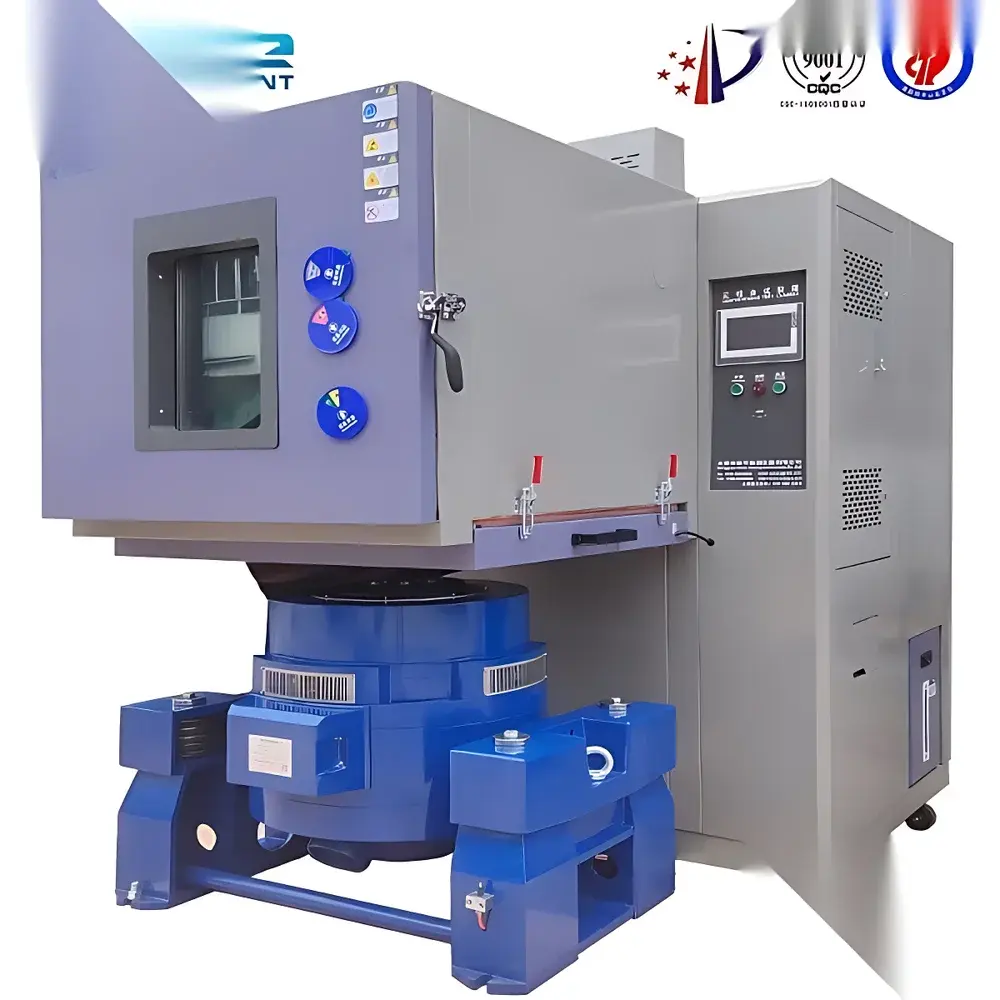
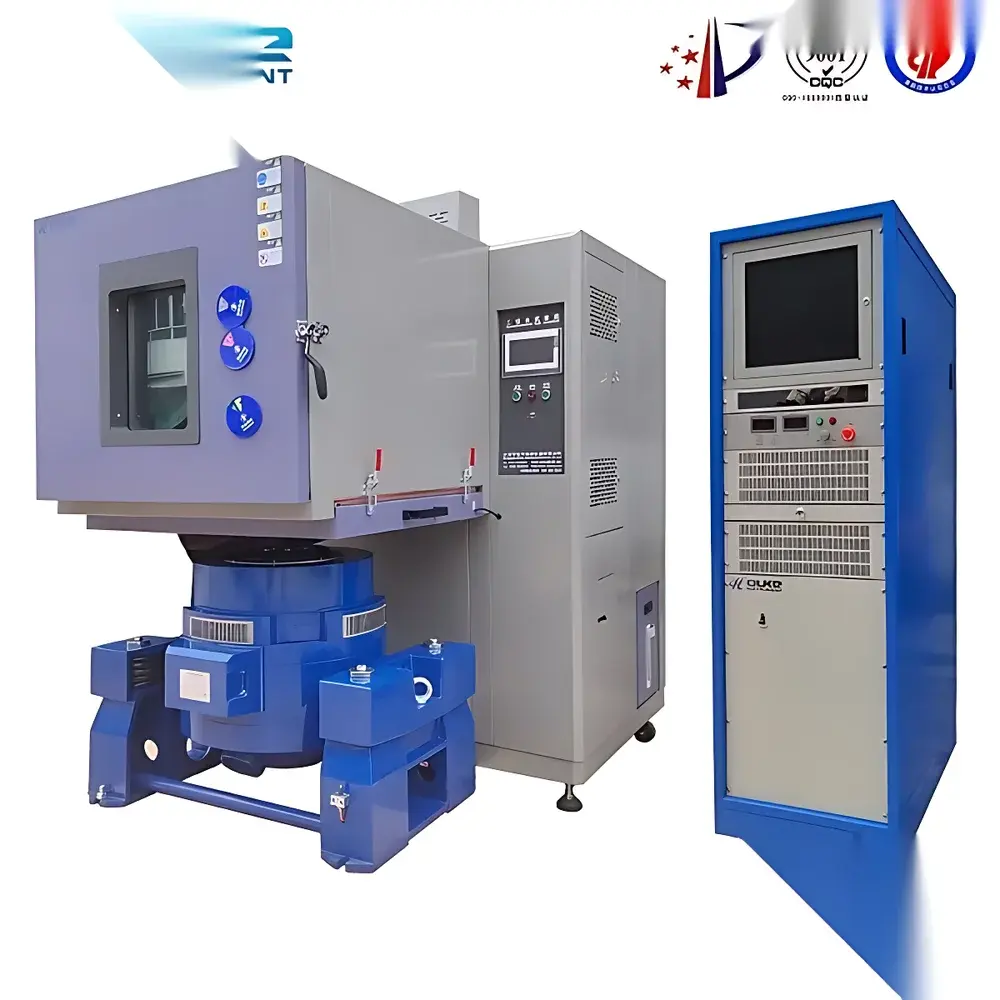
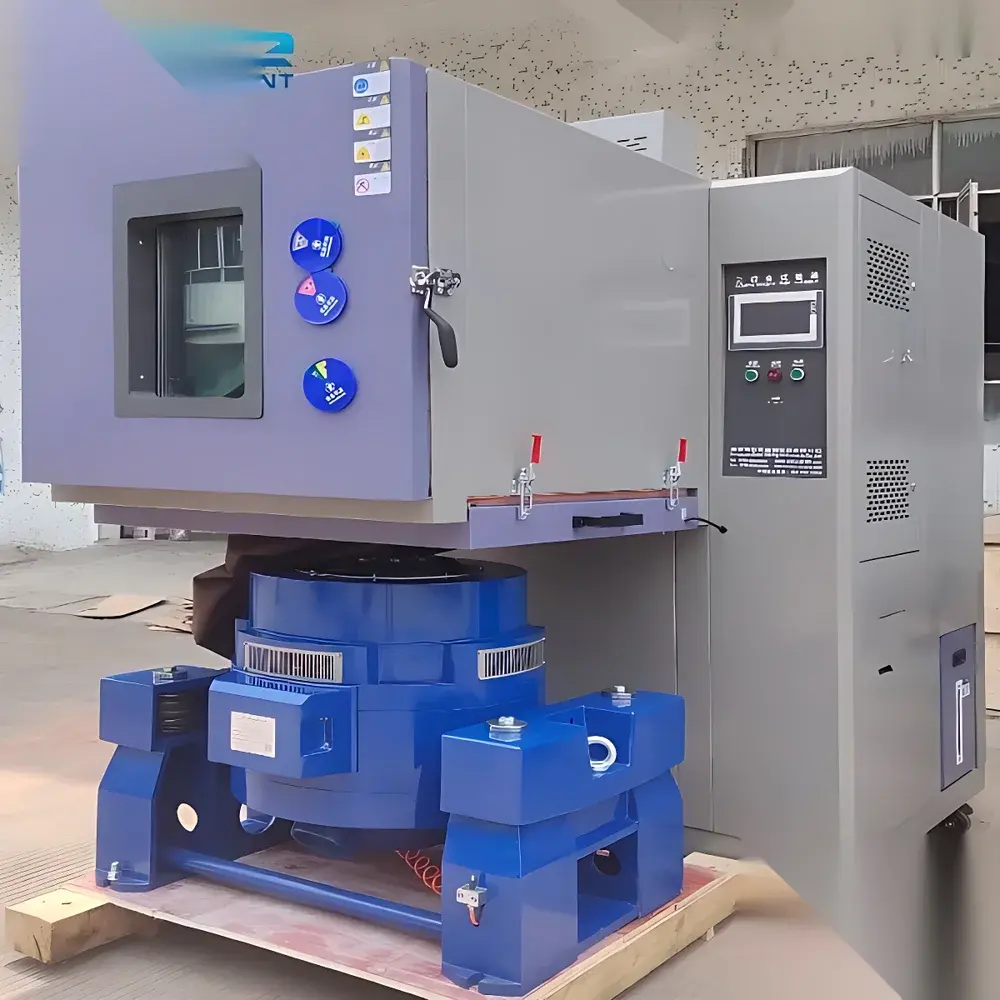
Combined Temperature-Humidity-Vibration Test System (Tri-Environmental Test Chamber)
| Brand | Other Brands |
|---|---|
| Origin | Imported |
| Manufacturer Type | Authorized Distributor |
| Load Capacity | 25 kg / 50 kg / 75 kg / 100 kg |
| Table Size | 350 × 350 mm (customizable) |
| Vibration Axis | Vertical, Horizontal, or Dual-Axis (selectable) |
| Frequency Range | 1–600 Hz / 1–3000 Hz / 1–5000 Hz |
| Peak-to-Peak Displacement | 0–5 mm |
| Max Acceleration | <20 g |
| Vibration Waveform | Sine |
| Frequency Resolution | 0.01 Hz |
| Frequency Accuracy | ±0.1 Hz |
| Test Duration | 0–9999 h/min/sec (programmable) |
| Power Supply | AC 220 V / 50 Hz or AC 380 V / 50 Hz |
Overview
The Combined Temperature-Humidity-Vibration Test System is an integrated environmental simulation platform engineered for rigorous reliability validation of electro-mechanical components, automotive subsystems, consumer electronics, instrumentation, and industrial equipment. It simultaneously applies controlled thermal stress (high/low temperature), humidity variation, and mechanical vibration—replicating real-world transport, storage, and operational conditions in accordance with international standards such as IEC 60068-2-64 (vibration), IEC 60068-2-14 (thermal shock), and MIL-STD-810H (combined environments). Unlike sequential testing methods, this tri-environmental chamber enables synchronized exposure to multiple stressors, revealing latent failure modes—including solder joint fatigue, connector loosening, material creep under thermal cycling, and resonance-induced structural degradation—that single-stress tests frequently overlook. Its modular architecture supports configurable vibration exciters, precision climate control modules, and programmable test profiles compliant with GLP and GMP documentation requirements.
Key Features
- Four-point synchronous electromagnetic excitation ensures uniform force distribution across the 350 × 350 mm stainless steel test table—minimizing modal distortion and enabling high-fidelity sine vibration reproduction.
- Programmable sweep and fixed-frequency test sequences allow complex profiles: e.g., a 10–30 Hz linear sweep repeated for 50 cycles, followed by dwell at 25 Hz for 15 minutes—fully automated without manual intervention.
- Real-time amplitude prediction algorithm dynamically adjusts drive signals to maintain target displacement or acceleration across frequency ranges, eliminating manual recalibration during long-duration tests.
- Non-magnetic, electrostatically shielded table surface prevents interference with sensitive sensors or magnetic components under test—critical for aerospace avionics and medical device validation.
- Integrated electromagnetic interference (EMI) suppression circuitry isolates control electronics from high-current exciter transients, ensuring stable frequency tracking and data integrity over multi-day continuous operation.
- Stepless amplitude adjustment (0–5 mm p-p) combined with acceleration limiting (<20 g) permits safe testing of fragile assemblies while preserving dynamic fidelity at low frequencies.
Sample Compatibility & Compliance
The system accommodates specimens up to 100 kg and 350 mm × 350 mm footprint—suitable for printed circuit board assemblies (PCBAs), ECUs, MEMS sensors, optical modules, and small mechanical subassemblies. Climate control meets IEC 60068-2-30 (damp heat cyclic) and ISO 16750-4 (road vehicle environmental conditions). Vibration performance conforms to ISO 10816-1 (machine vibration severity) and ASTM D999 (shipping container vibration simulation). Full audit trails—including parameter setpoints, actual measured values, timestamped event logs, and operator ID—are retained for FDA 21 CFR Part 11-compliant electronic records when paired with optional validated software.
Software & Data Management
A Windows-based control interface provides intuitive profile creation, real-time waveform monitoring (displacement, velocity, acceleration), and post-test spectral analysis (FFT). All test data—including raw time-history files, summary statistics (RMS, peak, kurtosis), and pass/fail status per IEC 61000-4-29 criteria—are exportable in CSV, XML, and PDF formats. Optional network connectivity enables remote monitoring, centralized fleet management, and integration into LIMS or MES platforms via OPC UA or Modbus TCP protocols. Software validation packages—including IQ/OQ documentation, traceability matrices, and electronic signature support—are available for regulated industries.
Applications
This system is routinely deployed in R&D labs for design verification (DVT), in manufacturing QA for incoming component screening, and in reliability engineering for accelerated life testing (ALT). Typical use cases include: validating solder joint integrity in automotive ADAS controllers under combined thermal cycling and road-spectrum vibration; assessing display module delamination resistance in handheld devices subjected to temperature-humidity-vibration stress; qualifying battery pack enclosures for electric vehicles per UN ECE R100 thermal shock + random vibration protocols; and certifying medical infusion pump housings against IEC 60601-1 mechanical durability requirements.
FAQ
What standards does this system support for combined environmental testing?
It complies with IEC 60068-2-64 (vibration), IEC 60068-2-14 (thermal shock), IEC 60068-2-30 (damp heat), and MIL-STD-810H Method 514.7 (vibration) and Method 502.7 (temperature/humidity)—with full traceability to NIST-calibrated reference instruments.
Can the system perform random vibration testing in addition to sine?
Standard configuration supports sine waveforms only. Random vibration capability requires optional hardware upgrade (electrodynamic shaker with digital controller and PSD synthesis firmware).
Is the chamber suitable for testing samples containing lithium-ion batteries?
Yes—when equipped with explosion-proof climate chamber options, integrated gas monitoring, and UL 1642-compliant safety interlocks, it supports UN 38.3 T.5 thermal cycling and T.6 vibration testing under controlled ventilation.
How is calibration maintained across temperature, humidity, and vibration axes?
Each subsystem undergoes independent annual calibration using accredited third-party providers; certificate-of-conformance includes uncertainty budgets per ISO/IEC 17025 and traceability to national metrology institutes (NMI).
Does the system support automated reporting for ISO 9001 internal audits?
Yes—the software generates customizable test reports with embedded metadata (operator, date/time, instrument IDs, calibration status), digital signatures, and revision-controlled templates aligned with ISO 9001:2015 clause 8.5.2.



