
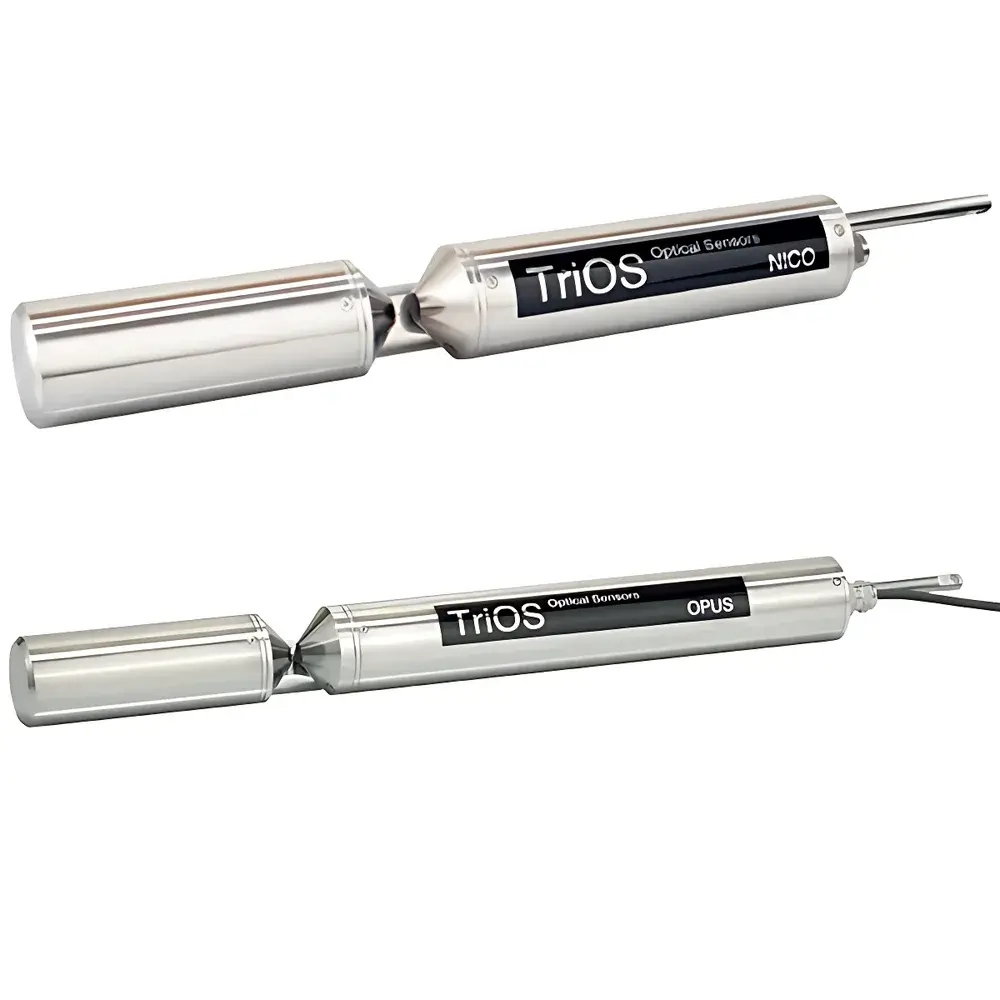
TriOS NICO Surface Water Nitrate Analyzer
| Brand | TriOS |
|---|---|
| Origin | Germany |
| Model | NICO |
| Measurement Principle | UV Absorption Spectrophotometry (Multi-Wavelength Compensation) |
| Detection Channels | 4 |
| Wavelengths | 212 nm (NO₃⁻), 254 nm (DOC correction), 360 nm (turbidity correction) |
| Optical Path Lengths | 0.3, 1, 2, 5, 10, 50 mm |
| NO₃-N Range | 0–100 mg/L |
| Accuracy | ±(5% + 0.1 mg/L) |
| Turbidity & DOC Compensation | Yes |
| Response Time | 2 min |
| Minimum Measurement Interval | 1 min |
| Data Storage | 2 GB internal |
| Digital Interfaces | Ethernet (TCP/IP), RS-232/RS-485 (Modbus RTU) |
| Analog Output | 4–20 mA |
| Power Supply | 12–24 VDC (±10%) |
| Max. Power Consumption | ≤8 W |
| Housing Materials | Stainless Steel 1.4571 / 1.4404 or Titanium Grade 2 (3.7035) |
| Dimensions (L × Ø) | 470 mm × 48 mm (for 10 mm path length) |
| Weight | ~3 kg (stainless), ~2 kg (titanium) |
| Pressure Rating | SubConn: 30 bar |
| Fixed Cable | 3 bar |
| Flow Cell | 1 bar |
| Flow Rate | 2–4 LPM |
| Inlet Velocity | 0.1–10 m/s |
| IP Rating | IP68 |
| Operating Temp. | +2 to +40 °C (sample & ambient) |
| Storage Temp. | −20 to +80 °C |
| Calibration/Maintenance Interval | 24 months |
Overview
The TriOS NICO Surface Water Nitrate Analyzer is an industrial-grade, multi-wavelength ultraviolet absorption spectrophotometer engineered for continuous, reagent-free quantification of nitrate-nitrogen (NO3-N) in natural surface waters. It operates on the fundamental principle of Beer–Lambert law-based attenuation measurement across three discrete UV wavelengths—212 nm (primary nitrate absorption band), 254 nm (organic matter interference correction), and 360 nm (turbidity scattering compensation)—enabling robust, matrix-corrected concentration derivation without chemical digestion or sample pretreatment. Unlike conventional single-wavelength analyzers, the NICO’s quadruple photodiode detection system captures simultaneous spectral response at each wavelength, allowing real-time deconvolution of overlapping absorbance contributions from dissolved organic carbon (DOC), suspended solids, and nitrate ions. Its modular optical architecture—comprising a pulsed xenon broadband source, precision collimating optics, selectable path lengths (0.3–50 mm), and thermally stabilized photodetectors—ensures high reproducibility under variable field conditions typical of rivers, reservoirs, and intake channels.
Key Features
- Reagent-free, maintenance-light operation with no consumables or wet chemistry required
- Triple-wavelength UV absorption (212/254/360 nm) with integrated turbidity and DOC compensation algorithms
- Configurable optical path lengths (0.3, 1, 2, 5, 10, 50 mm) to optimize sensitivity and dynamic range for diverse water matrices
- G2 web-enabled interface supporting browser-based configuration, firmware updates, and remote diagnostics via Ethernet (TCP/IP)
- Onboard 2 GB non-volatile memory with timestamped data logging (NO3-N, NO3, NOx-N, NOx, temperature, raw absorbance values)
- Industrial-grade housing in corrosion-resistant stainless steel (DIN 1.4571 / 1.4404) or titanium (Grade 2, DIN 3.7035) rated IP68 and pressure-tolerant up to 30 bar (SubConn variant)
- Compliant with ISO 7027 for turbidity measurement principles and aligned with ASTM D3868 and EPA Method 353.2 for UV-based nitrate determination
Sample Compatibility & Compliance
The NICO is validated for direct immersion or flow-cell deployment in unpumped or low-pressure (1–4 LPM) surface water applications—including rivers, lakes, irrigation canals, and drinking water intakes—without filtration or dilution. Its nanocoated sapphire optical windows resist biofouling and abrasion, while the 2–40 °C operational temperature range accommodates seasonal variability across temperate and subtropical climates. The instrument meets IEC 61326-1 (EMC for industrial environments), EN 61000-6-2/-6-4, and RoHS directives. For regulated monitoring programs, its deterministic calibration traceability, audit-ready data logs, and Modbus RTU output support integration into SCADA systems compliant with EU WFD (Water Framework Directive) reporting requirements and U.S. EPA Clean Water Act Section 304(h) data quality objectives. Optional GLP/GMP-compliant data export modes include CSV with metadata headers and time-synchronized Modbus registers.
Software & Data Management
The embedded G2 firmware provides secure, role-based access via HTTPS-enabled web interface—no proprietary software installation required. Configuration includes adjustable measurement intervals (≥1 min), auto-zeroing cycles, alarm thresholds (e.g., NO3-N > 10 mg/L), and automatic temperature compensation using integrated Pt100 sensor. All raw and processed data are stored with UTC timestamps, sensor status flags, and checksum-verified integrity. Export options include HTTP POST to cloud platforms (e.g., AWS IoT Core, Azure IoT Hub), FTP/SFTP push, or local USB retrieval. The Modbus RTU register map exposes 32-bit floating-point outputs for NO3-N, temperature, path length, lamp intensity, and diagnostic codes—facilitating seamless integration with PLCs, DCS, or environmental data management systems (EDMS). Firmware updates are performed over-the-air with signed package verification and rollback capability.
Applications
- Real-time nitrate load monitoring at riverine tributaries and watershed outlets for nutrient budget modeling
- Early-warning detection of agricultural runoff events in drinking water source protection zones
- Performance verification of denitrification units in municipal wastewater treatment plants (WWTPs)
- Long-term trend analysis in national environmental monitoring networks (e.g., U.S. USGS NWIS, EU EEA WISE)
- Regulatory compliance reporting for nitrate vulnerability assessments under EU Nitrates Directive (91/676/EEC)
FAQ
Does the NICO require regular manual calibration?
No. The NICO is factory-calibrated with traceable NIST-standard reference solutions and designed for drift-free operation over 24 months. Field verification may be performed using certified nitrate standards; full recalibration is only recommended after physical damage or extended exposure to extreme fouling conditions.
Can it operate in highly turbid or colored water?
Yes. The 254 nm and 360 nm correction channels enable quantitative compensation for both humic substances and particulate scattering, extending reliable measurement capability to waters with turbidity up to 100 NTU and UV254 absorbance > 1.5 AU/cm.
Is the analog 4–20 mA output isolated and configurable?
Yes. The current loop is galvanically isolated, supports HART-compatible smart transmitters, and allows user-defined scaling (e.g., 0–100 mg/L NO3-N mapped to 4–20 mA) with linear or square-root characterization.
What flow cell options are available for pressurized installations?
TriOS offers two certified flow cells: a low-pressure quartz cell (max. 1 bar, 2–4 LPM) for open-channel bypass lines, and a high-pressure stainless-steel cell (max. 10 bar) compatible with SubConn wet-mateable connectors for submerged telemetry applications.
How is data security handled during remote access?
The G2 interface implements TLS 1.2 encryption, HTTP digest authentication, and configurable session timeouts. All firmware updates are cryptographically signed; unsigned packages are rejected by the bootloader. Audit logs record all configuration changes with user ID and timestamp.
Related Products







