
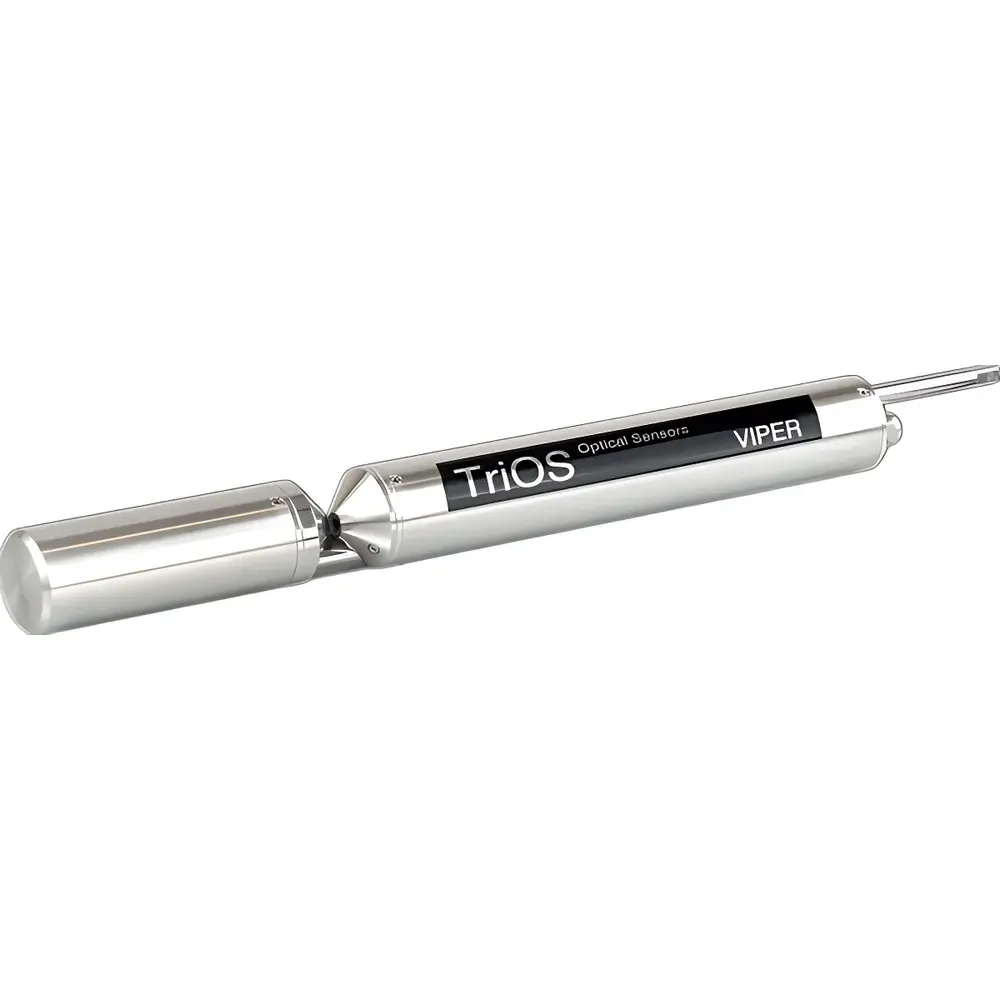
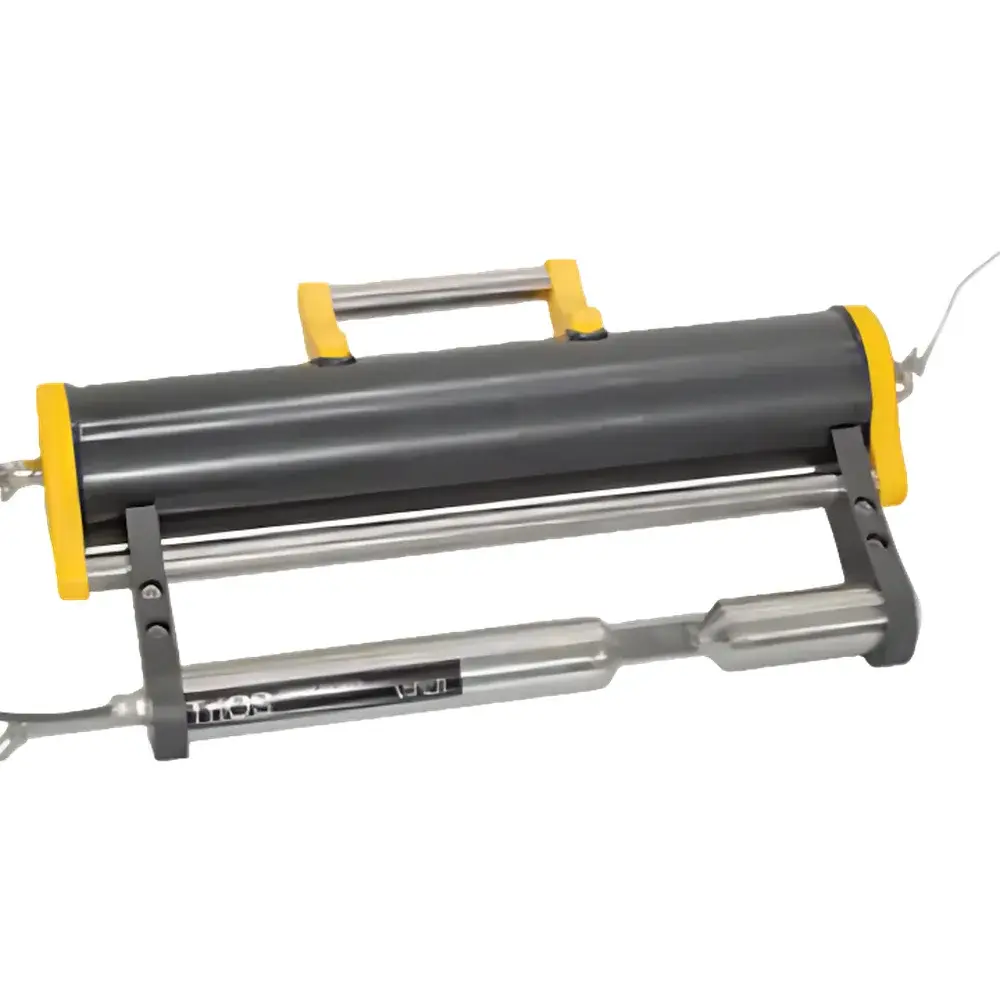
TriOS Viper G2 High-Spectral Attenuation Spectrophotometer
| Brand | TriOS |
|---|---|
| Origin | Germany |
| Model | Viper G2 |
| Wavelength Range | 360–720 nm |
| Light Source | 5 high-efficiency LEDs |
| Detector | 256-channel miniature spectrometer (2.2 nm/pixel) |
| Optical Path Lengths | 10, 50, 100, 150, 250 mm |
| Measurement Principle | Spectral transmittance/attenuation |
| Absorbance Range | 0.01–2.5 AU |
| Accuracy | < 0.2 % |
| Turbidity Compensation | Yes |
| Data Storage | ~2 MB |
| Response Time | 2 min |
| Minimum Measurement Interval | ≥1 min |
| Housing Material | Stainless Steel (1.4571 / 1.4404) or Titanium Alloy (3.7035) |
| Dimensions (L × Ø) | 495 mm × 48 mm (for 50 mm path length) |
| Weight | ~2.4 kg (stainless), ~1.3 kg (titanium) |
| Digital Interfaces | Ethernet (TCP/IP), RS-232 / RS-485 (Modbus RTU) |
| Power Supply | 12–24 VDC (±10 %) |
| Power Consumption | ≤3 W |
| Calibration Interval | 24 months |
| Max. Pressure Rating | SubConn: 30 bar |
| Fixed Cable | 3 bar |
| Flow Cell | 1 bar (2–4 LPM) |
| IP Rating | IP68 |
| Operating Temperature | +2 to +40 °C |
| Storage Temperature | −20 to +80 °C |
| Flow Velocity Range | 0.1–10 m/s |
| Compliant Standards | DIN EN ISO 7887-3:2011, DIN EN ISO 6271:2005, GOST 3351-74 |
Overview
The TriOS Viper G2 High-Spectral Attenuation Spectrophotometer is an in-situ, field-deployable optical sensor engineered for precise, real-time measurement of spectral attenuation and transmittance across the visible spectrum (360–720 nm). Based on the fundamental principle of Beer–Lambert law-compliant attenuation spectroscopy, the Viper G2 quantifies light absorption and scattering characteristics of aqueous media without sample extraction or chemical reagents. Its modular optical path design—offering five discrete path lengths (10, 50, 100, 150, and 250 mm)—enables optimal sensitivity adaptation across a wide dynamic range of turbidity and chromophore concentration, from clear drinking water to highly scattering estuarine and coastal waters. The instrument integrates five spectrally stable, long-lifetime LEDs as broadband excitation sources and a high-resolution 256-channel miniature spectrometer (2.2 nm/pixel) for full-spectrum acquisition. All optical windows are coated with anti-fouling nanocoating to mitigate biofilm formation—a critical requirement for long-term unattended deployment in natural and engineered water systems.
Key Features
- In-situ, non-invasive operation: Eliminates sampling bias, filtration artifacts, and time delays associated with lab-based analysis.
- Multi-path-length configuration: Enables application-specific optimization for low-absorbance (e.g., potable water) or high-absorbance (e.g., wastewater effluent, river plumes) conditions.
- Nanocoated sapphire optical windows: Provide mechanical durability and resistance to biological fouling under continuous immersion.
- LED-based illumination: Ensures thermal stability, low power draw (≤3 W), and >50,000-hour operational lifetime without spectral drift.
- Integrated turbidity compensation algorithm: Corrects absorbance values using concurrent scattering information, essential for accurate colorimetric quantification in heterogeneous media.
- Robust mechanical architecture: Available in marine-grade stainless steel (1.4571 / 1.4404) or titanium alloy (3.7035) housings rated to 30 bar (SubConn variant), suitable for submersible, flow-through, or pipe-mounted installations.
- Industrial communication protocols: Native support for Modbus RTU over RS-485/RS-232 and TCP/IP Ethernet ensures seamless integration into SCADA, PLC, and centralized telemetry platforms.
Sample Compatibility & Compliance
The Viper G2 is validated for direct in-situ measurement in natural waters (freshwater, estuarine, coastal), drinking water distribution networks, wastewater treatment streams, and process liquids in food, beverage, and pharmaceutical manufacturing. Its optical design conforms to internationally recognized standard methodologies: SAC436 determination per DIN EN ISO 7887-3:2011; Pt-Co (APHA/Hazen) color index calculation per DIN EN ISO 6271:2005; and Cr-Co color per GOST 3351-74. The instrument supports GLP/GMP-aligned data integrity through timestamped spectral storage (~2 MB onboard), audit-trail-capable firmware logging, and optional integration with FDA 21 CFR Part 11-compliant data management systems. Its IP68 ingress protection and operating temperature range (+2 to +40 °C) meet requirements for permanent outdoor and submerged deployment in regulatory monitoring networks.
Software & Data Management
TriOS SensorControl software provides full instrument configuration, real-time spectral visualization, and automated derivation of standardized color indices—including SAC436, SAC525, SAC620, Pt-Co (at 390 nm and 455 nm), and Cr-Co (at 380 nm and 413 nm)—from a single acquired spectrum. Raw spectral data (360–720 nm, 256 channels) are stored in ASCII or binary format with metadata (timestamp, temperature, path length, calibration ID). Firmware updates and parameter reconfiguration can be performed remotely via Ethernet or serial interface. The system supports scheduled autonomous measurement cycles (≥1 min interval), configurable alarm thresholds, and event-triggered data export. Exported datasets comply with ISO/IEC 17025 traceability frameworks when paired with factory-calibrated reference standards.
Applications
- Drinking water quality surveillance: Continuous monitoring of color, organic load (via SAC436), and disinfection by-product precursors.
- Environmental compliance reporting: Real-time assessment of river, lake, and estuary water clarity and chromophoric dissolved organic matter (CDOM) dynamics.
- Wastewater treatment optimization: Tracking decolorization efficiency in tertiary treatment stages and identifying upstream contamination events.
- Food & beverage process control: Objective, reagent-free verification of product color consistency (e.g., juices, teas, beers) without batch-to-batch variability introduced by human visual assessment.
- Industrial cooling water management: Early detection of microbial growth or hydrocarbon intrusion via spectral signature deviation.
- Research-grade aquatic optics: High-resolution attenuation profiling for bio-optical modeling and remote sensing ground-truthing.
FAQ
What spectral resolution does the Viper G2 provide?
The detector delivers 256 equidistant spectral channels across 360–720 nm, corresponding to a pixel resolution of 2.2 nm.
Can the Viper G2 measure parameters beyond color indices?
Yes—raw spectral data can be post-processed to derive additional optical properties such as spectral absorption coefficients, specific UV absorbance (SUVA), or custom empirical indices defined by user algorithms.
Is factory calibration traceable to national standards?
All instruments ship with NIST-traceable calibration certificates for wavelength accuracy and radiometric responsivity, aligned with ISO/IEC 17025-accredited procedures.
How often does the Viper G2 require recalibration in the field?
TriOS specifies a 24-month calibration interval under normal operating conditions; however, end-users may perform routine performance verification using certified neutral density filters or air/water reference measurements.
Does the instrument support automatic temperature compensation?
Yes—integrated PT1000 temperature sensor enables real-time correction of spectral absorbance for thermal effects on water refractive index and chromophore extinction coefficients.
Can the Viper G2 be deployed in pressurized pipelines?
When equipped with the SubConn pressure housing option, it is rated for continuous operation at up to 30 bar; flow-cell variants are rated for 1 bar at flow rates of 2–4 LPM.
Related Products







