
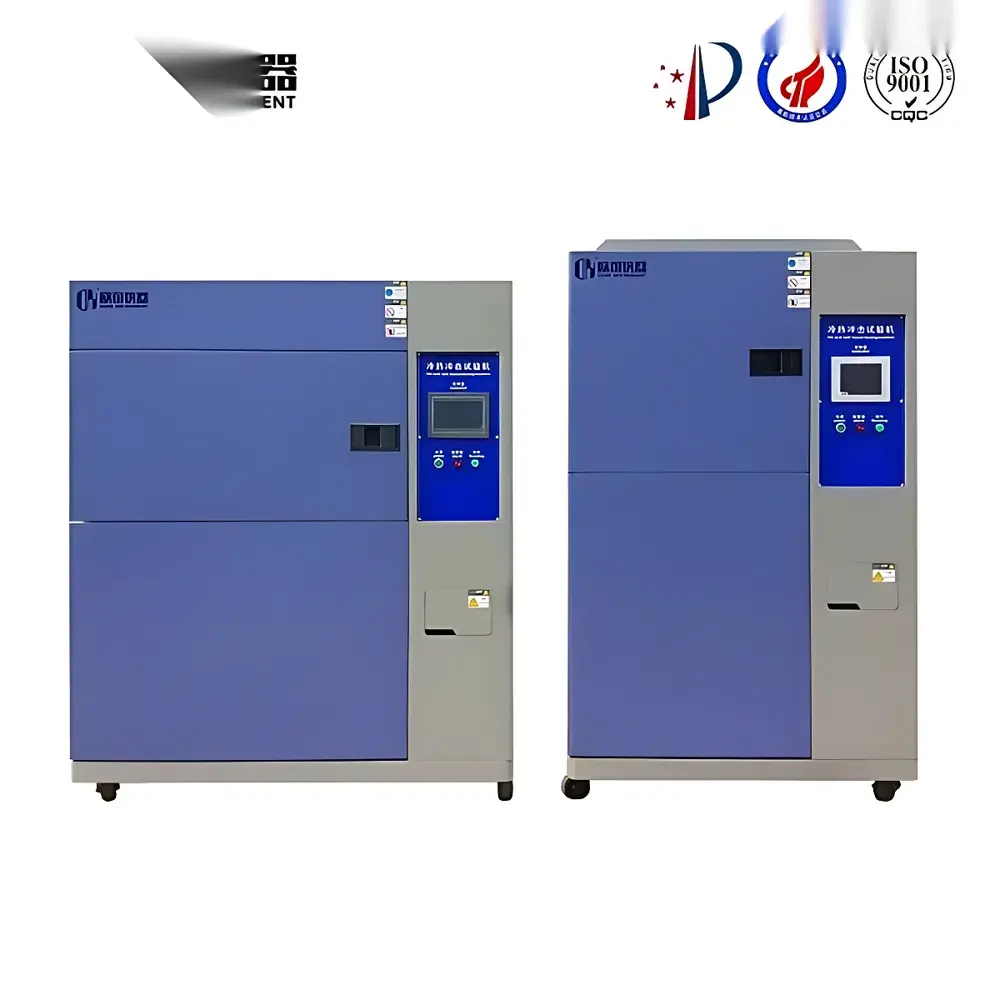
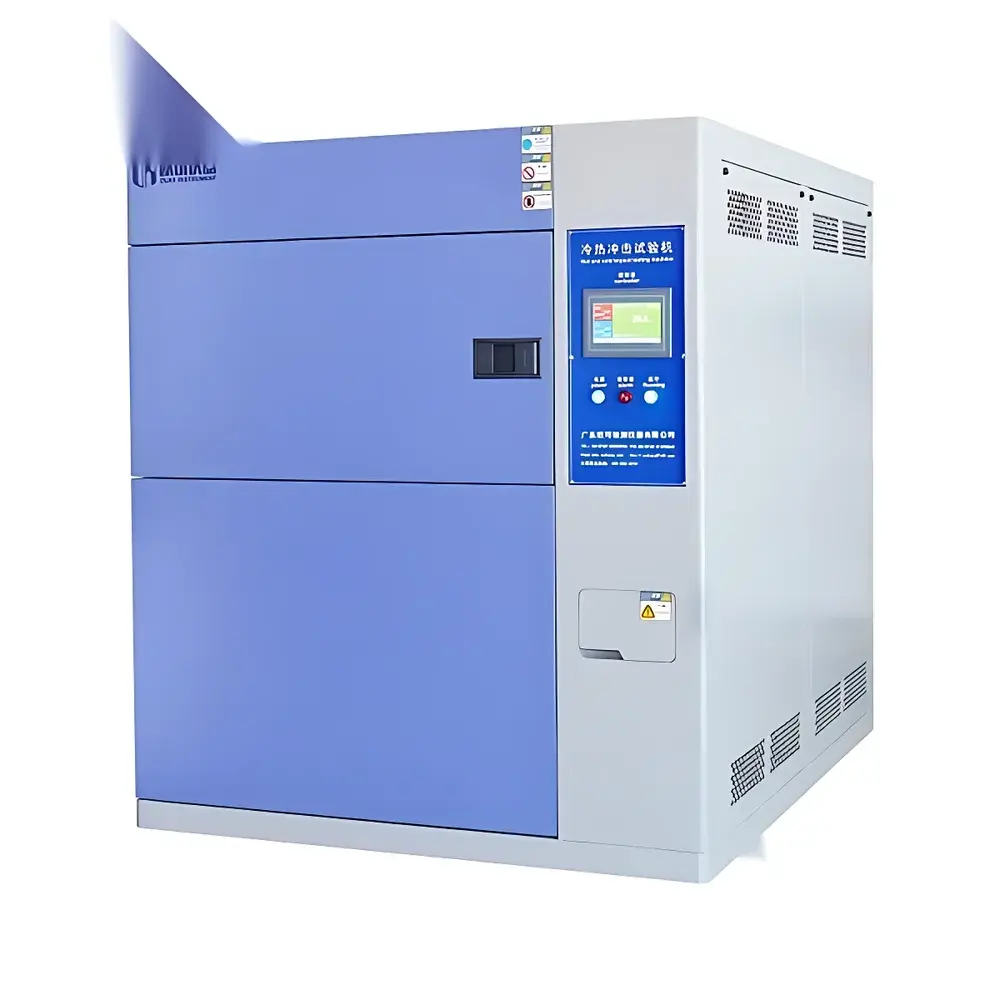
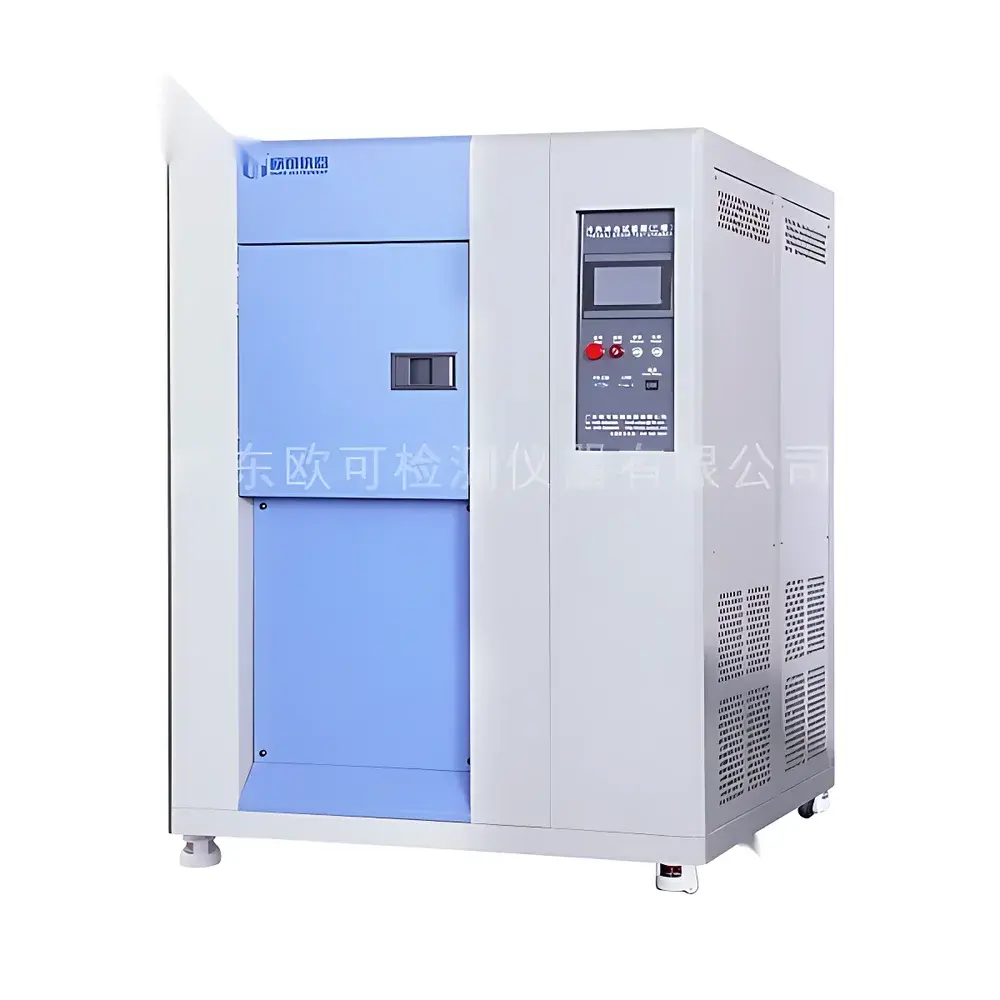
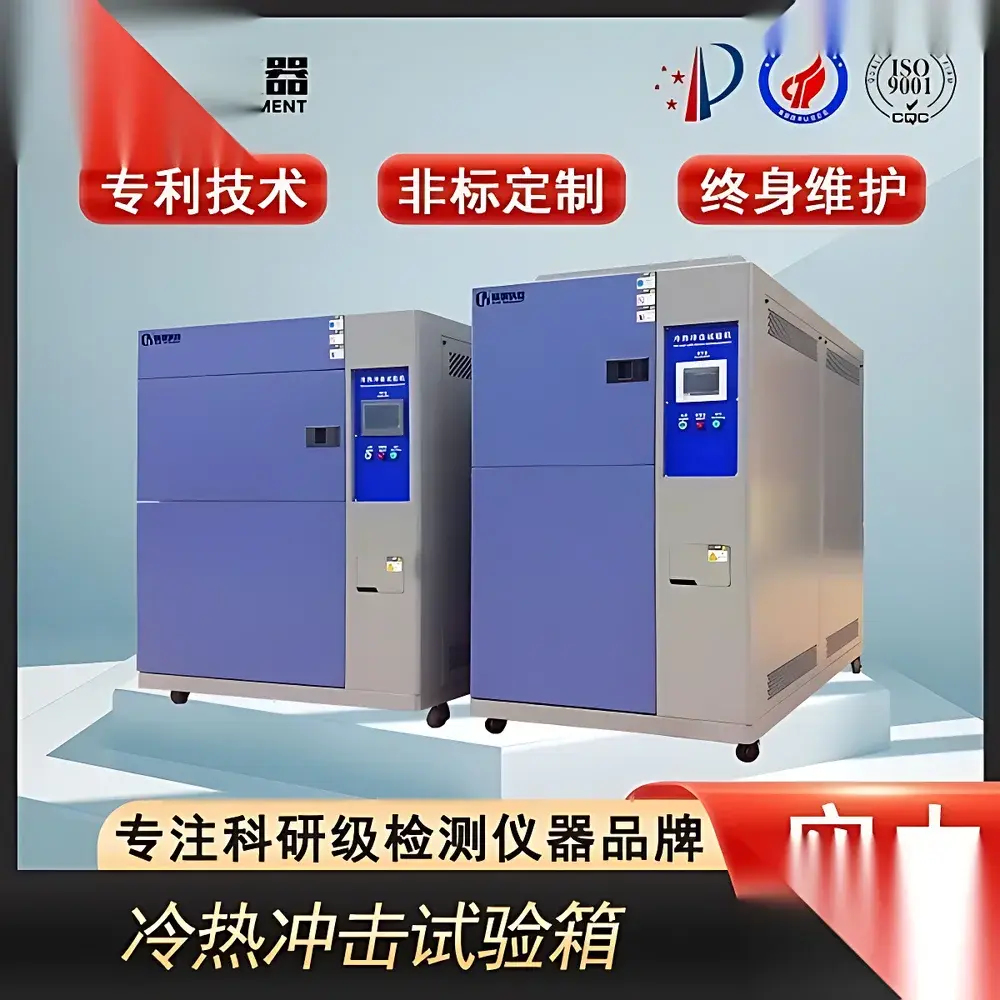
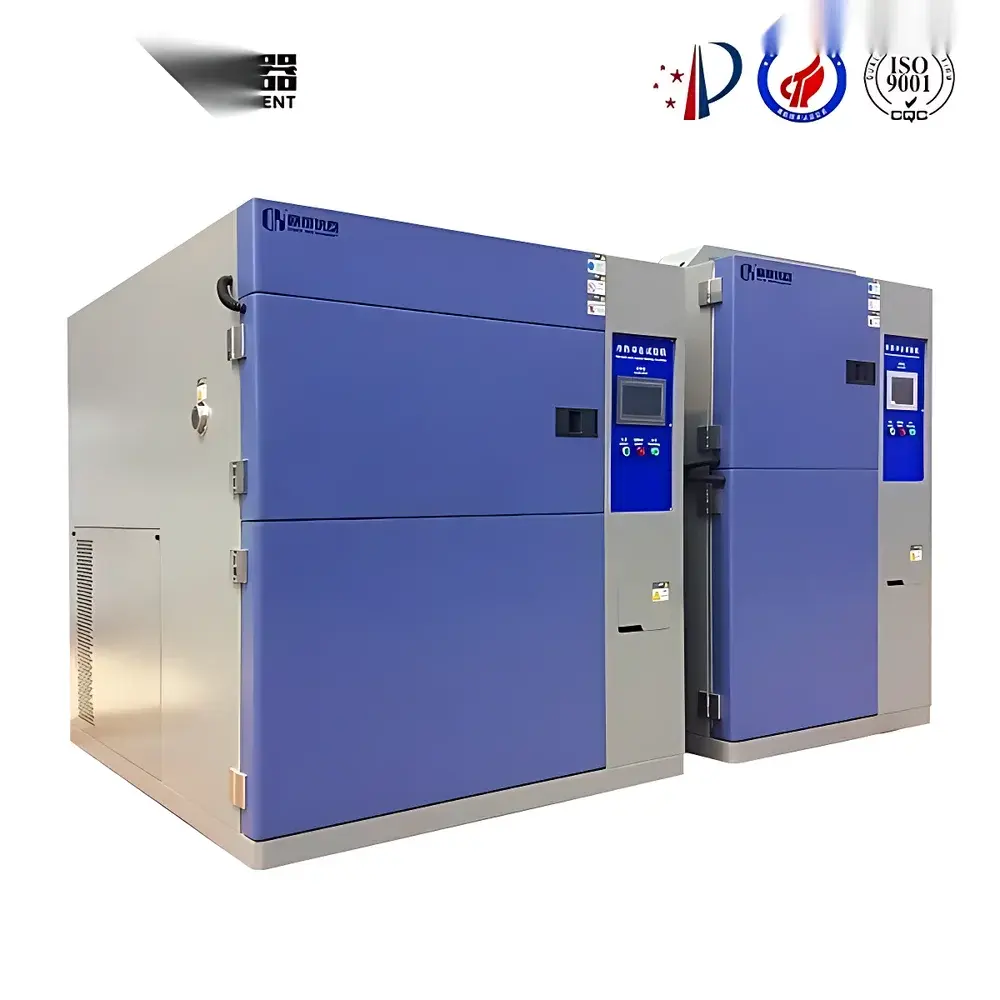
Thermal Shock Test Chamber – Dual-Chamber Rapid Temperature Cycling System
| Key | Temperature Range: -40 °C to +100 °C |
|---|---|
| Humidity Range | 20–98% RH |
| Temperature Uniformity | ±1 °C |
| Humidity Uniformity | ±5% RH |
| Ramp Rate (Heating) | ~4.0 °C/min |
| Ramp Rate (Cooling) | ~1.0 °C/min |
| Construction | Interior & Exterior – SUS304 Stainless Steel, Matte Finish |
| Insulation | High-Density Polyisocyanurate Foam (HFO-blown, Low-GWP) |
| Cooling System | Air-Cooled, Single-Stage Compressor (for -20 °C), Dual-Stage Compressor (for -40 °C to -70 °C) |
| Door Configuration | Dual-Facing Front & Rear Access Doors |
| Sample Mounting | LCD-Adjustable Tilt Fixture |
| Sensor Placement | Directly in Test Zone (Not in Air Duct) |
| Compliance Support | JEDEC JESD22-A104, MIL-STD-810H Method 503.5, IEC 60068-2-14, AEC-Q200, IPC-9701, IPC-J-STD-020 |
Overview
The Thermal Shock Test Chamber – Dual-Chamber Rapid Temperature Cycling System is an engineered environmental stress screening (ESS) platform designed for high-fidelity thermal shock qualification of electronic components, optoelectronic modules, and advanced display assemblies. Unlike single-chamber thermal cycling systems, this dual-compartment configuration physically separates extreme low-temperature and high-temperature zones—enabling rapid, repeatable transfer of test specimens between chambers via a motorized shuttle mechanism. This architecture eliminates thermal inertia lag and ensures precise dwell time control at target extremes, critical for validating solder joint integrity, interfacial adhesion, and coefficient-of-thermal-expansion (CTE) mismatch resilience in devices such as TFT-LCD panels, OLED substrates, LTPS backplanes, and NdFeB permanent magnets.
Key Features
- Dual-Zone Architecture: Independent -40 °C to -70 °C cryogenic chamber and +100 °C high-temperature chamber with automated specimen transfer; eliminates air-mixing artifacts and guarantees true step-change thermal shock profiles.
- Test-Zone-Centric Sensing: Platinum resistance thermometers (PRTs) and capacitive humidity sensors mounted directly within the test zone—not in recirculation ducts—ensuring measurement traceability to actual sample exposure conditions per ISO/IEC 17025 calibration requirements.
- Aluminum Load Validation Standard: Structural load capacity verified using calibrated aluminum mass blocks (not polymer simulants), ensuring thermal mass fidelity during qualification runs per JEDEC JESD22-A104 Annex B.
- Surface-Temperature Dwell Extension: Programmable surface temperature monitoring (via optional external thermocouple inputs) enables dynamic extension of dwell time until specimen surface reaches thermal equilibrium—reducing total cycle count without compromising test validity.
- Lead-Free Process Compatibility: Supports tin whisker growth acceleration testing per IPC-9701 and JEDEC JESD22-A121, including controlled ramp profiles optimized for SnAgCu (SAC) alloy reliability assessment.
- Energy-Efficient Low-Temperature Operation: Capable of executing 0 °C thermal shock cycles with reduced compressor duty cycle, lowering operational energy demand while maintaining ASTM E1545-compliant temperature stability.
Sample Compatibility & Compliance
This system accommodates flat-panel display subassemblies up to 600 mm × 450 mm × 100 mm (W×D×H), including full-size TFT-LCD modules, OLED lighting panels, and LTPS driver IC carriers. The adjustable tilt fixture allows angular positioning for gravity-sensitive encapsulants or anisotropic conductive film (ACF) bondline evaluation. All thermal profiles are programmable to meet mandatory test standards including: IEC 60068-2-14 (Change of Temperature), MIL-STD-810H Method 503.5 (Temperature Shock), AEC-Q200 Stress Test Qualification, and IPC-J-STD-020 (Moisture Sensitivity Level classification). Humidity-controlled shock sequences comply with IPC-9701 Appendix A for electrochemical migration studies. The stainless steel interior (SUS304, 2B finish) resists corrosion from halogen-free flux residues and conformal coating solvents.
Software & Data Management
Control is executed via a real-time embedded OS with 10.1″ capacitive touchscreen interface, supporting up to 99 programmable test profiles with nested subroutines. Each profile stores ramp rates, dwell times, humidity setpoints, and shuttle timing parameters. Data logging records temperature/humidity at 1 Hz resolution with timestamped CSV export. Optional Ethernet/IP connectivity enables integration into centralized MES platforms for audit-ready data archiving. Full 21 CFR Part 11 compliance is available with user role management, electronic signatures, and immutable audit trails—validated for GLP/GMP-regulated environments. Calibration certificates (traceable to NIST) and uncertainty budgets are provided with initial commissioning.
Applications
- Qualification of display module reliability under automotive thermal cycling (e.g., infotainment screens subjected to cabin ambient swings).
- Solder joint fatigue analysis in multi-layer ceramic packages exposed to repeated -40 °C ↔ +100 °C transitions.
- Interfacial delamination screening in OLED thin-film encapsulation stacks.
- Tin whisker acceleration testing for lead-free PCBAs used in aerospace avionics.
- Thermal expansion coefficient (CTE) mismatch validation between glass substrates and deposited metal layers in LTPS fabrication.
- Environmental stress screening (ESS) of NdFeB sintered magnets prior to coating and magnetization.
FAQ
What standards does this thermal shock chamber support out-of-the-box?
Preconfigured test templates include JEDEC JESD22-A104, IEC 60068-2-14, MIL-STD-810H Method 503.5, and IPC-J-STD-020. Custom profile creation allows alignment with proprietary OEM specifications.
Is humidity control active during thermal shock transitions?
Yes—humidity is maintained only during dwell phases at specified setpoints; it is de-energized during shuttle transfer to prevent condensation-induced electrical leakage or frost formation on samples.
Can the system accommodate non-standard sample geometries?
The dual-access door design and modular tilt fixture enable adaptation for irregular shapes; custom mounting fixtures can be fabricated per ISO 9001-certified mechanical drawing submission.
What maintenance intervals are recommended for the dual-stage refrigeration system?
Compressor oil analysis and refrigerant purity verification every 12 months; heat exchanger cleaning every 6 months in high-dust industrial environments.
Is remote diagnostics supported?
Standard Ethernet interface supports secure SSH-based remote troubleshooting and firmware updates under IT-managed VLAN segmentation.



