
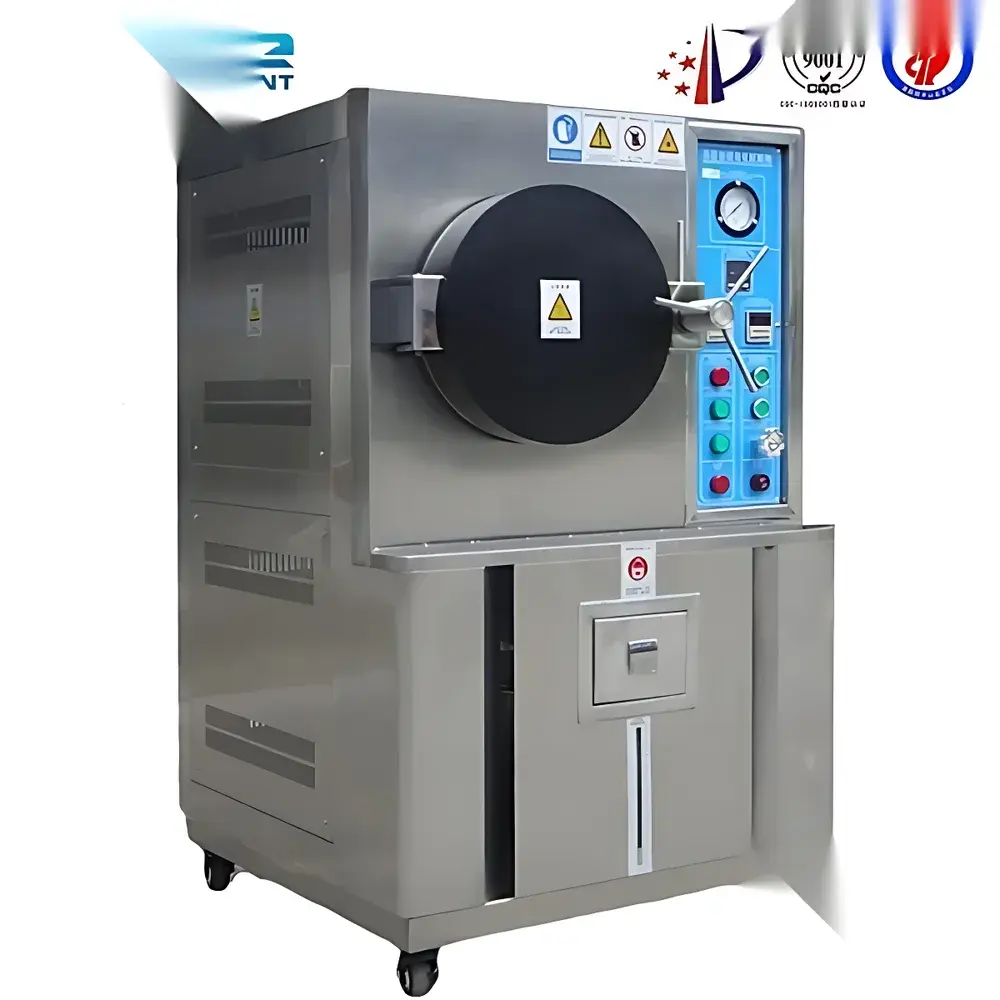
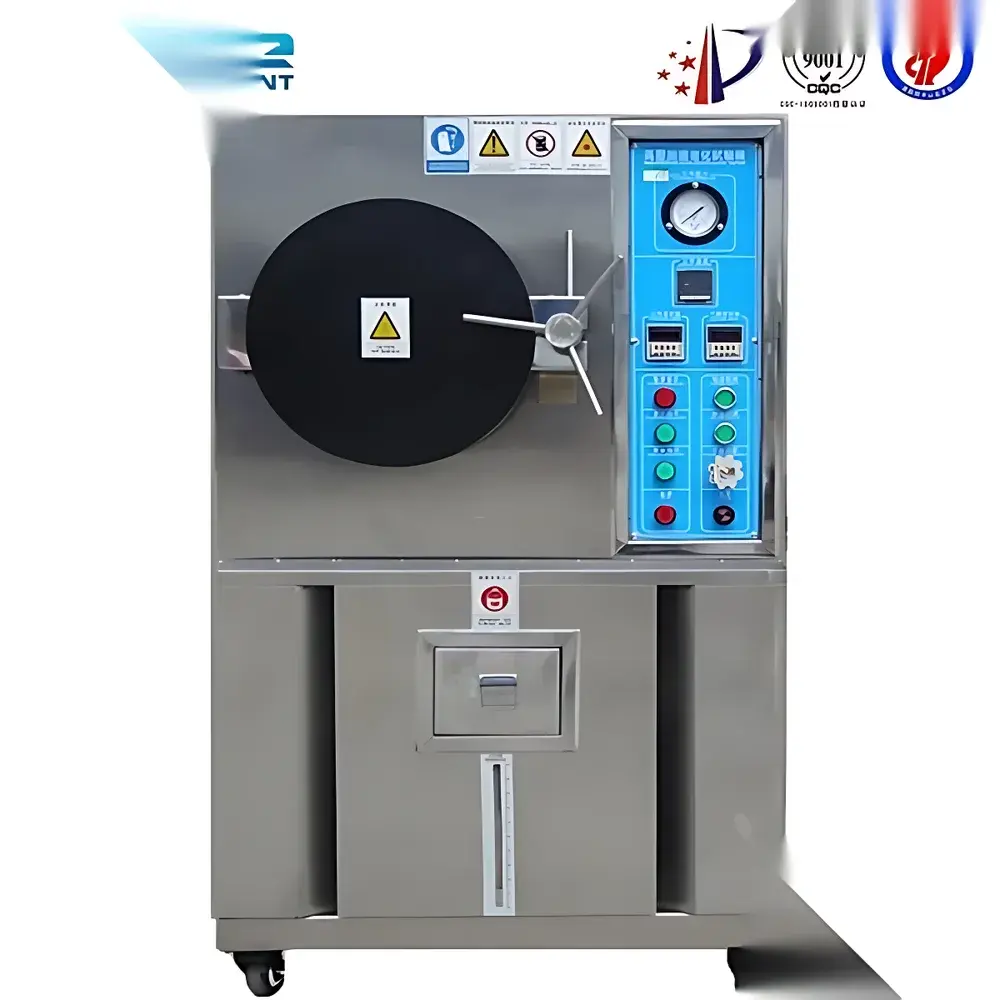
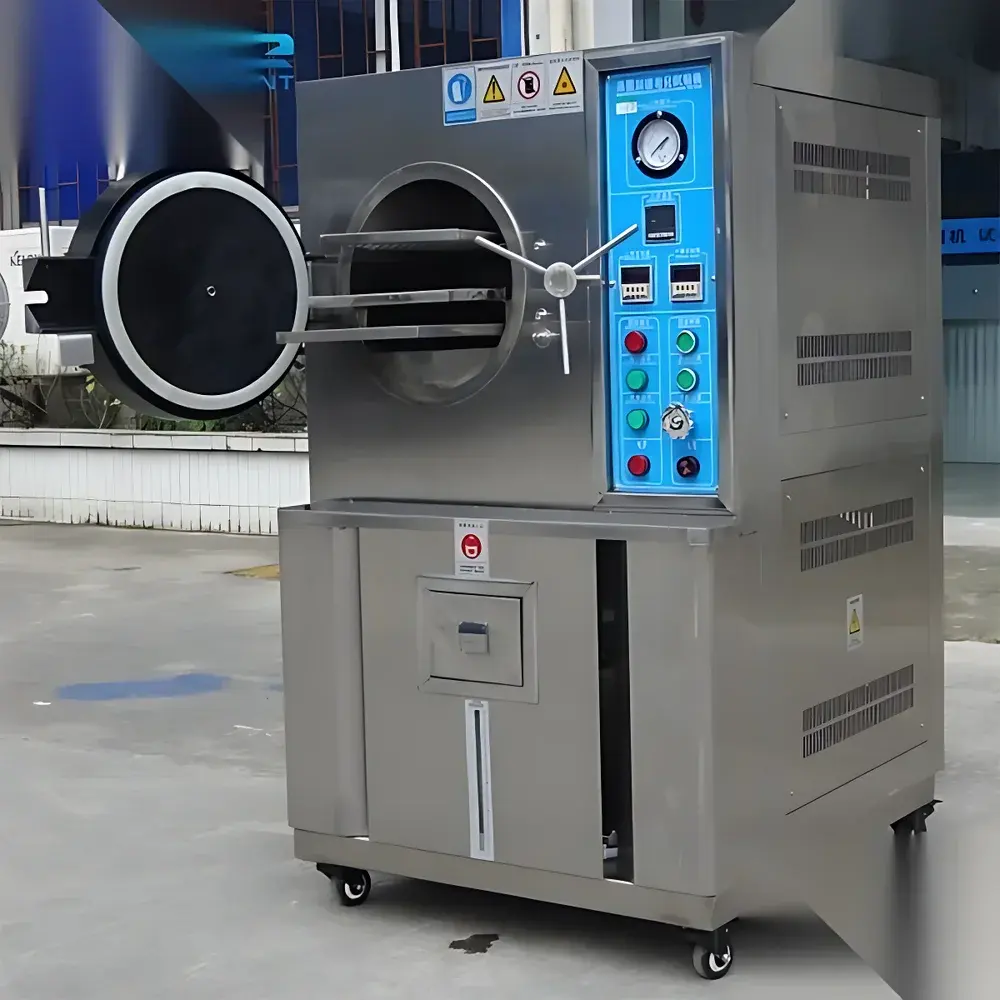
PCT High-Temperature High-Pressure Test Chamber (OK-HAST Series)
| Brand | Other Brands |
|---|---|
| Origin | Imported |
| Manufacturer Type | Authorized Distributor |
| Temperature Range | +10 °C to 132 °C (optional custom up to 147 °C) |
| Internal Chamber Dimensions (Ø × H, cm) | 25×30, 35×40, 45×50, 65×60 |
| Chamber Material | AISI 316 Stainless Steel |
| External Enclosure | Powder-Coated or Stainless Steel |
| Pressure Range | 0.2–3.0 kg/cm² (≈20–294 kPa gauge) |
| Pressurization Time | ~45 min to 2.0 kg/cm² |
| Humidification Method | Electric Heating Tube |
| Water Replenishment | Stainless Steel Float Valve System |
| Vacuum Preconditioning | Integrated Vacuum Pump with Filtration |
| Power Supply | 220–240 V AC, 50/60 Hz, Single Phase |
| Safety Features | Dual-Limit Overpressure Relief (Auto + Manual), Interlocked Circular Door, LED Digital Timer, Real-Time Pressure/Temperature Monitoring, Fault Indicator Lights, Auto-Shutdown on Anomaly |
Overview
The PCT High-Temperature High-Pressure Test Chamber (OK-HAST Series) is an engineered environmental stress test system designed for accelerated reliability evaluation of electronic components, printed circuit boards (PCBs), semiconductor packages, and hermetic seals under combined thermal, pressure, and humidity stresses. Based on the principle of saturated steam pressurization—where elevated temperature and controlled overpressure drive moisture diffusion into microvoids and interfacial boundaries—the chamber replicates long-term field exposure in compressed timeframes. It complies with industry-standard test protocols including JEDEC JESD22-A102 (HAST), JESD22-A110 (uHAST), and IPC-9701A for moisture sensitivity level (MSL) qualification. Unlike conventional autoclave-based systems, this chamber integrates vacuum preconditioning prior to pressurization to remove ambient air and ensure uniform saturation, minimizing localized condensation and thermal shock during ramp-up.
Key Features
- Stainless steel (AISI 316) internal chamber with electropolished finish for corrosion resistance, cleanability, and long-term dimensional stability under repeated thermal cycling.
- Circular door with dual-seal mechanical interlock: operation is physically inhibited unless the door is fully closed and pressure-locked, meeting ISO 13857 safety clearance requirements.
- Integrated vacuum pump with particulate and moisture filtration ensures removal of residual oxygen and contaminants before steam introduction—critical for eliminating oxidation artifacts during high-humidity testing.
- Float-controlled stainless steel water replenishment system maintains consistent water level for up to 200 hours of unattended operation, reducing manual intervention and operator variability.
- LED digital timer synchronized to chamber temperature stabilization threshold—initiates countdown only after internal setpoint is achieved and held for ≥2 minutes, per JEDEC-defined dwell criteria.
- Real-time analog pressure and temperature gauges (±0.1 kg/cm² and ±0.5 °C resolution) provide immediate visual verification; redundant solid-state sensors feed data to the control logic for closed-loop regulation.
- Two-stage pressure relief architecture: primary spring-loaded safety valve (ASME BPVC Section VIII compliant) plus secondary manual vent for emergency depressurization.
Sample Compatibility & Compliance
The OK-HAST series accommodates a wide range of non-combustible, non-volatile test specimens—including QFN, BGA, CSP, and wafer-level packages—without risk of chemical interaction or outgassing-induced contamination. Chamber geometry supports standard JEDEC trays (JEDEC STD-22) and custom fixtures. All models meet CE marking requirements for electromagnetic compatibility (EMC Directive 2014/30/EU) and low-voltage safety (LVD Directive 2014/35/EU). The control firmware logs all operational parameters—including vacuum duration, pressurization rate, dwell time, and fault events—with timestamped records suitable for GLP/GMP audit trails. Optional 21 CFR Part 11-compliant software add-on enables electronic signature, user access tiers, and immutable audit logs.
Software & Data Management
While the base configuration operates via hardwired logic and front-panel controls, optional PC-based software (Windows 10/11 compatible) provides remote monitoring, real-time graphing of pressure/temperature profiles, and export of CSV-formatted test logs. Data fields include cycle count, cumulative exposure time, peak pressure/temperature excursions, and event-triggered annotations (e.g., “vacuum complete”, “pressure alarm”). Calibration certificates traceable to NIST standards are provided with each unit. Firmware updates are delivered via secure USB interface with version rollback capability.
Applications
- Qualification of moisture barrier integrity in molded IC packages prior to reflow soldering.
- Failure analysis root cause determination for popcorning, wire bond lift, or die attach delamination.
- Process validation of conformal coating adhesion under humid thermal stress.
- Reliability screening of automotive-grade electronics per AEC-Q200 extended temperature and pressure requirements.
- Accelerated aging studies of medical device encapsulants and biocompatible polymers.
FAQ
What is the maximum allowable test duration per cycle?
Standard operation supports continuous runs up to 200 hours; extended durations require review of water reservoir capacity and cooling system duty cycle.
Can the chamber be operated without vacuum preconditioning?
Yes—but omission of vacuum step voids compliance with JEDEC JESD22-A102 and may compromise test reproducibility due to air entrapment.
Is calibration service available post-installation?
Yes—annual calibration kits and certified technician visits are offered globally through authorized service partners, with documentation aligned to ISO/IEC 17025.
What electrical infrastructure is required for installation?
A dedicated 20 A circuit with grounded outlet and stable voltage supply (220–240 V ±5%) is mandatory; voltage fluctuations exceeding ±10% trigger automatic shutdown.
How is condensate managed during depressurization?
A gravity-fed drain line evacuates unsaturated steam condensate continuously during pressure ramp-down, preventing pooling and thermal gradient formation across the chamber floor.



