
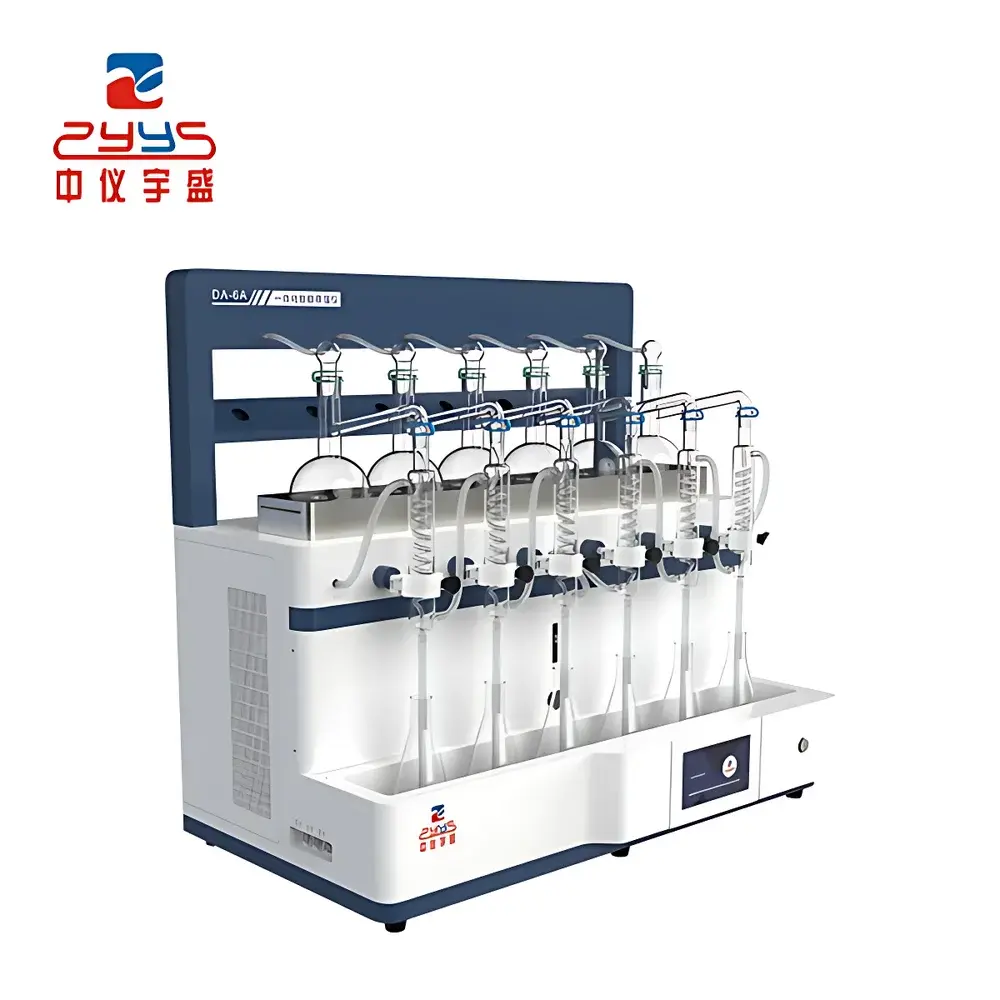
Zhongyi Yusheng DA-6A Integrated Intelligent Distillation System
| Brand | Zhongyi Yusheng |
|---|---|
| Origin | Beijing, China |
| Manufacturer Type | Direct Manufacturer |
| Instrument Type | Standard Quartz Glass Distillation Apparatus |
| Heating Method | Far-Infrared Ceramic Heating Element |
| Cooling Method | Built-in Air-Cooled Recirculating Chiller System |
| Capacity | 6 Parallel Distillation Channels |
| Control Interface | 7-inch Touchscreen with Programmable Method Storage |
| Endpoint Detection | Dual-Control (Precision Mass-Based + Timed Termination) |
| Compliance | GB/T 5750.5–2023, HJ 503–2009, HJ 484–2009, GB 5009.225–2016, HJ 833–2017 |
Overview
The Zhongyi Yusheng DA-6A Integrated Intelligent Distillation System is an engineered solution for automated, reproducible, and standards-compliant distillation in analytical laboratories. Designed around the principle of controlled thermal separation under atmospheric pressure, the system integrates precise far-infrared ceramic heating, real-time mass-based endpoint detection, and closed-loop chilled recirculation cooling into a single compact platform. Unlike conventional distillation setups requiring external chillers or manual intervention, the DA-6A eliminates dependency on municipal water supply or auxiliary refrigeration units—its integrated air-cooled chiller maintains condenser inlet temperatures consistently below 10 °C, even in ambient environments up to 35 °C. This ensures stable vapor condensation kinetics across all six independent distillation channels, minimizing analyte loss and enhancing recovery fidelity. The system adheres to fundamental thermodynamic requirements for quantitative volatilization, particularly for low-boiling-point analytes such as phenols, ammonia nitrogen, cyanide, sulfides, and SO₂—making it suitable for method-defined applications in environmental, food safety, clinical, and agricultural testing.
Key Features
- Far-infrared ceramic heating modules with embedded thermal isolation—providing uniform heat distribution across quartz distillation flasks while eliminating hot-spot formation and reducing risk of bumping or foaming.
- Integrated air-cooled recirculating chiller with digital temperature display and setpoint control (range: 2–15 °C), enabling consistent condensation efficiency without external water sources or plumbing.
- Dual-mode endpoint detection: simultaneous mass-based termination via high-resolution load cells (±0.1 g repeatability) and programmable time-limit cutoff—preventing over-distillation and ensuring method traceability.
- Automatic anti-suckback protection: vacuum break activation upon endpoint detection, followed by controlled venting to prevent backflow contamination of distillates.
- Intuitive 7-inch capacitive touchscreen interface supporting user-defined method templates—including ramp profiles, hold times, cooling setpoints, and channel-specific activation—with non-volatile storage for ≥100 protocols.
- Independent channel operation: any one to six positions can be activated simultaneously; each displays real-time weight change, elapsed time, and status indicator—enabling flexible batch processing and cross-method validation.
- Self-contained water management: auto-fill function with float-level sensing and overflow cutoff—eliminating manual reservoir monitoring and mitigating operational downtime.
Sample Compatibility & Compliance
The DA-6A is validated for aqueous and semi-aqueous matrices commonly encountered in regulatory testing workflows, including wastewater, drinking water, soil leachates, food extracts, and fermentation broths. Its quartz glass distillation path ensures chemical inertness toward acidic, alkaline, and oxidizing reagents used in standard methods—for example, phosphoric acid digestion for volatile phenols (HJ 503–2009) or tartaric acid conditioning for cyanide liberation (HJ 484–2009). All operational parameters—including heating rate, condenser temperature, and distillate collection timing—are configurable to align with method-specified procedural constraints. The system supports GLP-aligned documentation through timestamped method execution logs and endpoint-triggered event records. It meets structural and functional requirements referenced in GB/T 5750.5–2023 (inorganic non-metallic parameters in drinking water), HJ 833–2017 (sulfide in soils and sediments), and GB 5009.225–2016 (alcohol content in alcoholic beverages), among others.
Software & Data Management
The embedded firmware implements deterministic control logic with millisecond-level sampling of load cell output and thermal feedback signals. Each distillation run generates a structured metadata file containing instrument ID, operator ID, method name, start/stop timestamps, final collected mass, average heating power, and chiller setpoint deviation history. Export formats include CSV and PDF summary reports—compatible with LIMS integration via USB or optional Ethernet module. Audit trail functionality complies with data integrity principles outlined in FDA 21 CFR Part 11 when paired with user access controls and electronic signature configuration (available via firmware update). No cloud connectivity is enabled by default; all data remains locally stored unless explicitly exported by authorized personnel.
Applications
- Environmental analysis: Ammonia nitrogen (NH₃-N), volatile phenols, cyanide, fluoride, sulfide, and total Kjeldahl nitrogen (TKN) in water, wastewater, and soil extracts.
- Food & beverage testing: SO₂ residue in wines and dried fruits (GB 5009.34–2022), methanol in spirits (GB 5009.266–2016), ethanol concentration (GB 5009.225–2016), and citrus oil quantification (NY/T 2013–2011).
- Industrial compliance: Volatile fatty acids (VFA) in distillery effluents (DB34/T 2499–2015), residual solvents in pharmaceutical intermediates, and moisture content in hygroscopic raw materials.
- Research & education: Teaching laboratories benefit from its modular design, visual process feedback, and standardized operation—reducing inter-operator variability in undergraduate analytical chemistry curricula.
FAQ
Does the DA-6A require connection to a municipal water supply?
No. The integrated air-cooled recirculating chiller operates independently—no tap water or external chiller is needed.
Can individual channels be operated without affecting others?
Yes. Each of the six positions functions autonomously; activation, setpoints, and endpoint criteria are fully configurable per channel.
Is the system compatible with ISO/IEC 17025 accredited laboratories?
Yes—when deployed with documented calibration procedures for load cells and temperature sensors, and with method-specific validation per ISO/IEC 17025:2017 Clause 7.2.
What maintenance is required for long-term reliability?
Quarterly inspection of quartz joints for etching, annual verification of chiller refrigerant charge, and biannual recalibration of mass sensors using NIST-traceable weights.
How is data integrity ensured during unattended operation?
All runs generate immutable log files with cryptographic hash checksums; changes to method parameters trigger automatic version incrementing and require supervisor-level authentication.



