
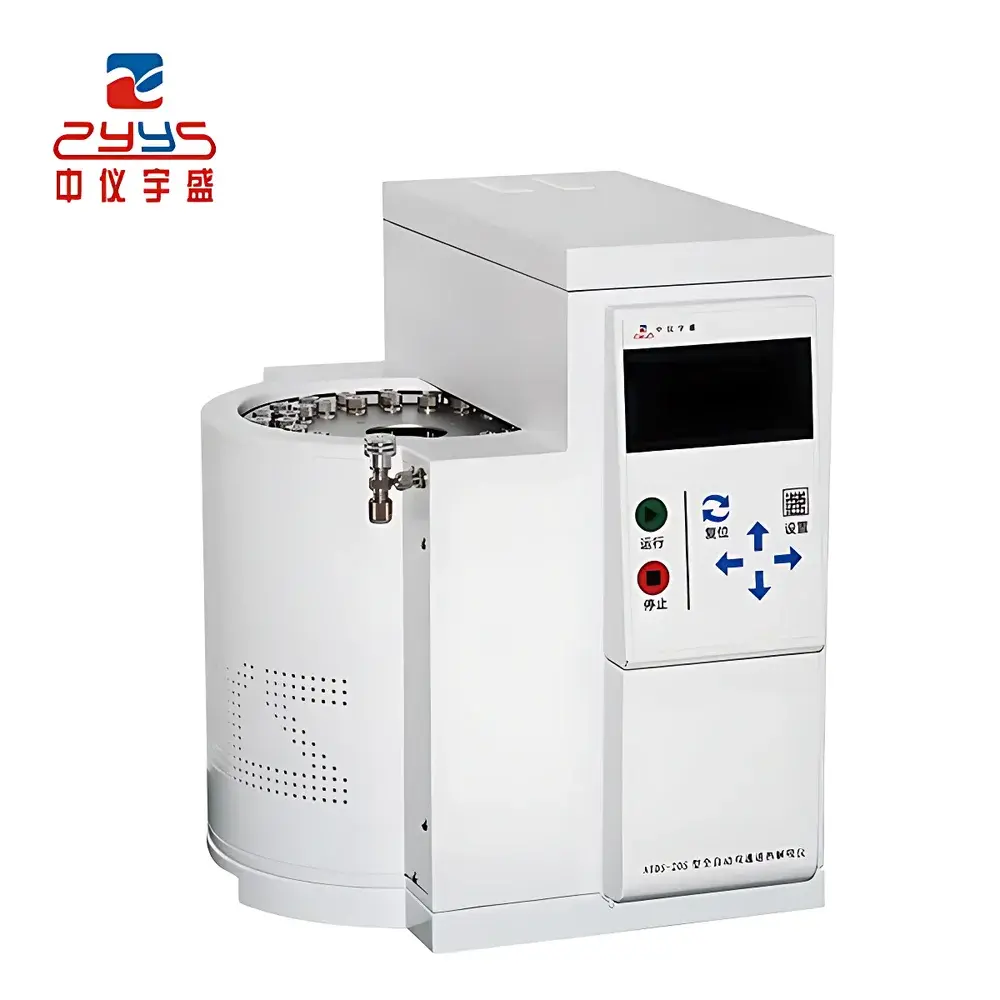
ZHYSHEN ATDS-20S Dual-Channel Fully Automated Thermal Desorber
| Brand | ZHYSHEN |
|---|---|
| Origin | Beijing, China |
| Manufacturer Type | Direct Manufacturer |
| Instrument Type | Secondary Thermal Desorber |
| Automation Level | Fully Automated |
| Sample Capacity | 20 positions per channel (dual-channel, total 40 samples per batch) |
| Compliance | HJ 644–2013, HJ/T 400–2007, GB/T 18883–2002, HJ 583–2010, GB 50325–2020, HJ 734–2014 |
| Thermal Zones | Four independently controlled zones (primary desorption, valve oven, transfer line, secondary desorption) |
| Sample Tube Activation | Built-in programmable tube conditioning |
| GC Interface | Universal hardware interface for Agilent, Thermo Fisher, Shimadzu, PerkinElmer, and domestic GC systems |
| Optional Accessories | Ambient-temperature or cryo-cooled secondary desorption module, fused quartz transfer line, replaceable injection needle |
Overview
The ZHYSHEN ATDS-20S Dual-Channel Fully Automated Thermal Desorber is a precision-engineered sample introduction system designed for quantitative analysis of volatile and semi-volatile organic compounds (VOCs and SVOCs) in environmental, occupational health, and indoor air quality applications. Operating on the principle of thermal desorption coupled with gas chromatography (GC), the ATDS-20S performs two-stage thermal release: primary desorption from sorbent tubes under controlled inert gas flow, followed by cryo-focused or ambient-temperature secondary desorption directly into the GC inlet. This two-step process ensures high analyte recovery, minimal breakthrough, and exceptional sensitivity—particularly critical for trace-level VOC quantification in compliance-driven workflows.
Key Features
- Dual independent channels enable parallel processing of two 20-position sample racks (40 samples per unattended run), significantly increasing laboratory throughput without compromising reproducibility.
- Four-zone independent temperature control: primary desorption furnace (up to 400 °C), GC interface valve oven (up to 300 °C), heated transfer line (up to 350 °C), and secondary desorption zone (configurable for ambient or cryogenic operation).
- Integrated microprocessor control with intuitive 7-inch capacitive touchscreen interface; supports method storage, real-time status animation, and time-programmable sequences including desorption, purge, re-desorption, GC trigger, and automated back-flush.
- Self-diagnostic startup routine with error logging, automatic carousel calibration, and positional homing—ensuring long-term operational reliability and minimizing manual intervention.
- Built-in sampling tube activation protocol: programmable heating profiles (up to 400 °C), inert gas purging, and timed cooldown—eliminating carryover and restoring tube performance prior to reuse.
- Universal GC interfacing: mechanical and electrical compatibility with major GC platforms (Agilent 7890/8890, Thermo Trace 1300/1600, Shimadzu GC-2030, PerkinElmer Clarus series) via standardized pneumatic and TTL signal connections.
- Contamination mitigation architecture: active back-flush of both transfer line and six-port switching valve using carrier gas; optional fused quartz transfer tubing for enhanced inertness in active compound analysis (e.g., aldehydes, acids, amines).
Sample Compatibility & Compliance
The ATDS-20S accepts standard 1/4″ OD stainless steel or glass sorbent tubes (e.g., Tenax TA, Carbopack B/C, Carboxen 1000) used in regulated air sampling protocols. It fully supports U.S. EPA TO-17 methodology equivalents and aligns with Chinese national and environmental standards including HJ 644–2013 (VOCs in ambient air), HJ 734–2014 (stack emissions), GB 50325–2020 (indoor air in civil construction), and GB/T 18883–2002 (general indoor air quality). All thermal ramp rates, hold times, and gas flows are programmable and auditable—facilitating GLP-compliant documentation and FDA 21 CFR Part 11–ready data integrity when paired with validated LIMS or chromatography data systems (CDS).
Software & Data Management
Control firmware includes timestamped event logging, method versioning, and password-protected user roles (operator, supervisor, administrator). Method files store complete thermal profiles, GC synchronization parameters, and tube conditioning cycles. Exportable CSV logs contain start/stop timestamps, zone temperatures, valve actuation events, and fault codes—enabling root-cause analysis during QA/QC review. The system supports external triggering via TTL pulse or Ethernet command (Modbus TCP), allowing tight integration into automated lab workflows managed by third-party scheduling software or enterprise CDS platforms.
Applications
- Environmental monitoring: ambient air, stack emissions, landfill fugitives, and soil vapor extraction studies per HJ 734–2014 and HJ 644–2013.
- Indoor air quality (IAQ) assessment in residential, commercial, and automotive cabins per GB 50325–2020 and HJ/T 400–2007.
- Workplace exposure evaluation for OSHA- or ACGIH-recommended VOCs using NIOSH/OSHA-specified sorbent tubes.
- Method development and validation for emerging contaminants (e.g., SVOCs, oxygenated VOCs) requiring high-fidelity thermal transfer and low-ppq detection limits.
- Reference material preparation: in situ calibration curve generation via standard vapor introduction and thermal spiking directly onto sorbent tubes.
FAQ
What distinguishes primary from secondary thermal desorption in the ATDS-20S?
Primary desorption releases analytes from the sorbent tube into a focusing trap; secondary desorption rapidly volatilizes the trapped analytes into the GC column—improving peak shape, sensitivity, and resolution over single-stage systems.
Can the ATDS-20S be integrated into an existing LIMS or CDS environment?
Yes—via time-stamped CSV log export, Modbus TCP communication, or hardware-triggered GC start signals compatible with Agilent OpenLab, Thermo Chromeleon, and Shimadzu LabSolutions.
Is tube conditioning performed automatically between sample runs?
Tube activation is programmable but not default-enabled per run; users define dedicated conditioning methods separately to preserve analytical integrity and extend tube lifetime.
Does the instrument support cryogenic focusing for improved low-boiling compound retention?
An optional cryo-cooled secondary desorption module is available—capable of trapping analytes down to −30 °C for enhanced recovery of C2–C6 hydrocarbons and formaldehyde derivatives.
How is cross-contamination prevented during high-throughput operation?
Dual-stage back-flush (transfer line + valve) with inert gas purge, combined with temperature-controlled zones and inert fused quartz tubing options, ensures <0.1% carryover across consecutive high-concentration samples.




