
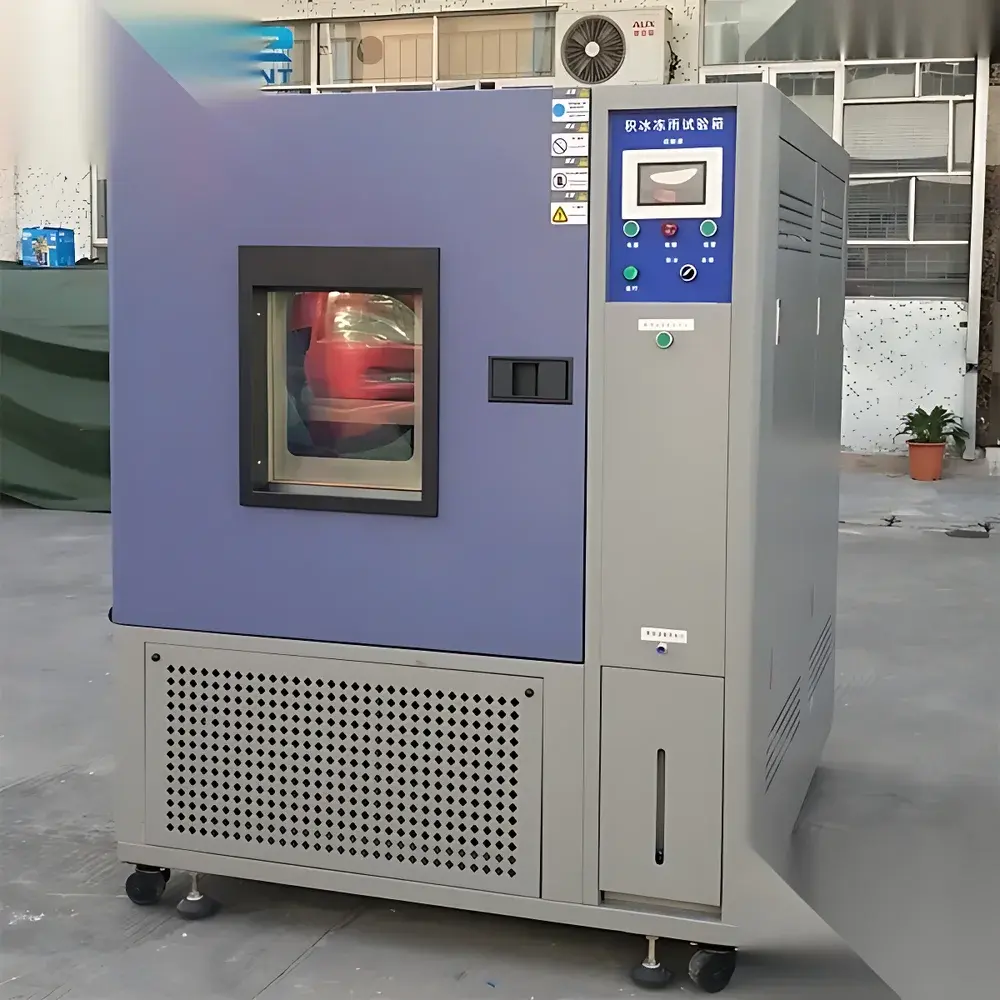
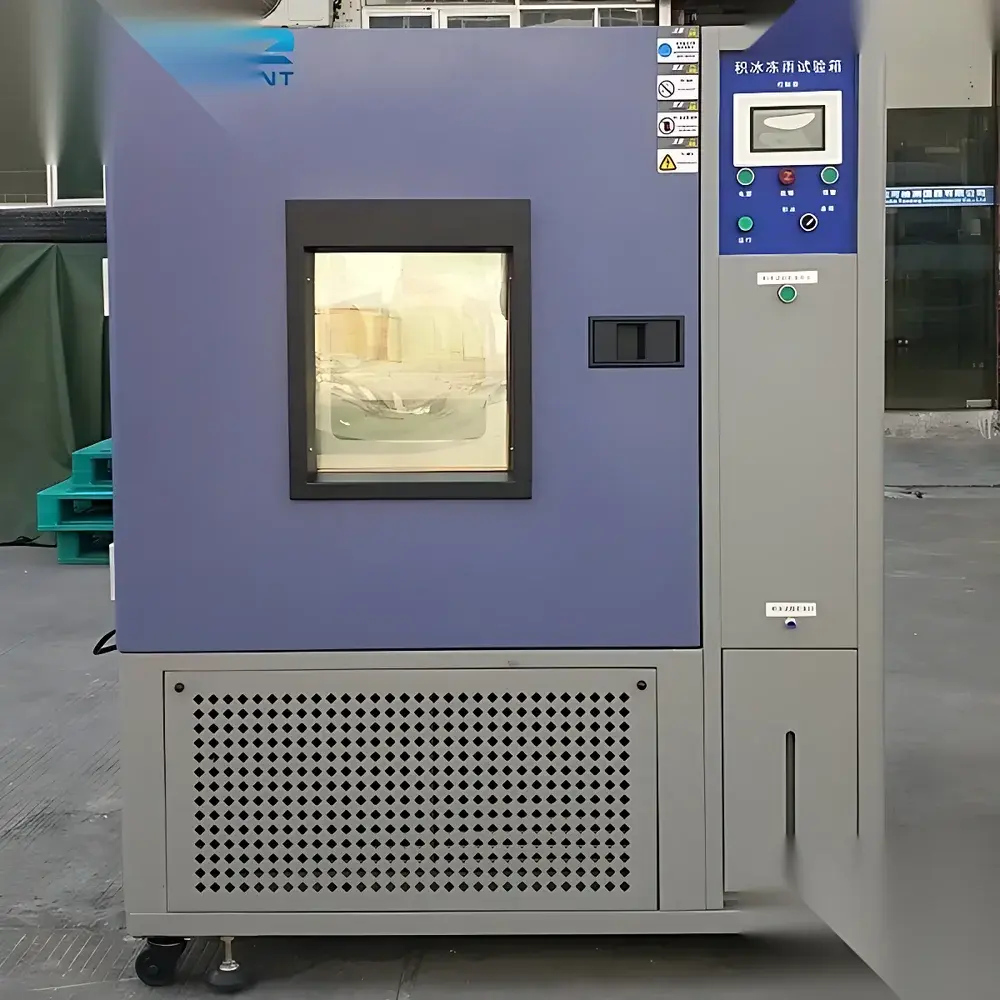
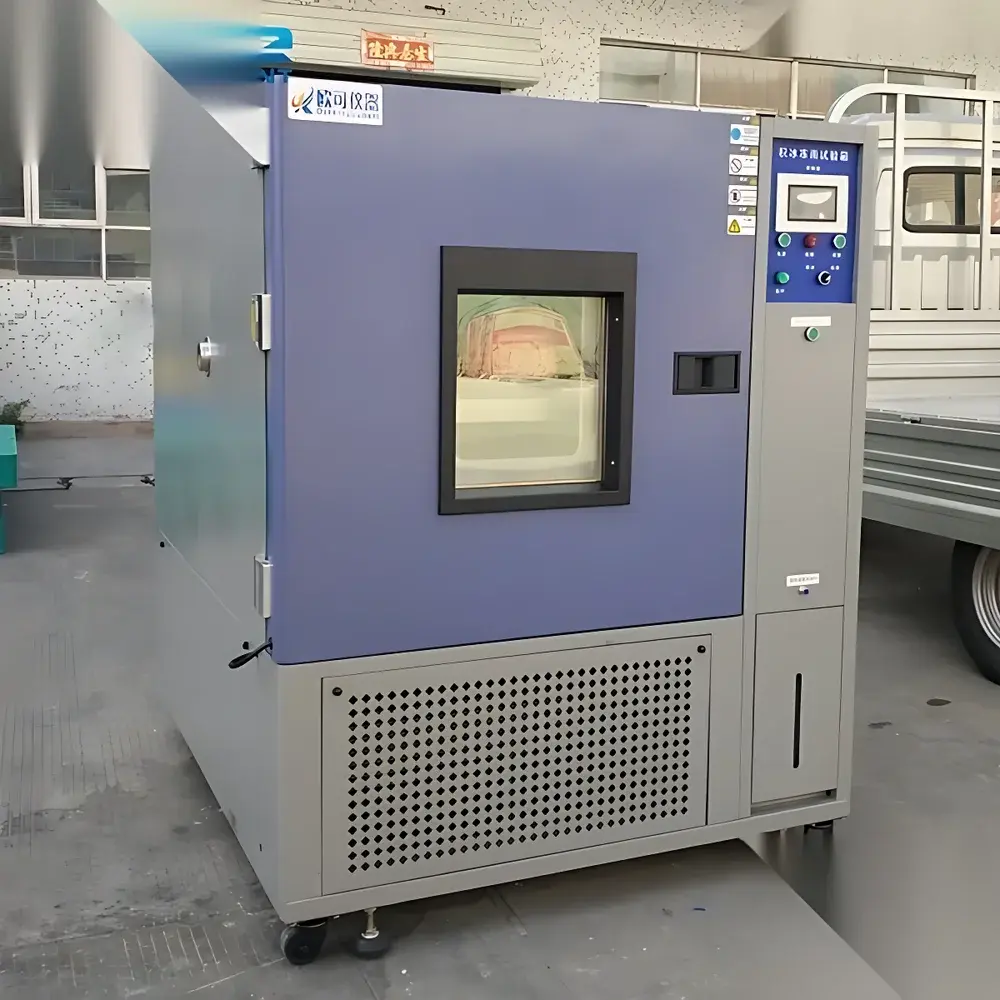
English Product Name
| Brand | Other Brands |
|---|---|
| Origin | Imported |
| Manufacturer Type | General Distributor |
| Price | USD 14,000 (approx.) |
| Internal Dimensions | 500×600×500 mm to 1000×1000×1000 mm (customizable) |
| External Dimensions | 1000×1750×1100 mm to 1500×2000×1600 mm (customizable) |
| Temperature Range | −20 °C to +80 °C (customizable) |
| Temperature Uniformity | ±2.0 °C |
| Temperature Fluctuation | ±0.5 °C |
| Rainfall Intensity | 25 mm/h |
| Nozzle Orifice Diameter | φ0.4 mm |
| Raindrop Diameter | 1.0–1.5 mm |
| Ice Accumulation Thickness Options | 6 mm, 13 mm, 37 mm, 75 mm |
| Ice Density Range | 0.2–0.9 g/cm³ |
| Water Temperature Control | 0–5 °C |
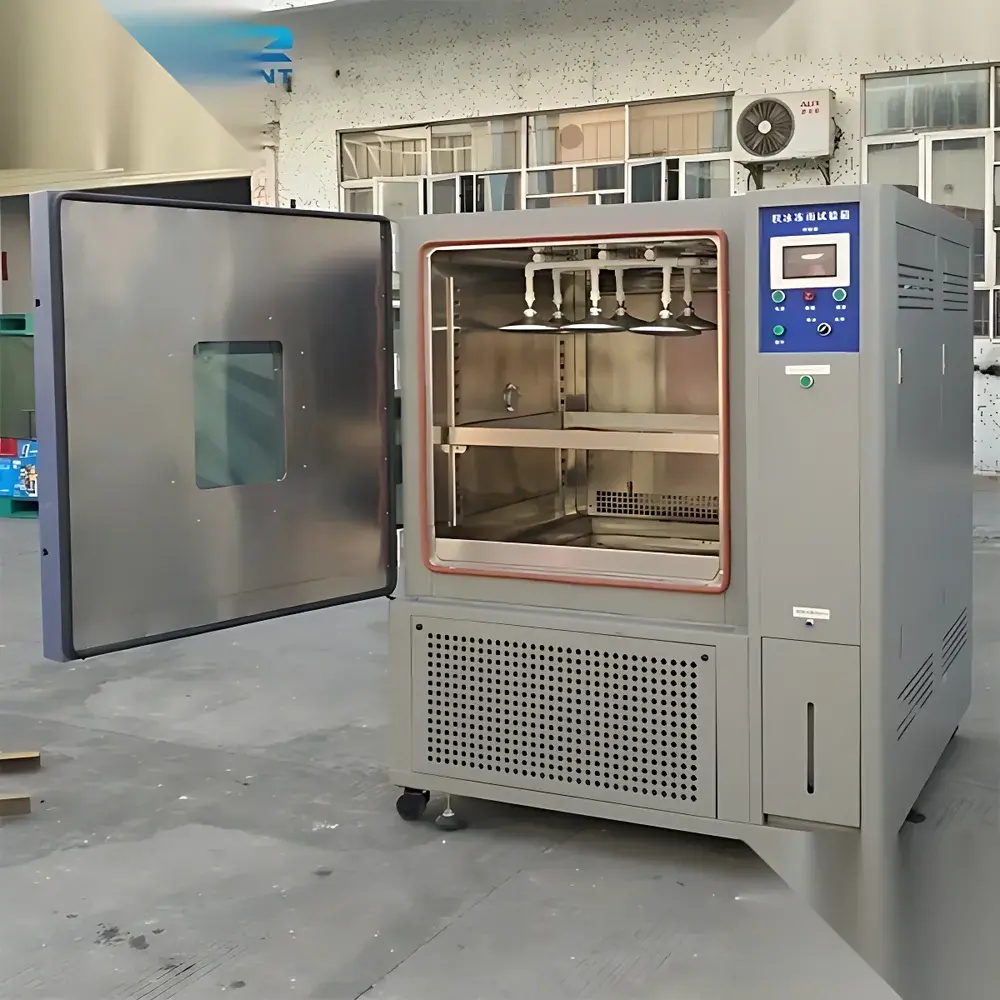
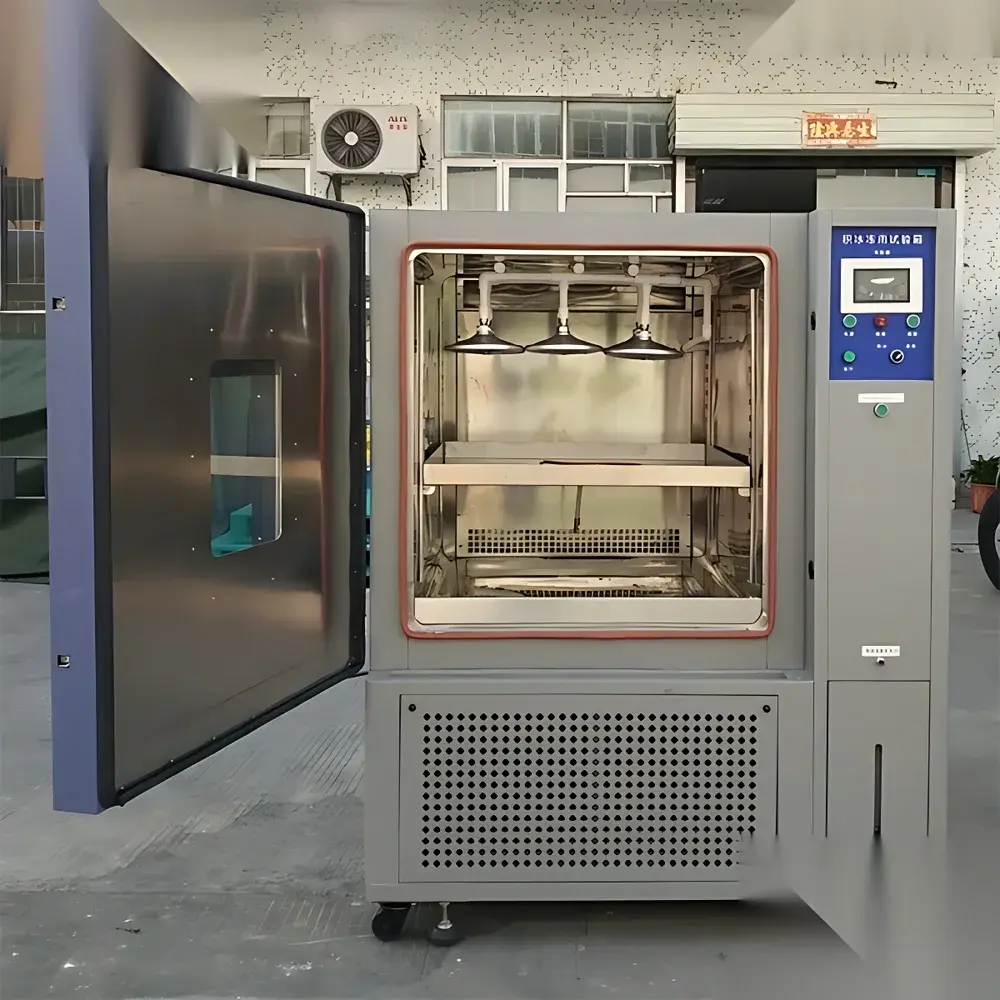
| Inner Chamber Material | SUS304 Stainless Steel |
| Outer Chamber Material | Galvanized Steel with Powder Coating or Optional SUS304 |
| Controller | 5.7″ TFT Color LCD Touchscreen (Bilingual: English/Chinese) |
| Power Supply | AC 220 V ±5%, 50 Hz ±0.5 Hz, Single-Phase Three-Wire |
| Ambient Operating Conditions | 5–35 °C, ≤85% RH |
Overview
The OK-JBDY Series Icing and Freezing Rain Environmental Test Chamber is a purpose-built climatic simulation system engineered to replicate the physical conditions associated with atmospheric icing and freezing rain events—critical stressors for aerospace electronics, avionics components, unmanned aerial systems (UAS), power transmission hardware, and outdoor sensor assemblies. Unlike general-purpose environmental chambers, this system integrates synchronized temperature control, precision-controlled water delivery, and calibrated droplet dynamics to generate reproducible ice accretion under defined meteorological parameters. It operates on the principle of controlled supercooled liquid impingement: water droplets are atomized at sub-zero ambient temperatures, impacting test specimens at velocities that simulate in-flight or field-deployed exposure, thereby forming adherent ice layers whose morphology, thickness, density, and adhesion strength can be systematically evaluated. The chamber complies with GJB 150.22A–2009, the Chinese military standard for laboratory-based icing and freezing rain testing, and its architecture supports traceable validation against international icing test frameworks including RTCA DO-160 Section 22 (Environmental Conditions and Test Procedures for Airborne Equipment) and SAE ARP5412 (Aircraft Icing Certification Guidelines).
Key Features
- Multi-stage refrigeration system utilizing hermetically sealed compressors (French Tecumseh or Chinese Taikang), enabling stable operation down to −20 °C while maintaining precise thermal uniformity across the working volume.
- Dual-mode temperature control: independent regulation of chamber air temperature and water supply temperature (0–5 °C), essential for achieving consistent droplet supercooling without premature freezing in the delivery manifold.
- Calibrated rain generation subsystem featuring stainless-steel nozzles (φ0.4 mm orifice) delivering monodisperse droplets (1.0–1.5 mm diameter) at a nominal intensity of 25 mm/h—fully compliant with GJB 150.22A–2009 rain rate requirements.
- Modular ice thickness configuration: selectable accumulation targets (6 mm, 13 mm, 37 mm, 75 mm) validated via post-test profilometry or optical thickness mapping; ice density adjustable between 0.2–0.9 g/cm³ through controlled nucleation and growth kinetics.
- Corrosion-resistant internal chamber constructed from full SUS304 stainless steel; external enclosure available in powder-coated galvanized steel or optional SUS304 for high-humidity or salt-laden environments.
- Intuitive 5.7-inch TFT touchscreen controller with dual-language (English/Chinese) interface, real-time data logging, programmable test profiles, and password-protected parameter locking for GLP/GMP-aligned operation.
Sample Compatibility & Compliance
The OK-JBDY chamber accommodates electronic enclosures, printed circuit board assemblies (PCBAs), radar housings, pitot tubes, optical sensors, and small-scale UAV airframes up to 1000 mm × 1000 mm × 1000 mm (custom dimensions available). Its design incorporates a single 50 mm diameter cable/port access hole and a removable stainless-steel sample support rack. All operational modes meet the mechanical and thermal boundary conditions specified in GJB 150.22A–2009, including ramp rates, dwell durations, and ice load verification protocols. While not certified to ISO/IEC 17025, the system supports audit-ready documentation—including calibration certificates for temperature sensors (PT100 Class A), flow meters, and pressure transducers—and is compatible with third-party validation per ASTM E2877 (Standard Guide for Icing Wind Tunnel Testing) when integrated into accredited laboratory workflows.
Software & Data Management
The embedded controller logs temperature, humidity (where applicable), water flow rate, and cycle time at user-defined intervals (1–60 seconds). Exportable CSV files include timestamps, setpoints, and measured values for post-test analysis in MATLAB, Python, or commercial statistical software. Optional Ethernet or RS485 interfaces enable remote monitoring and integration with centralized lab management systems. For regulated environments, firmware supports audit trail functionality (user login/logout, parameter changes, test start/stop events) aligned with FDA 21 CFR Part 11 principles—though formal electronic signature validation requires supplemental validation by the end-user’s QA department.
Applications
- Structural integrity assessment of airborne electronics subjected to dynamic ice loading during flight envelope expansion.
- Functional verification of de-icing system interfaces (e.g., heating element response, thermal runaway detection) under realistic accretion scenarios.
- Material compatibility testing: evaluating hydrophobic coating performance, adhesive bond durability, and sealant resilience under cyclic freeze-thaw-ice accumulation stress.
- Qualification of ground-based infrastructure sensors (e.g., weather stations, wind turbine anemometers) operating in cold-climate regions prone to freezing drizzle.
- Research into ice microstructure formation kinetics as a function of droplet size, impact velocity, and substrate thermal effusivity.
FAQ
Does the chamber support automated cycling between icing and thawing phases?
Yes—programmable multi-step profiles allow sequential execution of cooling, rain-on, hold, and defrost stages with user-defined dwell times and transition ramps.
Can the system be calibrated to NIST-traceable standards?
All primary sensors (temperature, flow, pressure) are supplied with factory calibration certificates; on-site recalibration using NIST-traceable references is supported via accessible service ports and documented procedures.
Is remote diagnostics or predictive maintenance available?
Basic remote status monitoring is enabled via Ethernet; advanced predictive analytics (e.g., compressor health estimation) require integration with external SCADA platforms and are not natively embedded.
What safety interlocks are included?
Over-temperature cutoff, low-water-level shutoff, door-open interruption, refrigerant pressure monitoring, and emergency power-off via front-panel pushbutton—all conforming to IEC 61000-6-2 EMC and IEC 61000-6-4 emission standards.
Are spare nozzles and stainless-steel filters included in the standard package?
One set of replacement nozzles (φ0.4 mm) and two inline water filtration cartridges (5 µm rating) are provided with initial delivery; extended consumables kits are available as optional accessories.



