
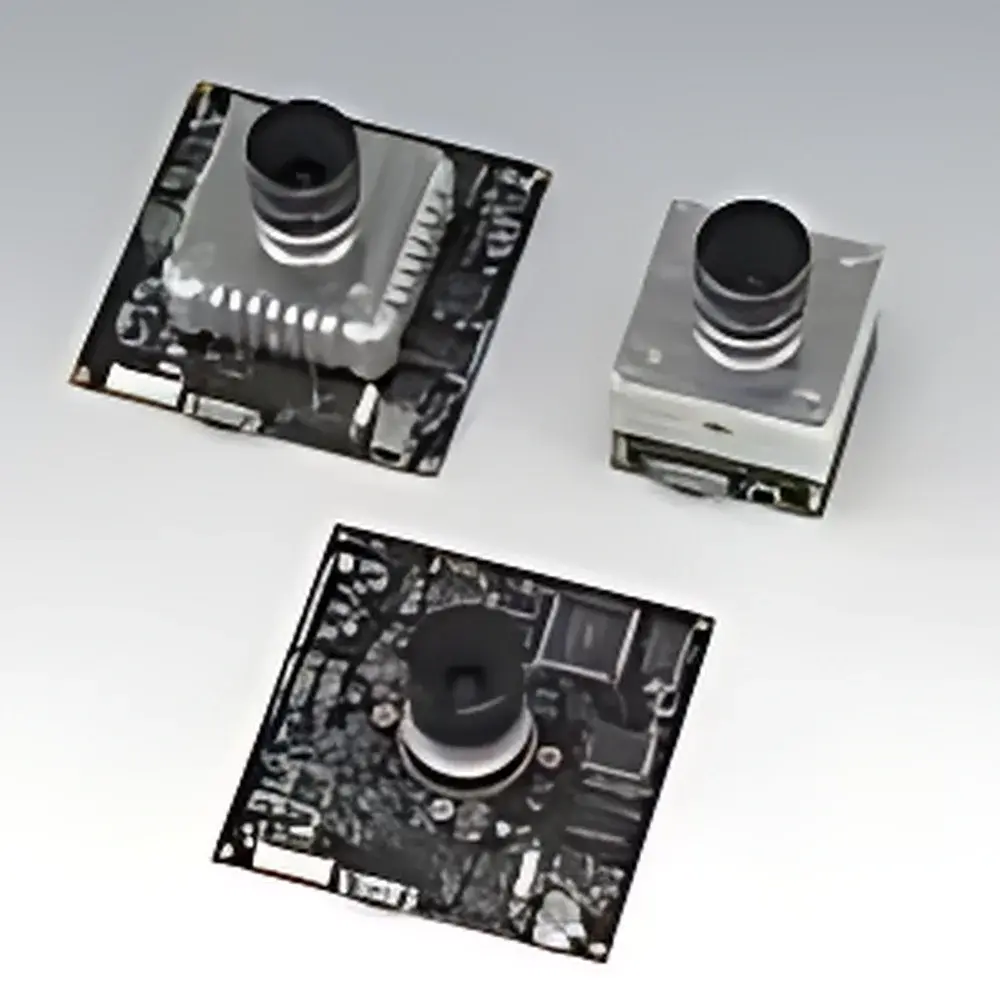
Hamamatsu C10990 Board-Level Digital CCD Camera
| Brand | Hamamatsu |
|---|---|
| Origin | Japan |
| Manufacturer Type | Original Equipment Manufacturer (OEM) |
| Import Status | Imported |
| Model | C10990 |
| Pricing | Upon Request |
Overview
The Hamamatsu C10990 is a high-performance board-level digital CCD camera engineered for integration into demanding scientific, industrial, and OEM imaging systems. Built around a precision front-illuminated or back-illuminated CCD sensor (model-dependent), it operates on the principle of charge-coupled device photoelectric conversion—capturing incident photons, accumulating electron charge in pixel wells, and serially reading out analog signals with correlated double sampling (CDS) to minimize reset noise. Its architecture prioritizes low-noise operation, high quantum efficiency (particularly in visible to near-infrared spectral ranges), and temporal stability—making it suitable for quantitative intensity measurements where signal fidelity and repeatability are critical. Designed as a bare-board solution without housing, lens mount, or integrated cooling fan, the C10990 targets system integrators requiring compact footprint, customizable thermal management, and direct PCIe or Camera Link interface control.
Key Features
- Board-level form factor optimized for embedded integration into microscopes, spectrometers, X-ray detectors, and automated inspection platforms
- High-resolution imaging capability with pixel counts up to 2048 × 2048 (depending on variant: C10990-904, C10990-942)
- Low-read-noise electronics supporting multiple gain modes and programmable exposure times from sub-millisecond to several seconds
- Flexible triggering options including hardware TTL input/output for synchronization with lasers, shutters, or motion stages
- On-board FPGA enabling real-time pixel binning, region-of-interest (ROI) readout, and dark-frame subtraction
- Compliance with standard industrial interfaces: Camera Link Base/Medium or PCIe Gen2 x4 (variant-specific), ensuring compatibility with major frame grabbers and host controllers
Sample Compatibility & Compliance
The C10990 supports diverse optical configurations through customizable sensor window options (e.g., quartz, UV-grade fused silica, or AR-coated glass) and optional thermoelectric (TE) cooler integration for stabilized operation at −10 °C to +20 °C. It is compatible with standard C-mount or M42 lens adapters (via customer-supplied mechanical interface), facilitating use with fluorescence filter cubes, DIC prisms, or X-ray scintillator screens (e.g., CsI:Tl, Gd₂O₂S). From a regulatory standpoint, the camera complies with CE marking requirements for electromagnetic compatibility (EMC Directive 2014/30/EU) and low-voltage safety (LVD Directive 2014/35/EU). While not certified as standalone medical devices, its performance characteristics align with ISO 13660 (image quality metrics) and ASTM E2749 (standard guide for evaluating CCD-based imaging systems in nondestructive testing), supporting GLP/GMP-aligned validation protocols when integrated into qualified systems.
Software & Data Management
Hamamatsu provides the HCImage Live software suite for evaluation and rapid prototyping, offering live preview, histogram analysis, multi-channel time-lapse acquisition, and TIFF/RAW export with embedded metadata (exposure time, gain, timestamp, sensor temperature). For OEM deployment, the camera supports Hamamatsu’s unified SDK (C++/C#/.NET), which delivers full register-level control over timing parameters, trigger modes, and data streaming—enabling seamless integration into custom LabVIEW, Python (via PyHamamatsu), or MATLAB environments. All firmware and driver packages undergo version-controlled release cycles, with audit trails maintained per ISO 9001 quality management standards. Data integrity is preserved via lossless 12-bit or 16-bit linear RAW output; optional on-camera memory buffering supports burst-mode acquisition without host transfer bottlenecks.
Applications
- Quantitative fluorescence microscopy—including GFP, RFP, Cy5, and IR-dye imaging—with precise intensity linearity across dynamic range
- Karyotyping and DNA ploidy analysis in cytogenetics labs using Feulgen-stained or DAPI-labeled nuclei
- Fluorescence in situ hybridization (FISH) with multi-color probe detection and chromosomal aberration scoring
- DIC/phase contrast combined with epifluorescence for label-free + labeled correlative imaging in live-cell studies
- Metallurgical and semiconductor failure analysis via brightfield/darkfield imaging of wafer defects or grain boundaries
- X-ray radiography and computed tomography using scintillator-coupled configurations for non-destructive evaluation (NDE)
- High-speed displacement tracking in MEMS characterization and vibration modal analysis
FAQ
Is the C10990 suitable for vacuum or cleanroom environments?
Yes—its PCB-only construction allows for bake-out compatibility and particulate-free mounting when used with appropriate conformal coating and connector selection.
Does Hamamatsu provide calibration certificates traceable to NIST standards?
Traceable photometric and spatial calibration reports are available upon request for specific sensor variants, aligned with ISO/IEC 17025-accredited procedures.
Can the C10990 operate in triggered rolling-shutter mode for pulsed-light applications?
Yes—the camera supports external trigger synchronization with configurable delay and width parameters, enabling precise gating for laser-induced fluorescence or time-resolved luminescence.
What cooling options are supported beyond passive heat sinking?
Thermoelectric coolers (TECs) can be integrated directly onto the sensor carrier board; custom cold-finger or liquid-cooled baseplate designs are supported under NDA for high-stability applications.
Is FDA 21 CFR Part 11 compliance supported in the OEM software stack?
While the base SDK does not include electronic signature or audit trail modules, Hamamatsu provides architectural guidance and API hooks to implement Part 11–compliant data handling within customer-developed applications.



