
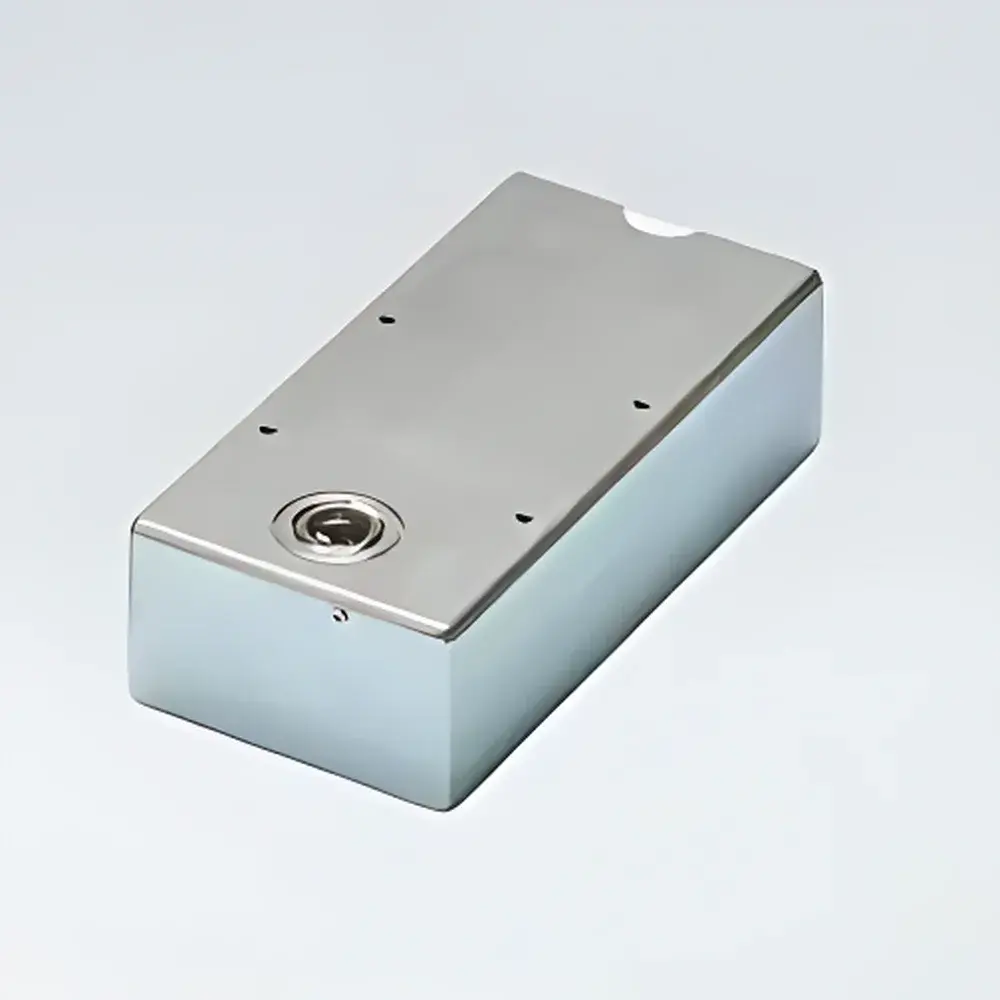
Hamamatsu L11317 5W Pulsed Xenon Lamp Module with Integrated Driver and Trigger Interface
| Brand | Hamamatsu |
|---|---|
| Origin | Japan |
| Manufacturer | Hamamatsu Photonics K.K. |
| Type | Imported OEM Light Source Module |
| Model | L11317 |
| Light Source Type | Pulsed Xenon Lamp |
| Illumination Configuration | Internal Illumination |
| Arc Length | 3.0 mm |
| Spectral Transmission Range (Quartz Window) | 160–2000 nm |
| Spectral Transmission Range (UV-Glass Window) | 185–2000 nm |
| Spectral Transmission Range (Borosilicate Glass Window) | 280–2000 nm |
| Max. Repetition Rate | 200 Hz (dependent on operating conditions) |
| Max. Average Input Power | 5 W |
| Pulse-to-Pulse Stability (CV) | ≤0.4% (at ≥10 Hz, 5 W operation) |
| Lifetime | ≥1 × 10⁹ flashes (measured at 190–1100 nm, output decay to 50% of initial) |
| Operating Temperature | 0–+40 °C |
| Compliance | IEC/EN 61326-1 (EMC), IEC/EN 62471 (Photobiological Safety, Risk Group 3), IEC/EN 63000 (RoHS) |
Overview
The Hamamatsu L11317 is a compact, self-contained 5W pulsed xenon lamp module engineered for high-reliability optical instrumentation requiring stable, broadband ultraviolet-to-near-infrared illumination in space-constrained platforms. Based on the principle of high-voltage capacitor discharge across a short-arc (3.0 mm) xenon plasma, the module generates intense, microsecond-duration light pulses with spectral continuity from 160 nm (deep UV) to 2000 nm (NIR), enabled by its synthetic fused silica optical window. Unlike continuous-wave sources, this pulsed architecture eliminates thermal load accumulation, enabling precise temporal control of illumination—critical for time-resolved spectroscopy, synchronous detection, and duty-cycle-limited applications such as flow cytometry or multi-well plate reading. The integrated driver circuitry supports both internal voltage regulation and external analog control (2.44–4.88 V), allowing seamless integration into OEM analytical systems where synchronization with detector gating or data acquisition triggers is mandatory.
Key Features
- Integrated design: Combines xenon lamp, high-voltage pulse generator, trigger interface, and thermal management in a single 52.5 × 32.5 × 35.5 mm package—optimized for embedded deployment in portable spectrometers, clinical analyzers, and process monitoring instruments.
- Broadband spectral output: Delivers uniform irradiance across 160–2000 nm when equipped with synthetic quartz window; optional UV-glass (185–2000 nm) and borosilicate (280–2000 nm) variants accommodate application-specific transmission trade-offs.
- High pulse stability: Achieves ≤0.4% coefficient of variation (CV) in radiant flux under standard 5 W operation (1000 V, 0.2 µF, 50 Hz), meeting repeatability requirements for quantitative absorbance and fluorescence intensity measurements per ISO 17025-compliant calibration protocols.
- Robust triggering architecture: Accepts TTL-compatible rectangular wave input (5–10 V, ≥10 µs width) with 330 Ω input impedance; trigger signal referenced to RTN (not GND) to minimize noise coupling—essential for low-noise, high-dynamic-range detection systems.
- Long operational lifetime: Rated for ≥1 × 10⁹ flashes at 5 W average power, defined as the point where integrated output (190–1100 nm) degrades to 50% of initial value or pulse-to-pulse variation exceeds specified limits—validated using Hamamatsu S1336-8BQ reference photodiode traceable to NIST standards.
- Regulatory compliance: Certified to IEC/EN 62471 (Risk Group 3 photobiological safety), IEC/EN 61326-1 (EMC emission and immunity), and IEC/EN 63000 (RoHS 3), supporting global market access and integration into Class I medical devices under FDA 21 CFR Part 820 and EU MDR Annex II.
Sample Compatibility & Compliance
The L11317 is compatible with optically transparent samples in cuvette, flow cell, microplate, or fiber-coupled configurations. Its deep-UV capability (down to 160 nm) enables direct excitation of aromatic amino acids, nucleic acids, and organic fluorophores without pre-filtration—making it suitable for UV-Vis spectrophotometry (ASTM E275, USP ), HPLC-UV detection, and enzymatic assay kinetics. The module’s low thermal load and absence of steady-state IR radiation prevent sample heating artifacts during prolonged exposure—critical for thermally sensitive biological matrices in vitro diagnostics (IVD). All electrical interfaces comply with IEC/EN 61000-6-3 (emissions) and IEC/EN 61000-6-2 (immunity), while photobiological hazard assessment confirms non-classified risk under IEC/EN 62471, permitting use in laboratory environments without additional shielding under normal operating conditions.
Software & Data Management
The L11317 operates as a hardware-controlled peripheral: no embedded firmware or USB stack is present. Control is implemented via analog voltage (pin 3) for master-slave intensity scaling and digital trigger (pins 4–5) for deterministic pulse timing. When integrated into GLP/GMP-regulated systems, its operation must be logged via host controller timestamps and validated against traceable photometric standards (e.g., NIST SRM 2031). Audit trails—including trigger count, cumulative flash number, and thermal status (via optional external thermistor)—must be recorded in accordance with FDA 21 CFR Part 11 requirements for electronic records and signatures. Hamamatsu provides detailed timing diagrams, pinout specifications, and electrical interface guidelines in the official datasheet (L11317-Datasheet-Rev.E), supporting IQ/OQ validation protocols.
Applications
- UV-Vis-NIR spectrophotometers requiring rapid scanning and high signal-to-noise ratio in 190–900 nm range
- Multi-mode microplate readers (MTP) for absorbance, fluorescence, and luminescence assays in pharmaceutical QC labs
- Portable gas analyzers leveraging differential optical absorption spectroscopy (DOAS) in 200–400 nm ozone and NO₂ bands
- Flow cytometers utilizing pulsed excitation for time-gated fluorescence lifetime discrimination
- In-line water quality monitors measuring nitrate, TOC, and turbidity via dual-wavelength UV absorption
- HPLC detectors with variable-wavelength or diode-array capabilities demanding spectral stability across lamp aging
- Color measurement systems conforming to CIE 15:2018, where spectral irradiance consistency directly impacts ΔE*ab accuracy
FAQ
What is the minimum recommended repetition rate for stable photometric output?
For optimal pulse-to-pulse stability (≤0.4% CV), Hamamatsu specifies a minimum operating frequency of 10 Hz. Below this threshold, statistical fluctuations in plasma ignition increase variability.
Can the L11317 be operated without active cooling?
Yes—the module is designed for passive thermal dissipation at ≤5 W average input. However, if enclosure ambient exceeds 40 °C or surface temperature rises above 45 °C during extended operation, forced-air cooling is advised to maintain rated lifetime.
Is the trigger input electrically isolated from the power supply ground?
No. The trigger reference (RTN) is common with the 24 V input return path. To mitigate ground loops, Hamamatsu recommends routing RTN separately from system GND and establishing chassis ground via M3 mounting screws, not signal lines.
How is spectral output calibrated for traceable measurements?
Hamamatsu does not provide factory spectral irradiance calibration. Users must perform absolute radiometric calibration using a NIST-traceable reference detector (e.g., Hamamatsu C12880MA or equivalent) and apply correction factors per the published relative spectral power distribution curve in the datasheet.
Does the module support analog intensity modulation beyond the 2.44–4.88 V control range?
No—the internal HV generator is optimized for linear response only within the specified 0–100% control voltage window. Operation outside this range may cause unstable arc formation or premature electrode erosion.




