
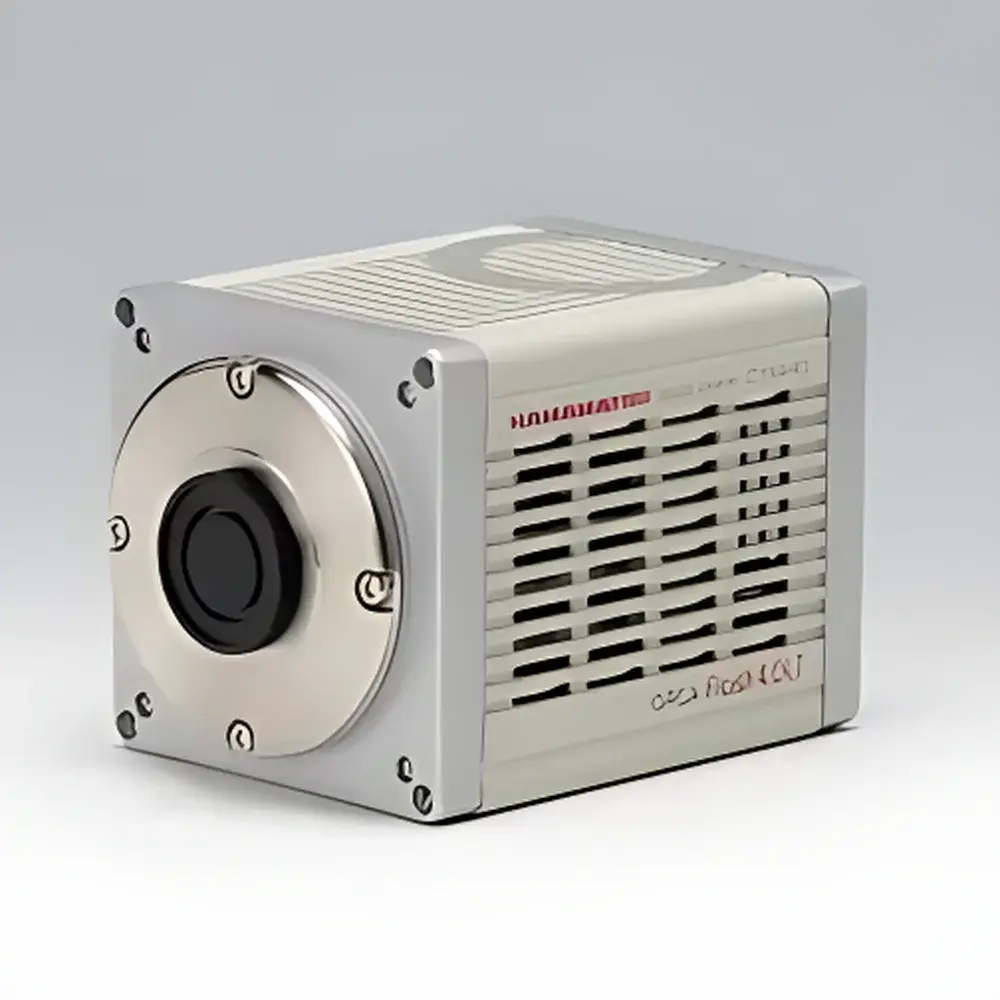
Hamamatsu ORCA-Flash4.0 LT sCMOS Camera
| Brand | Hamamatsu |
|---|---|
| Origin | Japan |
| Manufacturer Type | Original Equipment Manufacturer (OEM) |
| Product Origin | Imported |
| Model | C11440-42U |
| Pricing | Upon Request |
Overview
The Hamamatsu ORCA-Flash4.0 LT (Model C11440-42U) is a scientific-grade back-illuminated sCMOS camera engineered for high-fidelity, quantitative optical imaging in demanding life science and physical research environments. Unlike conventional interline CCD architectures, this camera implements second-generation sCMOS sensor technology to deliver simultaneous improvements in quantum efficiency (QE), read noise, dynamic range, frame rate, and field-of-view—without requiring cryogenic cooling or proprietary interface hardware. Its 2048 × 2048 pixel sensor features a 6.5 µm pixel pitch and a 13.3 mm diagonal active area, enabling full-frame acquisition at up to 100 fps with 16-bit digitization. The camera operates on a rolling shutter mode optimized for low-latency synchronization with external triggers, laser pulse generators, and stage controllers—making it suitable for time-resolved fluorescence microscopy, calcium imaging, light-sheet tomography, and multi-dimensional acquisition protocols.
Key Features
- Back-illuminated sCMOS sensor with peak quantum efficiency >80% at 560 nm, extending from 200 nm (UV-enhanced coating) to 1100 nm (NIR-sensitive configuration)
- Ultra-low read noise: ≤1.0 e⁻ RMS at 30 fps, ≤1.3 e⁻ RMS at full 100 fps—enabling photon-limited detection without EM gain or intensification
- Dynamic range exceeding 30,000:1 (calculated as full-well capacity / read noise), supporting quantitative intensity measurements across orders of magnitude
- Global reset with selectable exposure modes: rolling shutter for speed, global reset for precise temporal alignment in multi-channel or pulsed-light applications
- Hardware-based binning (2×2, 4×4) and region-of-interest (ROI) readout to maximize frame rate for sub-field applications
- USB 3.0 interface with deterministic latency (<1 ms) and support for GenICam-compliant software control via DCAM API or vendor-neutral HALCON/NI Vision drivers
Sample Compatibility & Compliance
The ORCA-Flash4.0 LT is compatible with standard C-mount and F-mount optical interfaces, and integrates seamlessly into inverted and upright research microscopes (e.g., Nikon Ti2, Olympus IX83, Zeiss Axio Observer) via optional relay lenses or adapter tubes. It supports both transmitted-light brightfield, phase contrast, DIC, and epi-fluorescence modalities—including multi-color excitation using LED or laser sources synchronized via TTL or LVDS triggers. The camera complies with CE, FCC, and RoHS directives. Its firmware architecture supports audit-trail-enabled operation per FDA 21 CFR Part 11 requirements when deployed in GLP/GMP-regulated environments, provided the host acquisition software implements electronic signature, user access control, and immutable data logging.
Software & Data Management
Hamamatsu provides the HCImage Live acquisition suite (Windows 10/11, 64-bit) with real-time histogram analysis, drift correction, flat-field normalization, and metadata embedding compliant with OME-TIFF v0.4 standards. Third-party integration is supported through standardized APIs including DCAM-SDK, Micro-Manager 2.0 (γ), and Python-based PyHamamatsu. All acquired images include embedded EXIF-like metadata: timestamp (UTC-synced), exposure duration, gain setting, sensor temperature (monitored via on-chip thermistor), and trigger source status. Raw 16-bit TIFF sequences can be directly imported into MATLAB, ImageJ/Fiji, or commercial platforms such as Imaris or Arivis Vision4D for volumetric rendering and spatiotemporal quantification.
Applications
- Live-cell calcium dynamics imaging (e.g., CFP/YFP ratiometric analysis in INS-1 β-cells)
- Multi-dimensional (x-y-z-t-λ) acquisition for confocal and light-sheet microscopy
- High-speed particle tracking and membrane dynamics studies requiring ≥50 fps at full resolution
- Quantitative immunofluorescence and tissue section scanning under low-signal conditions
- Time-gated luminescence and phosphorescence lifetime mapping when coupled with pulsed excitation sources
- Automated slide scanning and digital pathology workflows where FOV uniformity and photometric linearity are critical
FAQ
What is the maximum sustained frame rate at full resolution?
100 frames per second at 2048 × 2048 pixels with 16-bit output over USB 3.0.
Does the camera support hardware triggering for synchronization with external devices?
Yes—it accepts TTL/LVDS input for exposure start, frame trigger, and asynchronous reset, with jitter <100 ns.
Is cooling required for low-noise operation?
The sensor is thermoelectrically cooled to −10 °C below ambient (ΔT ≈ 20 °C typical), reducing dark current to <0.5 e⁻/pix/s; no liquid nitrogen or compressor-based cooling is needed.
Can the camera be used with non-Hamamatsu microscope systems?
Yes—via standard C-mount adapters and GenICam-compatible drivers; OEM integration kits are available for custom optical train designs.
How is calibration data managed and validated?
Factory-calibrated flat-field and dark-frame maps are stored in non-volatile memory and applied automatically during acquisition; users may generate updated maps using HCImage Live’s built-in calibration workflow.




