
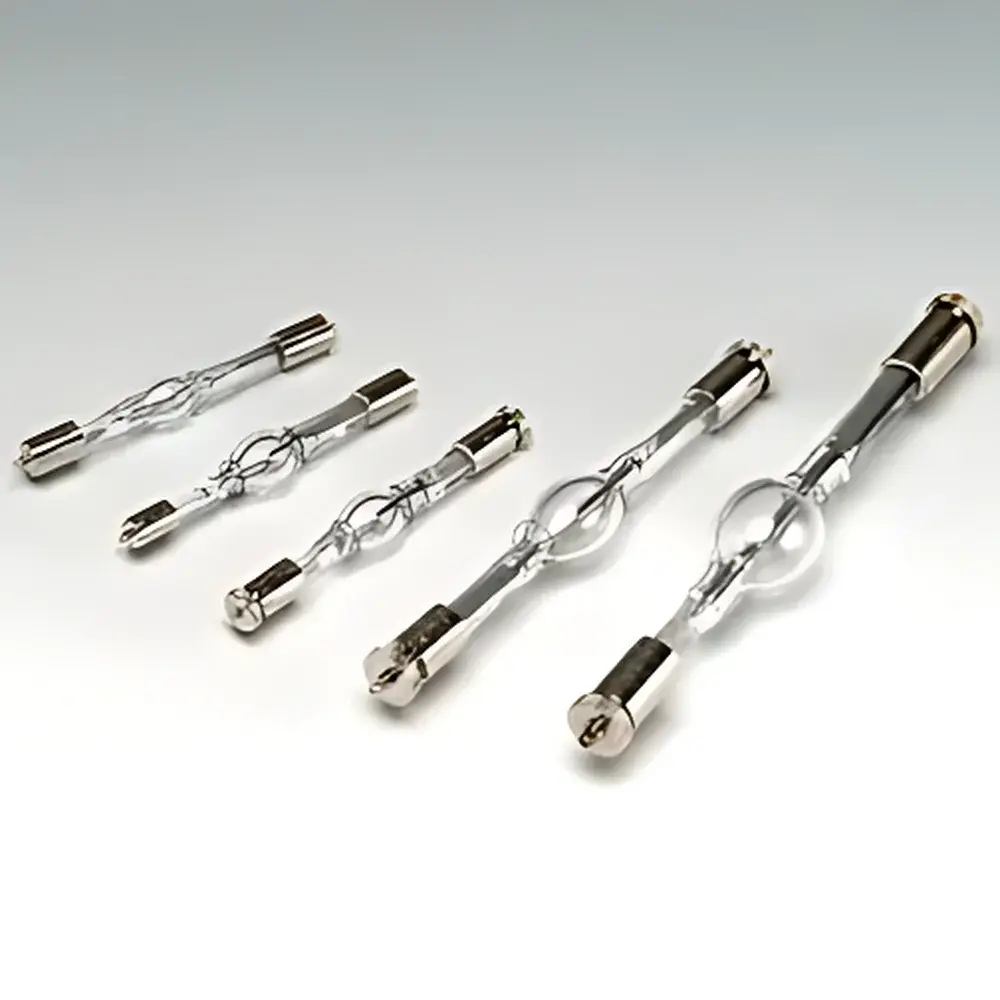
Hamamatsu L2273 150 W Short-Arc Xenon Lamp
| Brand | Hamamatsu |
|---|---|
| Origin | Japan |
| Manufacturer Type | Original Equipment Manufacturer (OEM) |
| Import Status | Imported |
| Model | L2273 |
| Light Source Type | Short-Arc Xenon Lamp |
| Illumination Mode | External Illumination |
| Power | 150 W |
| Arc Length | 2 mm |
| Operating Current | 8.5 ± 0.5 A |
| Operating Voltage | 17 V |
| Window Material | Fused Silica |
| Spectral Range | 185–2000 nm |
| Output Drift (Typical) | ±0.5 %/h |
| Peak-to-Peak Output Ripple (Max) | 1 % |
| Rated Lifetime | 1800 h |
| Average Lifetime | 3000 h |
| Mounting Orientation | Vertical ±15° or Horizontal ±15° |
| Cooling Method | Natural Convection |
| Minimum Supply Voltage | 65 V DC |
| Ignition Voltage | 20 kV |
| Mass | 45 g |
Overview
The Hamamatsu L2273 is a high-intensity, short-arc xenon lamp engineered for precision optical instrumentation requiring broad-spectrum, stable, and reproducible continuum illumination. Operating on the principle of high-pressure gas discharge in a sealed fused silica envelope, the L2273 generates a near-daylight spectral output spanning from deep ultraviolet (185 nm) to near-infrared (2000 nm), making it suitable for applications demanding spectral fidelity across UV-Vis-NIR domains. Its 2 mm arc length enables tight spatial collimation and high radiance—critical for monochromator-based spectrophotometers, fluorescence excitation systems, solar simulator calibration, and hyperspectral imaging setups. Designed as an OEM component, the lamp integrates seamlessly into custom optical benches and automated test platforms where mechanical stability, thermal predictability, and long-term photometric repeatability are essential.
Key Features
- Stable 150 W DC-powered discharge with low temporal drift (±0.5 %/h typical) and minimal peak-to-peak ripple (≤1 %), ensuring consistent irradiance during extended acquisition cycles.
- Fused silica envelope with high UV transmission down to 185 nm—enabling reliable operation in demanding UV spectroscopy and photochemical reaction monitoring.
- Natural convection cooling architecture eliminates requirement for forced-air or liquid cooling, reducing system complexity and vibration coupling in sensitive interferometric or microspectroscopic configurations.
- Compact form factor (45 g mass) and dual-mount flexibility (vertical ±15° or horizontal ±15°) support integration into space-constrained optical cavities and modular light engines.
- Ignition via 20 kV pulse ensures reliable cold-start performance without electrode sputtering degradation, contributing to its rated lifetime of 1800 h under specified operating conditions.
- Manufactured in Japan under Hamamatsu’s ISO 9001-certified production processes, with traceable lot documentation supporting GLP-compliant instrument qualification.
Sample Compatibility & Compliance
The L2273 is compatible with standard SMA905, FC/PC, or custom fiber-coupled interfaces when used with appropriate focusing optics and heat-absorbing filters. It meets IEC 62471:2006 (Photobiological Safety of Lamps) for Risk Group 3 classification under unfiltered exposure—users must implement appropriate UV shielding and interlock protocols per institutional laser safety officers’ requirements. While not a medical device, its spectral stability and lifetime consistency align with ASTM E927-22 (Standard Specification for Solar Simulation for Photovoltaic Testing) Class C spectral match criteria when paired with calibrated diffusers and spectral filters. The lamp complies with RoHS Directive 2011/65/EU and REACH Annex XVII restrictions on hazardous substances.
Software & Data Management
As a passive light source, the L2273 does not incorporate embedded firmware or digital interfaces. However, its operational stability enables robust synchronization with external control systems via TTL-triggered ignition modules and analog current monitoring circuits. When integrated into automated platforms (e.g., those running LabVIEW, Python-based PyVISA, or MATLAB Instrument Control Toolbox), lamp status—including ignition confirmation, current regulation feedback, and runtime hour logging—can be logged alongside spectrometer or detector data streams. For regulatory environments governed by FDA 21 CFR Part 11, audit trails for lamp replacement events, calibration verification intervals, and output stability checks can be maintained within validated LIMS or ELN systems.
Applications
- UV-Vis-NIR spectrophotometry reference sources in benchtop and portable analyzers
- Excitation source for time-resolved fluorescence and phosphorescence decay studies
- Broadband calibration standard for FTIR, CCD array detectors, and hyperspectral cameras
- Primary irradiance standard in photobioreactor characterization and UV curing process validation
- Component in accelerated weathering test chambers complying with ISO 4892-2 and ASTM G154
- Baseline illumination for optical coherence tomography (OCT) system alignment and dispersion compensation
FAQ
What is the recommended warm-up time before photometric stability is achieved?
Typical stabilization occurs within 15–20 minutes after ignition; full spectral equilibrium (especially in UV region below 250 nm) may require up to 30 minutes under constant current regulation.
Can the L2273 be operated with AC power supplies?
No—this lamp requires regulated DC current (8.5 ± 0.5 A) and is incompatible with standard AC ballasts; use only Hamamatsu-recommended DC constant-current drivers (e.g., C10222 series) or equivalent certified equivalents.
Is ozone generation a concern during operation below 200 nm?
Yes—ozone forms when unfiltered 185 nm radiation interacts with ambient oxygen; operation in enclosed, ventilated housings or nitrogen-purged optical paths is strongly advised for prolonged UV use.
How is lifetime defined for this lamp, and what failure mode is most common?
Rated lifetime (1800 h) reflects end-of-life defined as ≥20 % decline in 350 nm radiant flux at constant current; primary wear mechanism is tungsten electrode erosion leading to arc wander and increased voltage drop.
Does Hamamatsu provide spectral irradiance calibration certificates for individual L2273 units?
Calibration is available as an optional service (Hamamatsu Certificate of Conformance + NIST-traceable spectral irradiance data at 1 m distance, measured on calibrated double-monochromator system); contact authorized distributors for lead time and quoting.



