
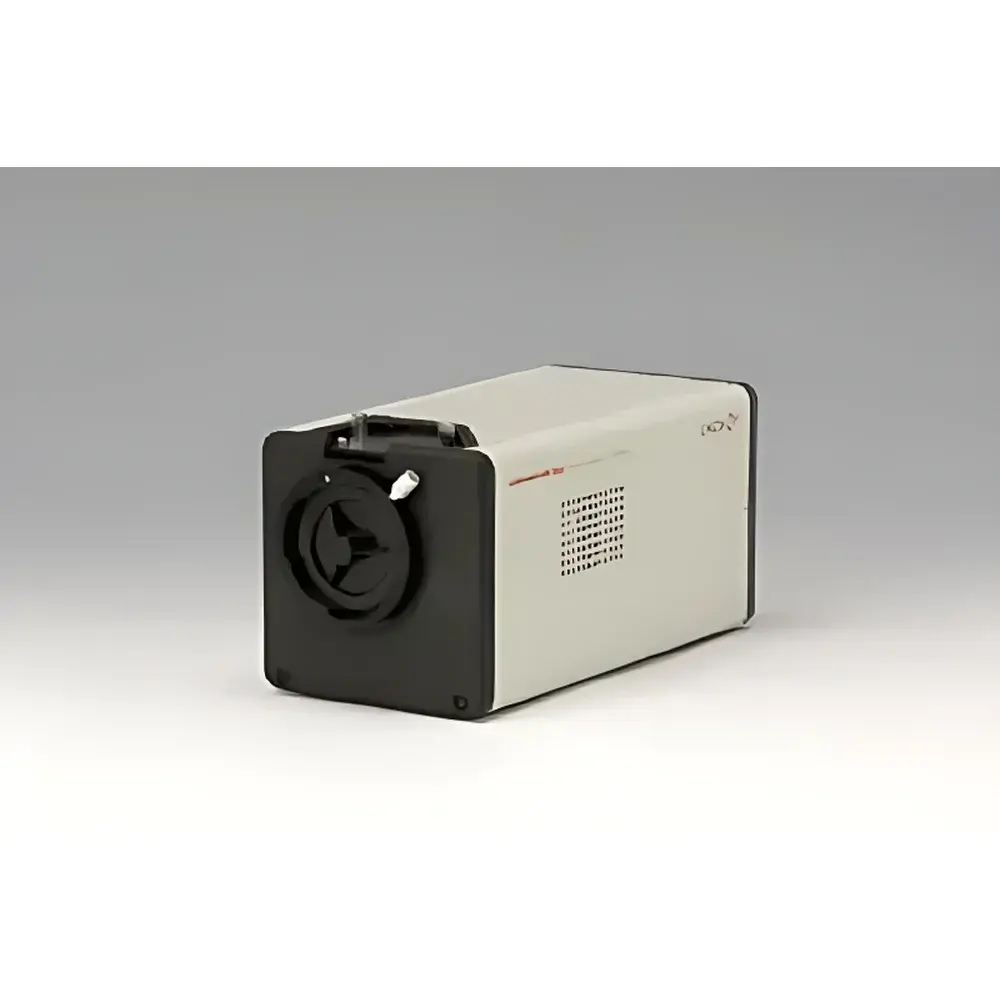
Hamamatsu ORCA-D2 Dual-Channel CCD Camera C11254-10B
| Brand | Hamamatsu |
|---|---|
| Origin | Japan |
| Manufacturer Type | Original Equipment Manufacturer (OEM) |
| Import Status | Imported |
| Model | C11254-10B |
| Pricing | Upon Request |
Overview
The Hamamatsu ORCA-D2 (Model C11254-10B) is a high-performance, vacuum-sealed dual-channel scientific CCD camera engineered for quantitative, simultaneous dual-wavelength imaging in demanding life science and physical optics applications. Built around two synchronized ER-150 interline CCD sensors—each delivering 1280 × 960 active pixels with 6.45 µm square pixel pitch—the ORCA-D2 implements a true hardware-level dual-path optical architecture. Unlike software-based image registration or sequential filter wheel acquisitions, this design enables real-time, full-frame, spatially registered acquisition at two distinct spectral bands without temporal misalignment, photobleaching bias, or mechanical latency. Its core measurement principle relies on photon-limited detection using back-illuminated interline CCD technology optimized for high quantum efficiency (>70% peak), low read noise (8 e⁻ rms), and deep cooling (–10 °C stabilized via thermoelectric + forced-air cooling), ensuring exceptional signal-to-noise ratio across visible to near-infrared (NIR) wavelengths (400–1000 nm). The system is fundamentally designed for applications requiring precise ratiometric quantification, such as FRET, calcium imaging, multicolor FISH, and dual-channel TIRF microscopy.
Key Features
- Dual-sensor architecture: Two independent 1.2-megapixel ER-150 interline CCDs enable true simultaneous acquisition—no compromise in frame rate, resolution, or spatial fidelity between channels.
- High quantum efficiency: >70% peak QE; ~2× higher sensitivity at 700 nm compared to legacy ICX285-based systems under identical weak-light conditions.
- Hardware-based spatial registration: Automatic optical alignment and chromatic correction via integrated calibration routines—eliminates post-acquisition software warping and preserves sub-pixel accuracy.
- Two operational modes: “Bright-light” and “Low-light” modes dynamically optimize gain structure, readout timing, and noise floor for respective illumination regimes.
- Vacuum-sealed sensor head: Minimizes thermal drift and condensation risk during extended exposures; supports stable operation at –10 °C ambient (20 °C lab environment).
- Flexible spectral configuration: Compatible with Hamamatsu’s modular optical building blocks—three pre-characterized bandpass options available for targeted excitation/emission selection.
- IIDC 1394b-compliant interface: Ensures deterministic trigger timing, IEEE 1394a/b compatibility, and seamless integration with third-party acquisition platforms (e.g., Micro-Manager, NIS-Elements, MetaMorph).
Sample Compatibility & Compliance
The ORCA-D2 is compatible with standard 2/3″ C-mount optical interfaces (flange back = 48 mm) and integrates natively into inverted and upright fluorescence microscopes, TIRF setups, and macro-imaging stations. Its vacuum-sealed construction and controlled thermal environment meet ISO 10934-1 requirements for stability-critical optical instrumentation. While not FDA-cleared as a medical device, the camera’s deterministic triggering, audit-trail-capable firmware logging (via optional Hamamatsu HCImage Live Pro), and traceable calibration protocols support GLP/GMP-aligned workflows. It complies with IEC 61000-6-3 (EMC emission) and IEC 61000-6-2 (immunity) standards for laboratory equipment. For regulated environments, raw image metadata—including exposure time, temperature, gain mode, and sensor ID—is embedded in TIFF/ND2 headers per NIH ImageJ and Bio-Formats specifications.
Software & Data Management
Hamamatsu provides HCImage Live—a native Windows-based acquisition suite supporting real-time dual-channel display, hardware-triggered synchronization, region-of-interest (ROI) statistics, and time-lapse metadata tagging. All calibration parameters (e.g., offset maps, gain coefficients, alignment matrices) are stored non-volatile within the camera firmware and auto-loaded upon connection. Export formats include 12-bit TIFF (uncompressed), HDF5 (with hierarchical metadata), and ND2 (Nikon-compatible). Third-party SDKs (C/C++, Python, MATLAB) enable custom pipeline development with full access to low-level register control, including programmable trigger output timing and sub-array readout. Audit trail functionality—required for 21 CFR Part 11 compliance—can be enabled via HCImage Live Pro with user authentication, electronic signatures, and immutable log archiving.
Applications
- Ratiometric ion imaging (e.g., Ca²⁺, pH, Cl⁻) using dual-emission dyes (Fura-2, BCECF)
- Fluorescence Resonance Energy Transfer (FRET) quantification without spectral bleed-through artifacts
- Simultaneous DAPI/FITC/TRITC/Cy5 multiplexing in fixed-tissue FISH and immunofluorescence
- Co-registered brightfield + fluorescence acquisition for morphological correlation
- Multi-focus z-stack acquisition using focus-tunable lens coupling and synchronized channel capture
- Time-resolved dual-band TIRF for membrane-proximal protein dynamics
- NIR-enhanced deep-tissue imaging in cleared samples (e.g., CLARITY, iDISCO)
FAQ
Does the ORCA-D2 support hardware binning?
No—binning is not implemented at the sensor level. However, on-the-fly sub-array readout (1×1, 2×2, 4×4, 8×8) enables effective field-of-view reduction and increased frame rates up to 50.5 fps.
Can I use third-party filters or dichroics with the optical building block system?
Yes—the modular mount accepts standard 25 mm diameter filters and dichroics; however, Hamamatsu-certified optical blocks guarantee optimal QE alignment and minimal ghosting across both channels.
Is dark current correction applied automatically during acquisition?
Yes—master dark frames are acquired at user-defined intervals (e.g., per session or per temperature setpoint) and applied in real time during live preview and recording.
What is the maximum sustained acquisition duration per frame?
Exposure times range from 117 µs to 60 s; continuous acquisition is limited only by host storage bandwidth and thermal management of the PC interface.
Does the camera support GenICam or USB3 Vision protocols?
No—it uses IEEE 1394b (FireWire) exclusively; Hamamatsu does not offer a USB3 or GigE variant of the ORCA-D2 platform.





