
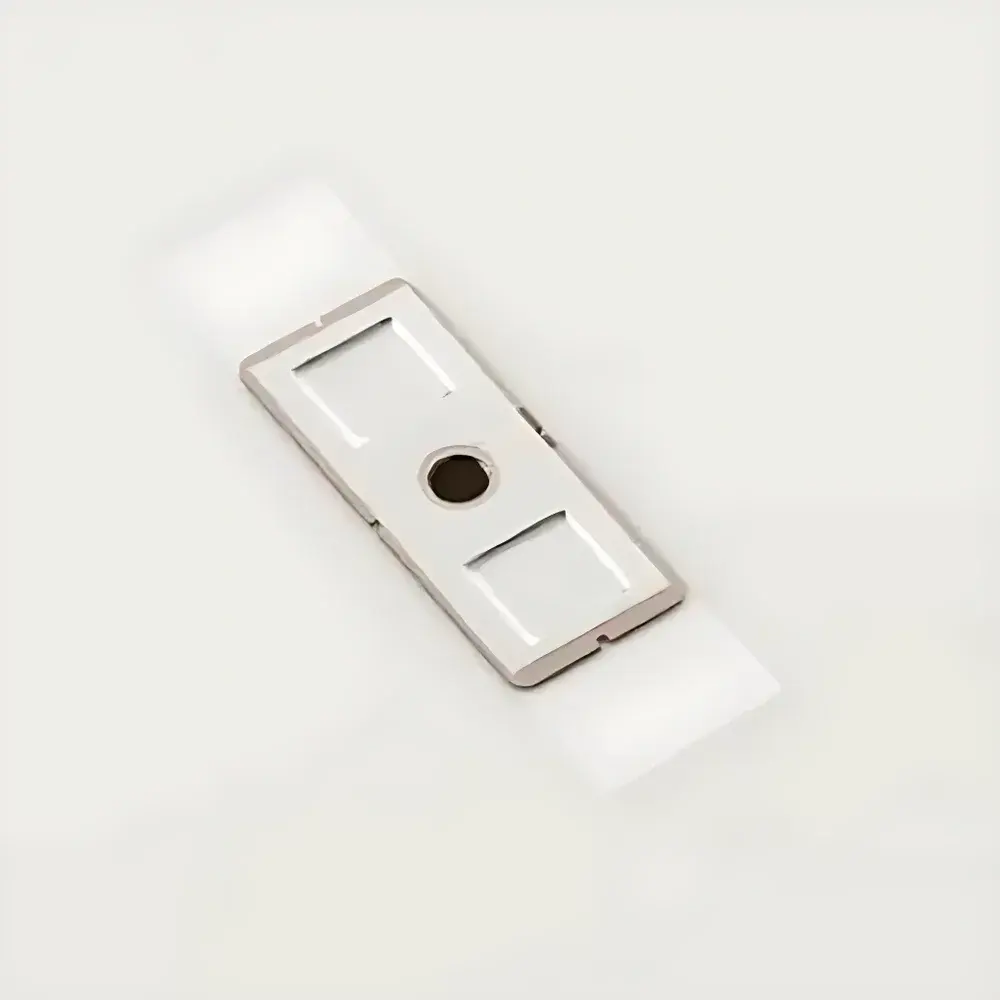
Hamamatsu DIUTHAME Porous Anodic Aluminum Oxide (AAO) Substrate for Matrix-Free Laser Desorption/Ionization – Model A13331-3-1
| Brand | Hamamatsu |
|---|---|
| Origin | Japan |
| Manufacturer | Hamamatsu Photonics K.K. |
| Product Type | Imported Mass Spectrometry Component |
| Model | A13331-3-1 |
| Pricing | Available upon Request |
Overview
The Hamamatsu DIUTHAME (Desorption Ionization Using Through-Hole Alumina Membrane) substrate A13331-3-1 is a high-precision, matrix-free ionization platform engineered for compatibility with commercial MALDI-TOF mass spectrometers. Fabricated from electrochemically anodized porous aluminum oxide (AAO), this substrate features a highly ordered, vertically aligned nanopore architecture—typically with pore diameters in the range of 50–200 nm and aspect ratios exceeding 100:1. Unlike conventional MALDI, which requires co-crystallization of analytes with organic matrix compounds (e.g., α-cyano-4-hydroxycinnamic acid), DIUTHAME enables direct laser desorption/ionization through surface-assisted energy transfer within the alumina nanochannels. This eliminates matrix-related chemical noise, suppresses background interference below m/z 500, and preserves labile biomolecules—including lipids, metabolites, and small peptides—without fragmentation or suppression effects. The A13331-3-1 variant is specifically optimized for single-spot analysis and targeted spatial profiling, supporting rapid sample interrogation without solvent-based matrix deposition, drying steps, or vacuum-compatible derivatization.
Key Features
- Matrix-free ionization: Removes dependence on crystalline organic matrices, eliminating matrix adducts, in-source decay, and signal heterogeneity.
- Reduced sample preparation time: Cuts pre-analysis workflow duration to ≤10% of standard MALDI protocols—enabling direct placement onto tissue sections or solid samples followed by immediate acquisition.
- High reproducibility: Uniform pore geometry and surface chemistry ensure consistent ion yield across repeated laser shots (RSD < 8% for lipid signals in frozen tissue sections).
- Nanopore-enhanced sensitivity: Confined laser–analyte interaction within sub-100 nm channels increases local energy density and promotes efficient desorption/ionization of low-abundance species.
- Chemical inertness & thermal stability: Anodic aluminum oxide withstands UV laser irradiation (e.g., 337 nm N₂ laser) without degradation, maintaining structural integrity over >1,000 laser shots per spot.
- Compatible with ambient and vacuum MALDI sources: Functions natively with standard TOF, TOF/TOF, and FT-ICR platforms without hardware modification.
Sample Compatibility & Compliance
The A13331-3-1 substrate supports direct analysis of biological tissues (frozen sections, blotted membranes), food matrices (chocolate, black rice, strawberry), polymer films, industrial materials, and microbial biofilms. It has been validated under standardized blotting protocols for metabolite imaging and demonstrated compatibility with GLP-aligned workflows in pharmaceutical development labs. While not certified to ISO 13485 or FDA 21 CFR Part 11 as a standalone device, its use conforms to analytical method validation guidelines outlined in ICH Q2(R2) when integrated into documented MS imaging SOPs. Data generated using DIUTHAME substrates meets reporting requirements for peer-reviewed publications in journals including Rapid Communications in Mass Spectrometry and Journal of the American Society for Mass Spectrometry.
Software & Data Management
No proprietary software is required; A13331-3-1 operates transparently within vendor-native acquisition environments (e.g., Bruker flexControl, Shimadzu LaunchPad, Waters MassLynx). Raw spectral data adhere to open formats (mzML, imzML), enabling interoperability with open-source tools such as SCiLS Lab, MSiReader, and Cardinal for multivariate image reconstruction. When used in regulated environments, audit trails and instrument parameter logging must be maintained via the host mass spectrometer’s built-in compliance modules—supporting traceability for GMP-relevant applications involving QC of active pharmaceutical ingredients or excipient distribution mapping.
Applications
- Label-free molecular imaging of frozen tissue sections (mouse brain, skin, flower petals) at cellular resolution using blotting or vapor extraction methods.
- High-throughput screening of polymer additives and degradation products in poly(lactic-co-glycolic acid) (PLGA) and polyethylene oxide systems.
- Spatial metabolomics in agricultural and food science: detection of anthocyanins in black rice, flavonoids in strawberries, and cocoa alkaloids in chocolate.
- Surface-assisted LDI-MS of industrial coatings and thin-film materials without solvent-induced delamination.
- Functional assay integration: real-time monitoring of acetylcholinesterase reaction kinetics directly on the DIUTHAME surface via time-resolved MS acquisition.
FAQ
Is A13331-3-1 compatible with my existing MALDI-TOF system?
Yes—it requires no hardware adaptation and functions with any commercial MALDI source operating at 337 nm or 355 nm laser wavelengths.
Can DIUTHAME replace MALDI matrix entirely?
For small molecules (20 kDa), performance remains under evaluation—matrix-assisted approaches are still recommended for top-down proteomics.
What is the shelf life and storage requirement?
Store at room temperature in sealed desiccator; stable for ≥24 months. Avoid ultrasonic cleaning or organic solvent immersion.
How does pore size affect ionization efficiency?
Smaller pores (≤80 nm) enhance confinement effects for metabolites; larger pores (≥150 nm) improve throughput for macromolecular adsorption—A13331-3-1 uses a balanced 100 nm nominal diameter.
Are there application notes or peer-reviewed protocols available?
Yes—over 15 published studies (ASMS, RCMS, JASMS) detail blotting, vapor extraction, and mist-assisted protocols; all referenced PDFs are accessible via Hamamatsu’s technical resource portal.





