
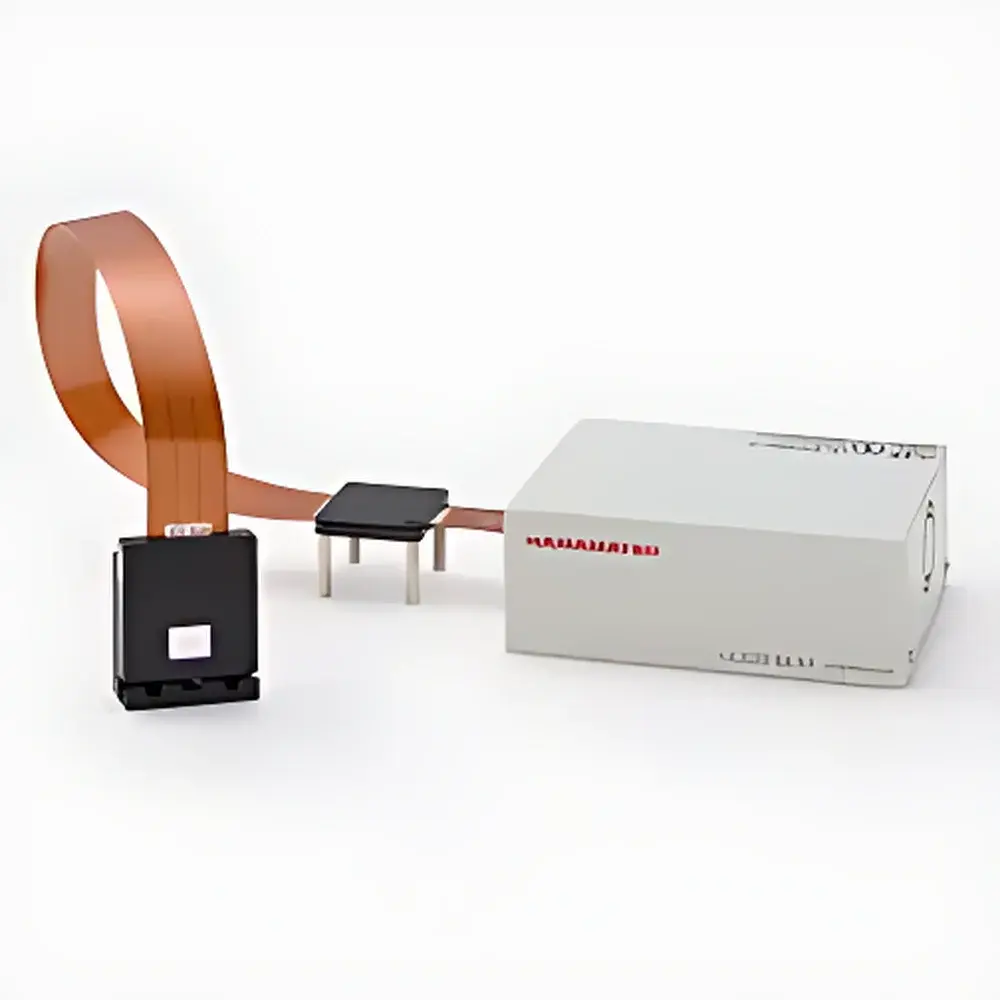
Hamamatsu LCOS-SLM X15213-19R
| Brand | Hamamatsu |
|---|---|
| Origin | Japan |
| Manufacturer Type | Original Equipment Manufacturer (OEM) |
| Import Status | Imported |
| Model | X15213-19R |
| Pricing | Available upon Request |
| Pixel Pitch | 12.5 µm |
| Active Area | 15.9 × 12.8 mm |
| Resolution | 1272 × 1024 pixels (SXGA) |
| Fill Factor | 96% |
| DVI Interface | DVI-D |
| USB Interface | USB-B 2.0 High-Speed |
| DVI Frame Rate | 60 Hz |
| Input Gray Levels | 256 (8-bit) |
| Rise Time | 30 ms |
| Fall Time | 155 ms |
| Operating Wavelength Range | 1850–2050 nm |
| Peak Optical Efficiency | 97% (at λ = 1950 nm) |
| Maximum Spatial Frequency | 40 lp/mm |
| Modulation Type | Reflective Pure-Phase |
Overview
The Hamamatsu LCOS-SLM X15213-19R is a high-performance reflective liquid crystal on silicon (LCoS) spatial light modulator engineered for precision wavefront control in demanding near-infrared optical systems. Designed specifically for operation in the 1850–2050 nm spectral band—encompassing key wavelengths used in fiber laser pumping, mid-IR parametric amplification, and gas sensing applications—the device implements pure-phase modulation with minimal amplitude coupling. Its silicon backplane architecture enables direct voltage addressing of the nematic liquid crystal layer, ensuring deterministic, sub-wavelength phase response across the full active aperture. Unlike transmissive SLMs, the reflective configuration maximizes thermal load handling and facilitates integration into folded or multi-pass optical geometries common in ultrafast pulse shaping, adaptive optics, and holographic beam steering systems.
Key Features
- Reflective pure-phase modulation architecture optimized for high-power NIR operation (1850–2050 nm)
- High optical efficiency: 97% measured at 1950 nm under calibrated illumination conditions
- Large active area (15.9 × 12.8 mm) with SXGA resolution (1272 × 1024 pixels) and 12.5 µm pixel pitch
- 96% fill factor minimizes zero-order diffraction and suppresses speckle-induced noise
- DVI-D interface compatibility enables plug-and-play integration with standard industrial PCs and graphics cards
- Real-time phase calibration support via integrated USB-B 2.0 port for firmware updates and nonlinearity correction
- Fast electro-optic response: 30 ms rise time and 155 ms fall time enable dynamic phase pattern sequencing
- Robust thermal management design validated for continuous-wave operation at incident power densities up to 5 W/cm² (dependent on beam uniformity and cooling configuration)
Sample Compatibility & Compliance
The X15213-19R is compatible with collimated, polarized input beams aligned to its specified angle of incidence (typically 45° ± 2°). It supports both linear and circular polarization states, though optimal phase fidelity requires use with properly oriented linearly polarized light matching the device’s designated polarization axis. The module complies with IEC 61000-6-3 (EMC emission limits) and IEC 61000-6-2 (immunity standards) for laboratory instrumentation. While not certified as medical or aerospace-grade hardware, its OEM-oriented construction meets IPC-A-610 Class 2 requirements for electronic assemblies. Calibration data—including pixel-wise phase response maps and intensity uniformity profiles—is provided with each unit and traceable to Hamamatsu’s internal metrology lab using interferometric verification (Zygo Verifire™ system).
Software & Data Management
Hamamatsu supplies the X15213-19R with proprietary SLM Control Software v3.2, a Windows-based application supporting real-time phase map generation, gamma correction, and hardware-level timing synchronization. The software exports phase patterns in industry-standard formats (BMP, TIFF, binary RAW) and includes built-in routines for Gerchberg-Saxton algorithm iteration, Zernike polynomial decomposition, and kinoform synthesis. For automated workflows, a documented C++/C# SDK and Python bindings (via ctypes) are available under NDA, enabling integration into LabVIEW, MATLAB, or custom acquisition platforms. All phase calibration files are stored in HDF5 format with embedded metadata (wavelength, temperature, date stamp), satisfying basic GLP documentation requirements. Audit trails for pattern loading events are logged locally and exportable for regulatory review, though native 21 CFR Part 11 compliance requires third-party validation of the host PC environment.
Applications
- Adaptive optics correction in high-power fiber laser cavities operating at 1950 nm
- Dynamic holographic beam shaping for industrial laser material processing (e.g., cladding, welding, annealing)
- Wavefront engineering in quantum optics experiments involving telecom-band entangled photon sources
- Multi-plane microscopy (MUM) and structured illumination in NIR tissue imaging
- Optical trapping and manipulation of dielectric particles using tailored Bessel or Airy beams
- Calibration reference for interferometric wavefront sensors and Shack-Hartmann systems
- Real-time diffractive optical element (DOE) emulation in free-space optical communications testbeds
FAQ
What is the maximum safe average power density this SLM can handle?
The X15213-19R is rated for continuous-wave operation at ≤5 W/cm² when uniformly illuminated and actively cooled; localized hotspots exceeding 10 W/cm² may induce irreversible LC alignment drift.
Is external polarization control required for optimal phase modulation?
Yes—linear polarization aligned to the device’s designated input axis is mandatory for achieving specified phase depth and linearity; a half-wave plate and polarizer are recommended upstream.
Can this SLM be used outside its specified 1850–2050 nm range?
Operation below 1850 nm risks increased absorption in the ITO electrode layer; above 2050 nm, reflectivity declines due to silicon substrate transparency—neither condition is supported by factory calibration.
Does the DVI interface support custom timing modes beyond 60 Hz?
No—the internal timing controller is fixed at 60 Hz frame rate; higher update rates require external FPGA-based drivers interfacing via the parallel LVDS test port (available under OEM agreement).
How is phase nonlinearity corrected during operation?
Pre-measured pixel-wise gamma curves are loaded into the onboard LUT memory; real-time correction is applied in hardware prior to LC voltage driving, eliminating CPU-side computation latency.





